
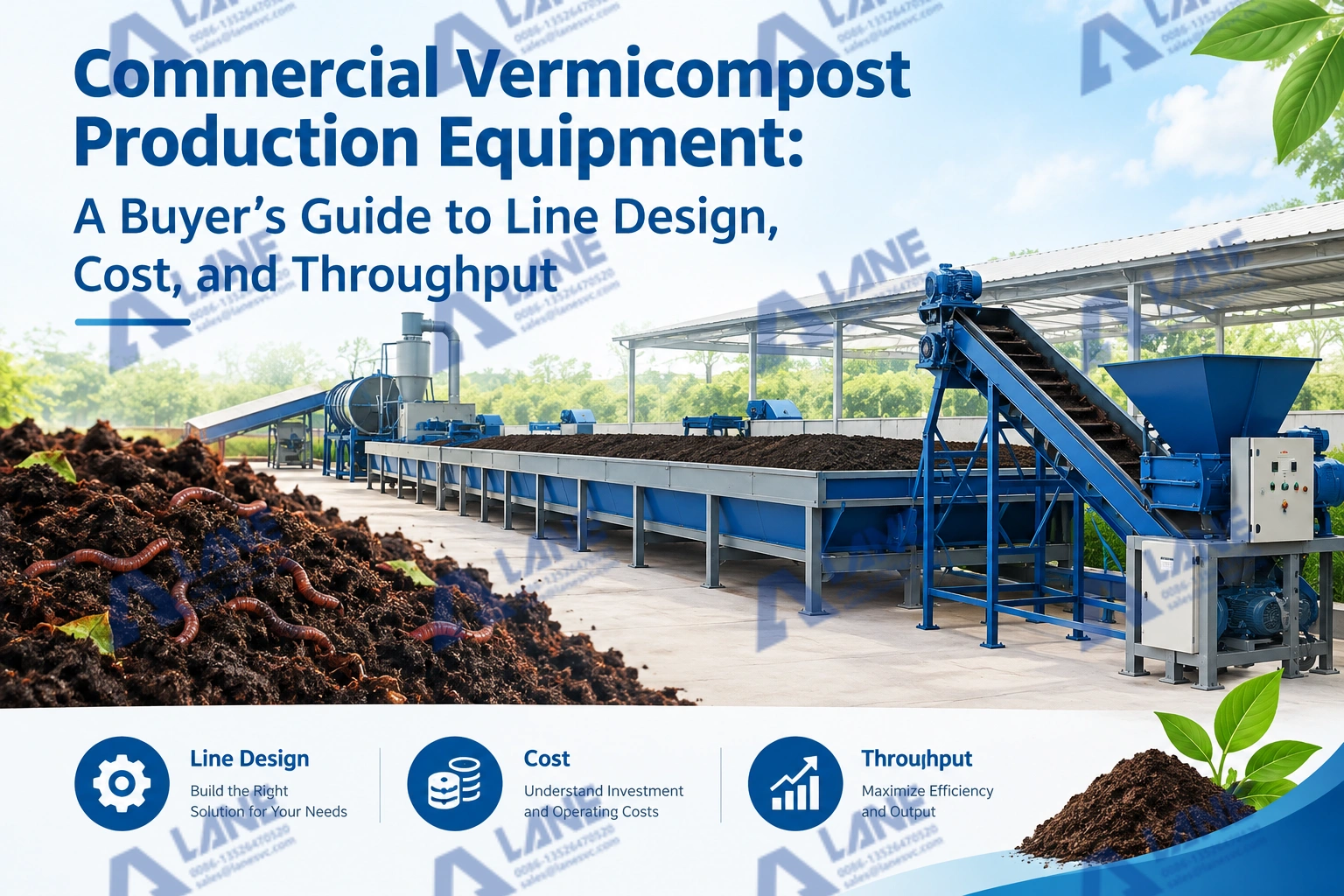
Compare commercial vermicompost production equipment by throughput, cost, and process. Learn how to size a vermicompost production line and choose a supplier.
Most inquiries about commercial vermicompost production equipment are not really about a machine. They are about a plant. The buyer has a feedstock stream, a building or a plot of land, a target bag price, and a lender who wants to know when the investment pays back. Everything else – the equipment train, the throughput, the labor plan – follows from those constraints.
This guide is written for fertilizer manufacturers, plant investors, process engineers, procurement managers, and EPC contractors comparing bids for a vermicompost production line. It covers process route selection, sizing, equipment scope, cost drivers, maintenance, testing, and supplier evaluation, so competing offers can be compared on technical merit instead of price alone.
A vermicompost production line is a sequence of unit operations, not a single product. A commercial vermicompost production equipment package normally covers six areas:
No two vendors draw the scope boundary in the same place. Ask every bidder to state who supplies the electrical and control work, who guarantees process performance, and where their responsibility ends.
The biology and the working window
Vermicomposting relies on epigeic earthworms – most commercial systems use Eisenia fetida or a closely related species – to fragment and digest organic matter. The worms work in a narrow band of conditions. Bed moisture is usually held between roughly 70% and 85%; temperature is typically kept near 15-25 °C (60-77 °F). Worms become stressed well before feedstock reaches thermophilic temperatures. That is why vermicomposting stays mesophilic, and why a pre-composting or cooling step often precedes the beds.
From raw manure to a marketable product
Raw material is shredded and mixed to a consistent texture, then conditioned until ammonia, salinity, and temperature have fallen to a level the worms tolerate. In continuous flow vermicomposting, the conditioned feed is applied across the top of a static bed and migrates downward as it is processed. Castings are harvested from the bottom, then screened and cured. Curing and screening are where product consistency is won or lost: unscreened castings carrying residual worms, weed seeds, or plastic fragments will fail a buyer’s incoming inspection regardless of how well the bed performed.
Two process routes dominate commercial projects, and the choice drives layout, labor, and capital.
Continuous flow vermicomposting uses a raised reactor with a static worm bed. Fresh feed is applied to the top surface, material migrates downward as worms process it, and a harvester or breaker bar removes finished product from the bottom. Because feeding and harvesting are continuous, labor is easier to schedule and the footprint per ton is smaller. The trade-off is a higher capital cost per unit of capacity and less tolerance for feedstock swings.
Batch windrow or raised-bed systems place worms in long rows and add feed to the surface in cycles. Capital cost is lower and the approach tolerates variable feedstock better, but it needs more floor area, more manual handling, and careful record keeping to avoid overfeeding a row.
For a first plant, the pragmatic answer is often a hybrid: batch beds for resilience during ramp-up, with continuous flow vermicomposting equipment added once feedstock quality and product demand are proven.
Sizing a vermicompost production line starts with the finished product, not the equipment. Work backwards:
A layout that reads well on paper often fails on access. Leave room for a front-end loader to reach every bed, for maintenance crews to pull a gearbox, and for a truck to leave loaded.
Capital cost is driven by capacity, degree of automation, and how much of the plant you build yourself.
Operating cost is usually dominated by labor, bedding and feedstock logistics, electricity for screening, ventilation, and packaging, plus testing and a warranty reserve. Model both at 70% and 100% of nameplate capacity. A vermicompost production line that only works at full utilization is a fragile investment.
Feedstock determines product quality more than any piece of hardware. Manure-based streams, crop residues, and food-waste digestate behave differently in the bed. Test for salinity, ammonia, heavy metals, and pesticide residue before committing to a long-term supply contract. If a feedstock source can change without notice, design the line for it.
Climate control is the second constraint. In cold regions, insulation and heating are not optional. In hot, dry regions, misting and shade matter more. Both cases usually justify a pre-composting stage, because it removes heat and ammonia before material reaches the worms and cuts bed losses.
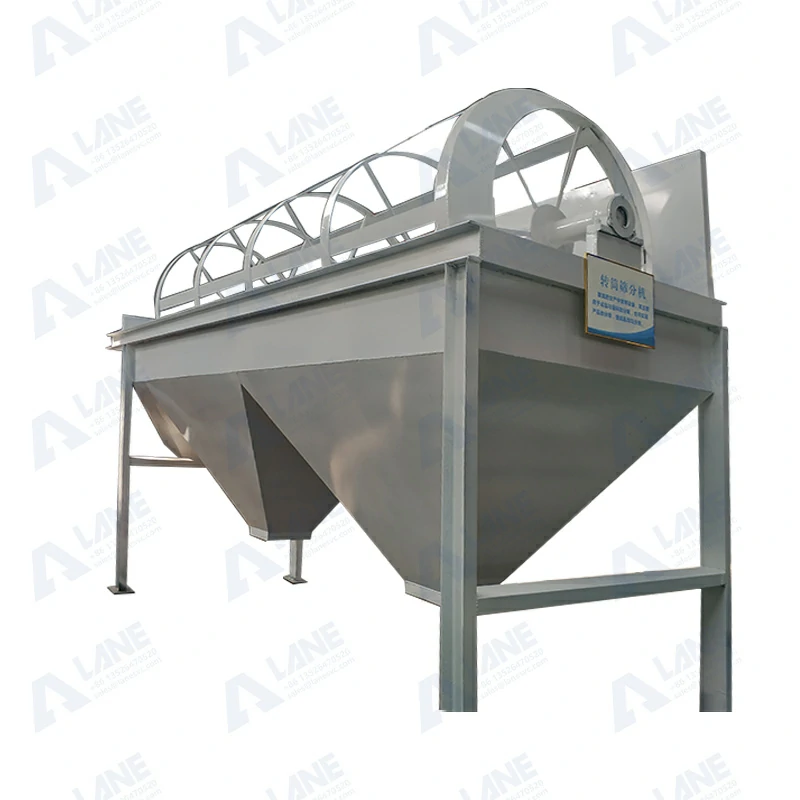
The screening and bagging end of commercial vermicompost production equipment deserves as much scrutiny as the beds themselves. Screening separates worms and cocoons from finished castings and sets the particle size customers will see. Trommel screens are common at high volume; vibratory screens suit finer separation. Return undersize material and any live worms to the beds – worm recovery is both an economic and a biosecurity matter.
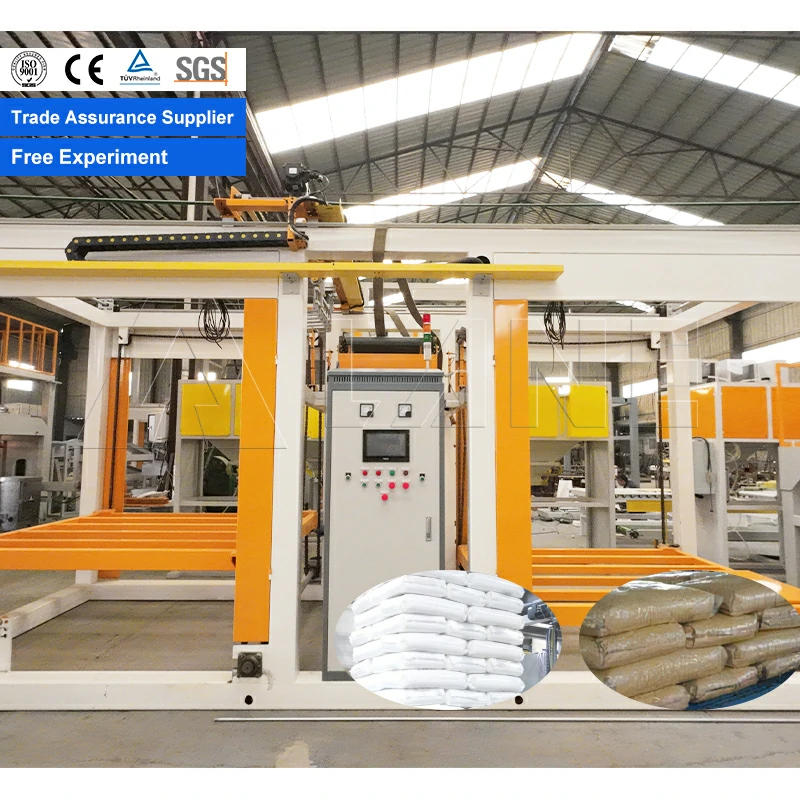
Blending and packaging turn a bulk commodity into a branded product. A ribbon mixer with load cells lets you produce consistent blends of castings, compost, and mineral amendments, while a net-weigh bagger controls giveaway, often the largest hidden cost in a bagging line.
A vermicompost production line operates in a wet, biologically active, mildly corrosive environment, and that reality should shape the maintenance plan:
A preventive maintenance plan built around the wet environment will do more for uptime than any single equipment upgrade.
Buyers increasingly ask for documentation before they ask for price. Expect to provide:
In the United States, the USDA National Organic Program rules govern which inputs may be used in certified organic production, and compost suppliers commonly align testing with the Test Methods for the Examination of Composting and Compost (TMECC) and the US Composting Council’s Seal of Testing Assurance program. Confirm current requirements with your certifier before you design the line, because some requirements shape equipment selection rather than just paperwork.
When you compare commercial vermicompost production equipment from several suppliers, treat the decision as a technical evaluation rather than a beauty contest. If you are buying your first vermicompost production line, the questions below matter more than the equipment photographs.
Demand for vermicompost follows the broader shift toward organic inputs, soil health programs, and reduced reliance on synthetic fertilizer. Growth is not uniform. Markets with strong horticulture, greenhouse, turf, or specialty-crop sectors absorb premium castings more readily than row-crop regions, where price per unit of nutrient drives the purchase.
Typical applications include:
How much does commercial vermicompost production equipment cost?
There is no single figure. Cost scales with capacity, automation, screening and bagging scope, climate control, and how much site work you include. Ask for a quotation broken into unit operations, plus a separate estimate for the building and site work, then compare total installed cost per ton of monthly output.
How much space does a vermicompost production line need?
Enough for processing beds, curing, screening, blending, bagging, and material storage, plus loader access and circulation space. Batch windrow systems typically need substantially more floor area per ton than continuous flow reactors. Build a scaled layout before you commit to a building.
How long does it take to produce finished vermicompost?
Weeks to months, depending on feedstock, bed conditions, and whether material is pre-composted. In continuous flow vermicomposting, material is harvested continuously, but individual particles still spend a long period in the bed. Plan inventory and curing space accordingly.
Do I need a pre-composting step?
Often, yes. Pre-composting or conditioning reduces ammonia, temperature, and salinity so the worms can work efficiently. It also gives you a buffer when feedstock quality changes, which is common in waste-derived streams.
Can continuous flow vermicomposting work in a cold climate?
Yes, with an insulated building and active heating. The cost of climate control can rival the equipment cost, so model energy use before choosing a location. Some operators in cold regions accept slower winter throughput rather than paying for full heating.
How many worms do I need to start?
It depends on your daily feed rate and how patient you are about ramp-up. Start from your target feed rate rather than a standard number, and confirm the actual processing rate with a pilot bed. Worm inventory is also a recurring cost, since new beds need stocking.
How do you separate worms from finished castings?
Most commercial lines use trommel or vibratory screens, sometimes combined with a light or heat gradient to drive worms out of the material before screening. Recovered worms and cocoons go back to the beds.
What testing should I ask a supplier to support?
Ask about nutrient analysis, organic matter, moisture, pH, stability and maturity, heavy metals, and pathogens, plus documentation of feedstock inputs. Requirements vary by market, so confirm the list with your certifier or your largest customer before ordering equipment.

Everything you need to know when looking at different types of organic fertilizer equipment, all in one place.
Copyright © 2026. LANE All rights reserved.
Send A Message