
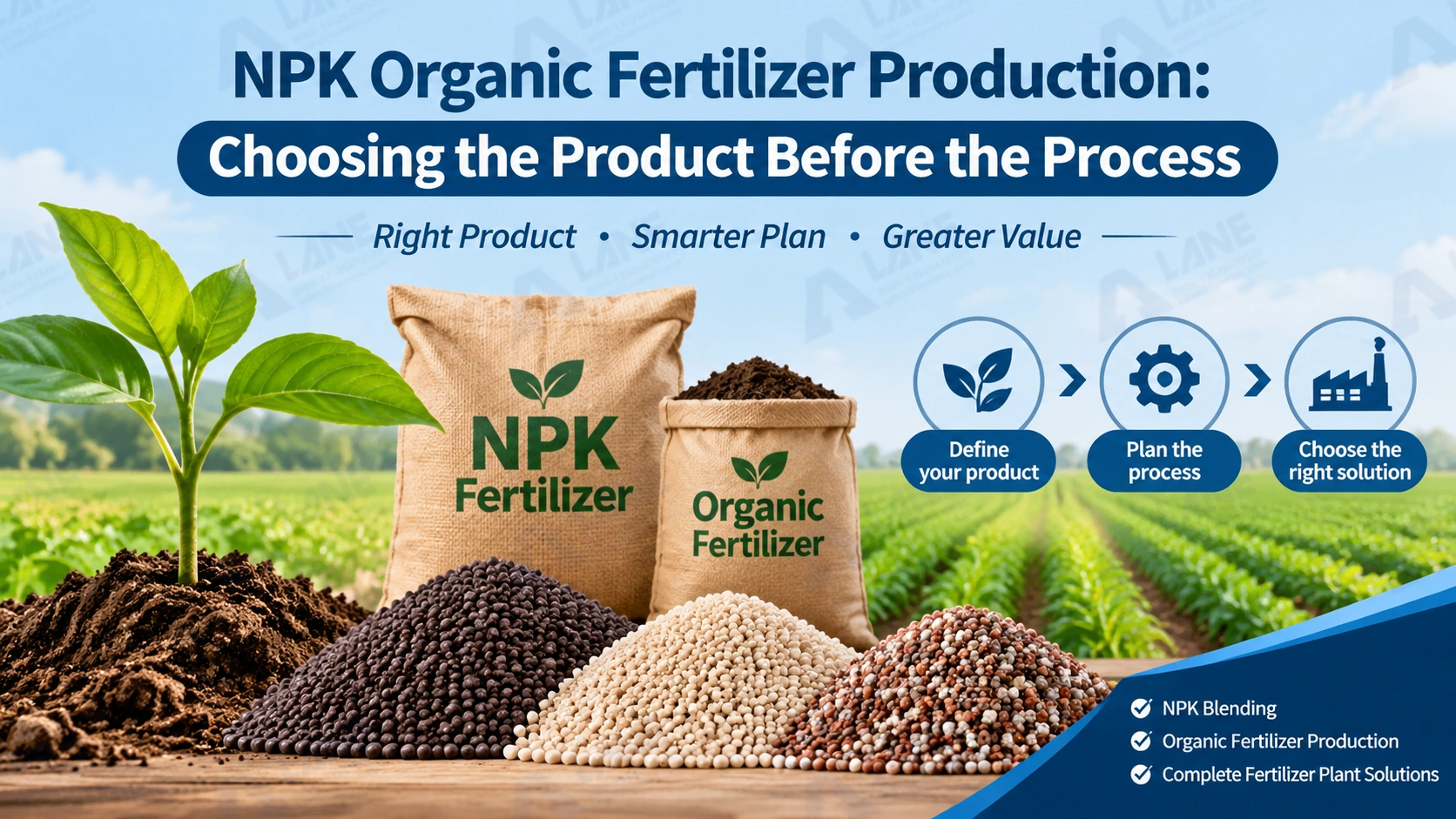
How to plan NPK organic fertilizer production: choosing the product claim, formulation arithmetic, granulation, drying, costs, and the rules on organic labels.
The phrase “organic NPK” describes at least three different products, and the one you pick decides everything downstream: the formulation, the equipment, the certification you can claim, and the price you can charge.
Get that decision wrong and the plant still runs. It just produces something the market will not pay a premium for.
This guide separates the three product strategies for NPK organic fertilizer production, works through the formulation arithmetic, covers the material pairs that fight each other in the mixer, and lays out the production line and its cost structure.
Low-analysis, fully organic. A 4-3-3 or 5-5-5 made entirely from compost, manure, bone meal, feather meal, and similar inputs. Analysis is low because organic matter is low in nutrients by nature. This is the only version that can plausibly support a certified organic claim.
Organo-mineral. An organic base carrying mineral nutrients, typically 10-5-10 or 8-8-8 with 20 to 40 percent organic content. Higher analysis, better agronomics, and no certified organic claim, because the mineral component disqualifies it in most certification schemes.
Mineral with an organic additive. A conventional NPK with a small humic or compost addition, sold with an organic story. The cheapest to produce and the easiest to get wrong legally, because the organic content is too low to be meaningful and the claim can be challenged.
Most NPK organic fertilizer production projects that come to us want the second product. They just have not decided it yet.
In any organo-mineral fertilizer, the organic fraction dilutes the analysis. A compost at 2-1-1 contributes nitrogen and almost nothing else per ton, so hitting a 10-5-10 target with 30 percent organic content means the mineral 70 percent has to carry a much higher concentration than the finished grade suggests.
That drives three decisions.
How much organic content the market actually pays for. In most markets, 20 to 40 percent is the meaningful band. Below that, buyers do not see a difference in the field. Above that, the analysis collapses.
Which nutrient sources to use. Urea for nitrogen, DAP or MAP for phosphorus, MOP or SOP for potassium, plus the organic base. Each has a compatibility problem, covered below.
How precise the batching has to be. Once you declare organic carbon and NPK on the same label, both are legal commitments, and the batching system has to hold both.
Some combinations are chemically hostile, and the symptom appears weeks later in the warehouse.
Urea and superphosphate release water when they meet. In a blend, that shows up as a bag that sets like concrete.
DAP or MAP with alkaline material, including lime-treated compost or ash, releases ammonia. You lose nitrogen and gain an odor.
Calcium from lime or gypsum with soluble phosphate forms insoluble calcium phosphate, which locks up the phosphorus you paid for.
The practical fix is sequencing. Add the mineral nutrients to the mixer first, add the organic base after, and keep the free moisture low enough that the reaction has no medium to run in. Binders help, but they do not rescue a bad order of addition.
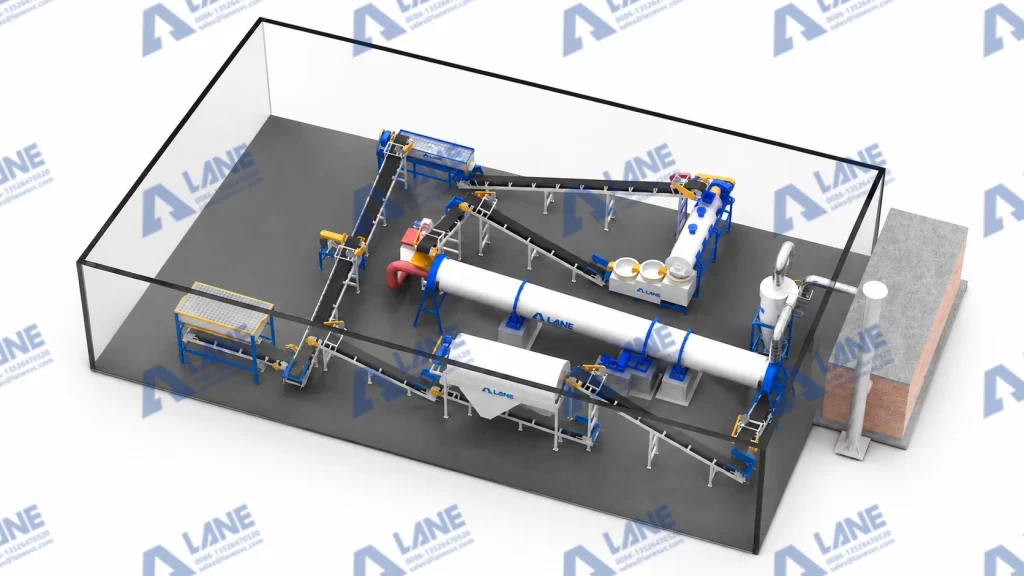
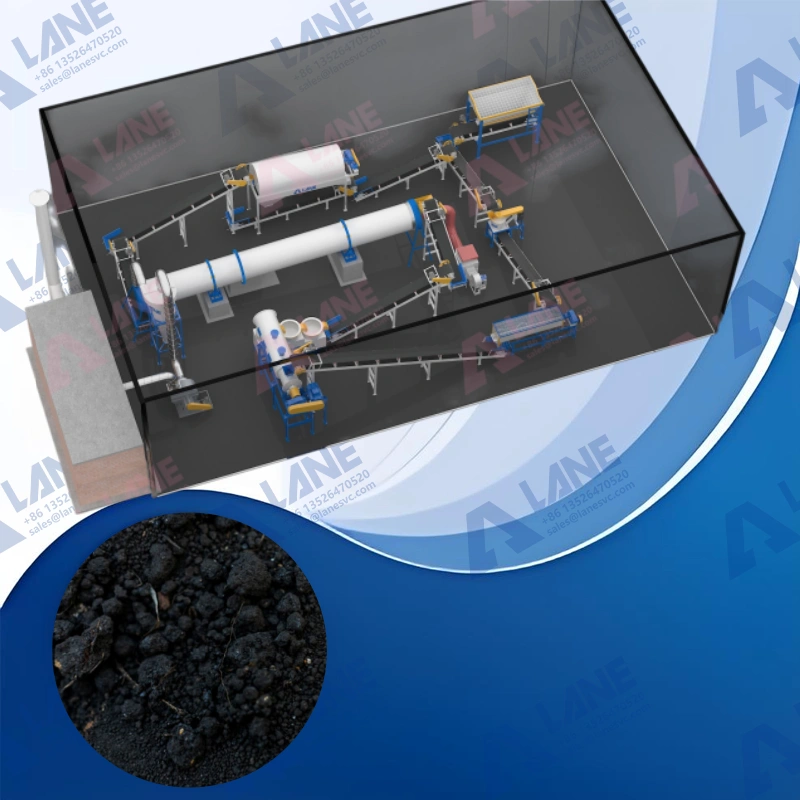
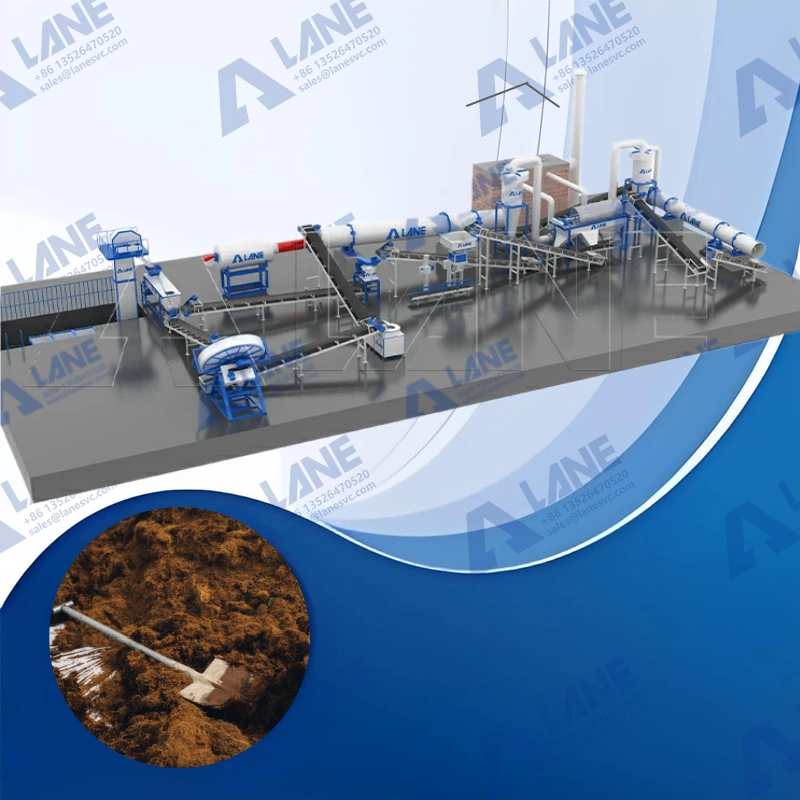
Organic preparation. Compost or digestate arrives at 30 to 40 percent moisture and has to come down to roughly 12 to 15 percent before grinding. A rotary dryer or a belt dryer does it, gently. Then a crusher reduces the material to under 2 millimeters, and a screener removes plastic, stones, and oversize fiber.
Mineral preparation. Urea, phosphate, and potash arrive at different particle sizes. Grinding and screening bring them into a range the mixer can handle, and the batching system weighs each one against the recipe.
Mixing. A horizontal twin-shaft or ribbon mixer produces a uniform powder in three to five minutes. Uniformity matters more here than in a straight NPK line, because the organic and mineral fractions have different densities and segregate if the mix is under-worked.
Granulation. This is where organic fertilizer granulation differs from mineral granulation, and where most projects get stuck.
Drying, cooling, screening, coating, bagging. The finishing train is conventional, with one constraint covered in the next section.
Organic material is fibrous, light, and moisture-hungry. Mineral salts are abrasive and sometimes hygroscopic. A granulator has to handle both at once.
A disc pan granulator works well at small to mid capacity when the organic fraction is compost-like and the feed moisture can be held at 25 to 35 percent. It is forgiving and cheap to run.
A rotary drum granulator suits higher tonnage and feeds with more mineral content. It tolerates the abrasive fraction better, and it needs more attention to build-up on the drum wall.
A stirring-pin granulator handles high-fiber material that refuses to ball in a pan or drum.
A double roller press works dry, without a dryer, and produces a flatter granule. It is the lowest-energy route when the formulation allows it.
The single variable that decides whether organic fertilizer granulation succeeds is feed moisture. Too dry and nothing balls. Too wet and the pan turns into a mud mixer. A plant without reliable moisture control on the feed is a plant that runs three days out of five.
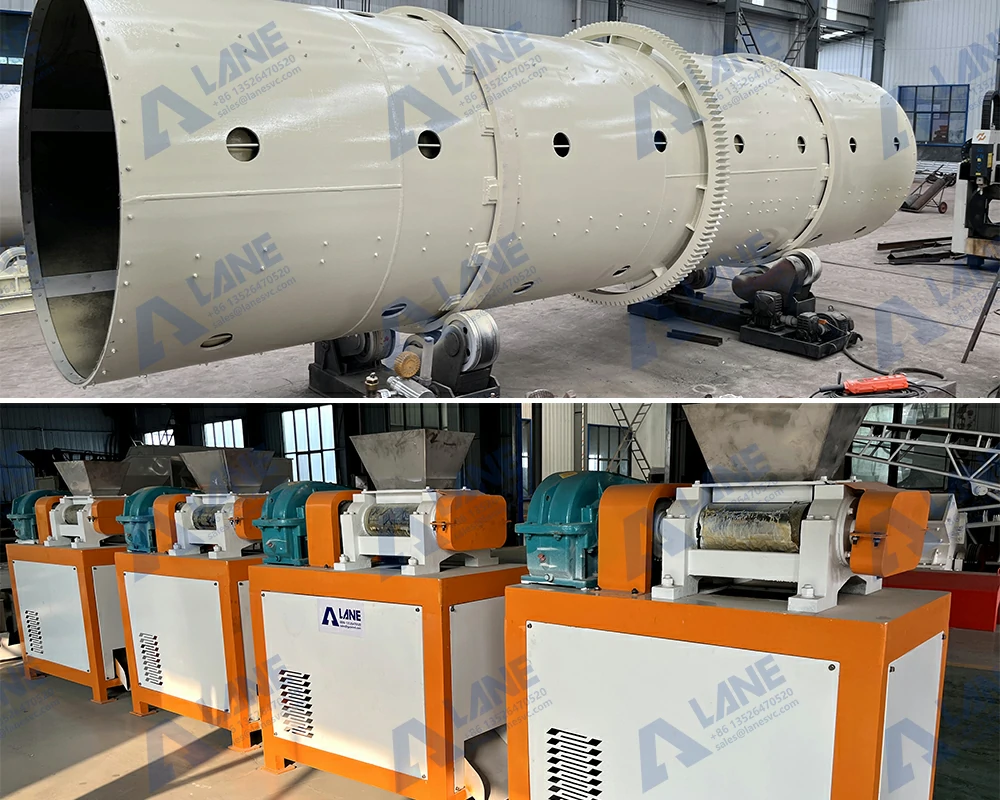
Organic fractions are heat-sensitive. Above roughly 80 degrees Celsius at the product surface, volatile compounds are lost and the material can scorch, which shows up as smell and color before it shows up in the analysis.
Use co-current airflow, keep the inlet temperature moderate, and control on product discharge temperature rather than inlet temperature. A dryer copied from an NPK line will run hotter than an organo-mineral granule wants.
This is where projects get expensive after launch.
In the European Union, Regulation (EU) 2019/1009 defines an organo-mineral fertilizer as a co-formulation of organic and inorganic components, and it sets declaration and contaminant rules for the category. The product must fit a defined function category before it can carry the CE mark.
Certified organic production is a separate regime, governed in the EU by Regulation (EU) 2018/848 and in the US by the National Organic Program. Mineral nitrogen is not permitted there, which means a product containing urea cannot be sold as an organic input regardless of how much compost it contains.
So the honest positioning is: organo-mineral products sell on agronomic performance and soil health, not on an organic label. If your business plan assumes an organic premium on a 10-5-10, the plan is wrong.
Test five things on every batch: organic carbon, total and available NPK, moisture, granule strength, and foreign matter. The last one is the one that ends contracts, because plastic and glass in compost arrive with the feedstock and leave in the bag.
Keep a retained sample from each batch for twelve months. When a distributor complains about caking or analysis, the sample answers the question in an hour instead of a month.
For NPK organic fertilizer production, ask for a granulation trial on your actual organic base and your actual mineral sources, not on a reference material. Organo-mineral formulations are sensitive to the specific compost, and a trial on someone else’s feedstock proves very little.
Ask how the line controls feed moisture during organic fertilizer granulation. If the answer is an operator with a squeeze test, the process is not controlled.
Ask what happens when the organic fraction arrives wetter than specification. A designer answers with a drying duty and a capacity derate. A reseller answers with a change order.
What is NPK organic fertilizer?
It is a fertilizer that carries both organic matter and a declared NPK analysis. In practice most commercial products are organo-mineral, combining compost or manure with mineral nutrient sources.
Can organic fertilizer have a high NPK analysis?
Only by adding mineral nutrients. Pure organic materials run 1 to 5 percent total nutrients, so any product claiming 10-10-10 with an organic claim is organo-mineral or mislabeled.
Is organo-mineral fertilizer certified organic?
Generally no. Certification schemes restrict mineral inputs, and mineral nitrogen in particular. The product can be sold as an organo-mineral fertilizer, not as a certified organic input.
What moisture should the granulator feed be?
Roughly 25 to 35 percent for a disc pan or drum, depending on the organic fraction. Below 20 percent the material dusts; above 40 percent it pastes.
Do I need a dryer?
For granular product, yes. Organic fertilizer granulation always needs a dryer, and it has to be gentle. Powder product sold locally may skip drying if the compost is already at 12 to 15 percent moisture.
Which granulator suits a high-fiber organic base?
Organic fertilizer granulation on fibrous material needs a machine built for fiber: a stirring-pin granulator handles feed that refuses to ball in a pan. A disc pan works when the organic fraction is well composted and screened.
What standards apply?
Regulation (EU) 2019/1009 for the EU market, national fertilizer registration elsewhere, and organic certification rules such as EU 2018/848 or the USDA National Organic Program if you intend to make that claim.

Everything you need to know when looking at different types of organic fertilizer equipment, all in one place.
Copyright © 2026. LANE All rights reserved.
Send A Message