
Biogas residue composting: C/N 20–30:1, moisture 55–65%, 55–65°C for 7+ days (turn/tank) & equipment buying tips.
Biogas residue composting: Can biogas residue be turned into usable organic fertilizer? Yes—but fresh material straight from the digester is not ready. Raw digestate normally has a C/N ratio of 12–15:1 (too low), moisture of 60–70% (too high), and leftover ammonium nitrogen that may cause ammonia volatilization and phytotoxicity. Successful composting needs carbon-rich bulking amendments to adjust C/N to 20–30:1 and moisture to 55–65%, together with aeration to sustain 55–65°C for a minimum of 7 days.
This guide walks through the composting process, compares windrow and in-vessel equipment options, and lists critical questions you should raise with your equipment supplier.
The short answer: raw biogas residue (digestate) is not ready to compost on its own. Anaerobic digestion removes the volatile carbon the pile needs to heat up, leaving a wet, low-C/N material that behaves differently from the original feedstock.
Three numbers tell you the problem:
| Parameter | Raw digestate | Composting target |
|---|---|---|
| Carbon-to-nitrogen (C/N) | 12–15:1 | 20–30:1 |
| Moisture | 60–70% | 55–65% |
| Ammonium-N share of total N | High (30–60%) | Converts to nitrate by end |
Because digestion converts organic nitrogen to ammonium-N, digestate has more ammonia-loss risk and less self-heating capacity than raw manure.
Two consequences follow:(1) it needs a carbon amendment, and (2) it needs genuine aerobic turning or forced aeration—not just time in a pile.
Mesophilic or thermophilic digestion is not a pathogen-kill or maturity step for the solid fraction; the European Commission’s Regulation (EU) 2019/1009 (Annex II, CMC 5) sets end-product limits (macroscopic impurities ≤3 g/kg dry matter, PAH16 ≤6 mg/kg dry matter) that only controlled composting reliably meets.
Common mistake: assuming digestate is already safe because it went through the digester. Digestion is not maturation. Without an aerobic curing step, pH, nitrogen form, and maturity do not meet fertilizer standards, and field application risks root burn and ammonia loss.
Step 1 — Add a Carbon Amendment (the Single Biggest Variable)
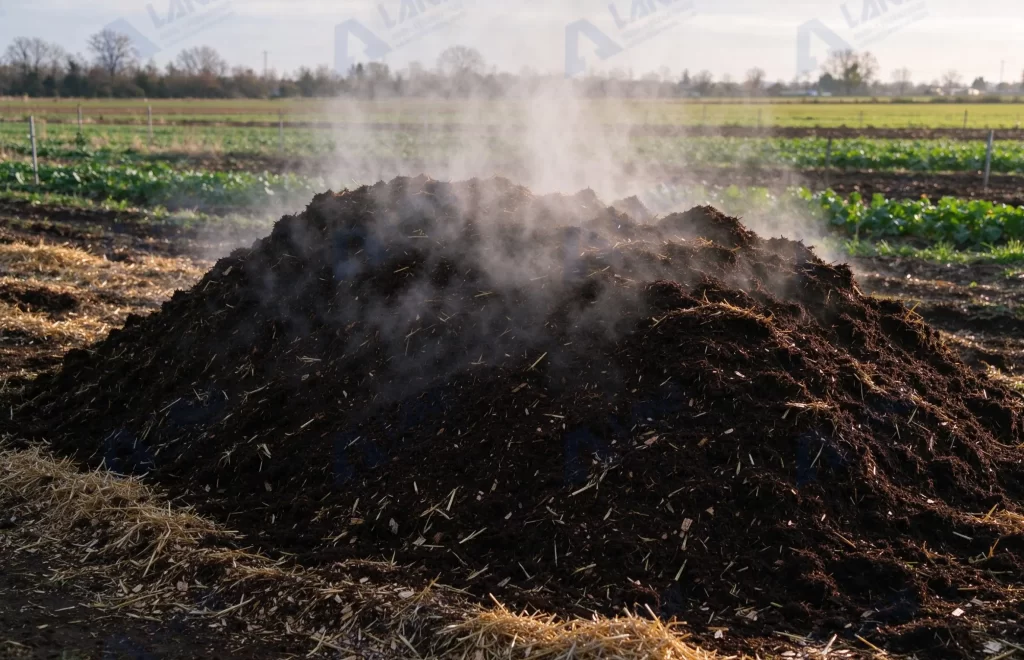
Digestate is carbon-starved. Plan on a bulking agent at roughly 20–35% by volume of the pile: crop straw, sawdust, wood chips, or screened compost. The amendment is not filler—it raises C/N to 25:1, absorbs moisture, and creates the pore space air needs to move. Too little carbon and the pile never heats; too much and it never matures. In practice, target C/N 25:1 and moisture 60% at start, then let the pile drop to 55% as it progresses.
Step 2 — Windrow Turning vs In-Vessel Fermentation (the Equipment Decision)
This is the decision that sets your capex, footprint, and odor profile.
| Option | Typical capacity | Suitable if | Main trade-off |
|---|---|---|---|
| Self-propelled windrow turner | 300–1,000 m³/day pass | Outdoor space available, low capex, flexible feed | Weather-dependent, larger footprint, open odor |
| In-vessel fermenter (tank/trough) | 5–100 t/day per unit | Tight site, odor control required, year-round operation | Higher capex, energy for forced aeration |
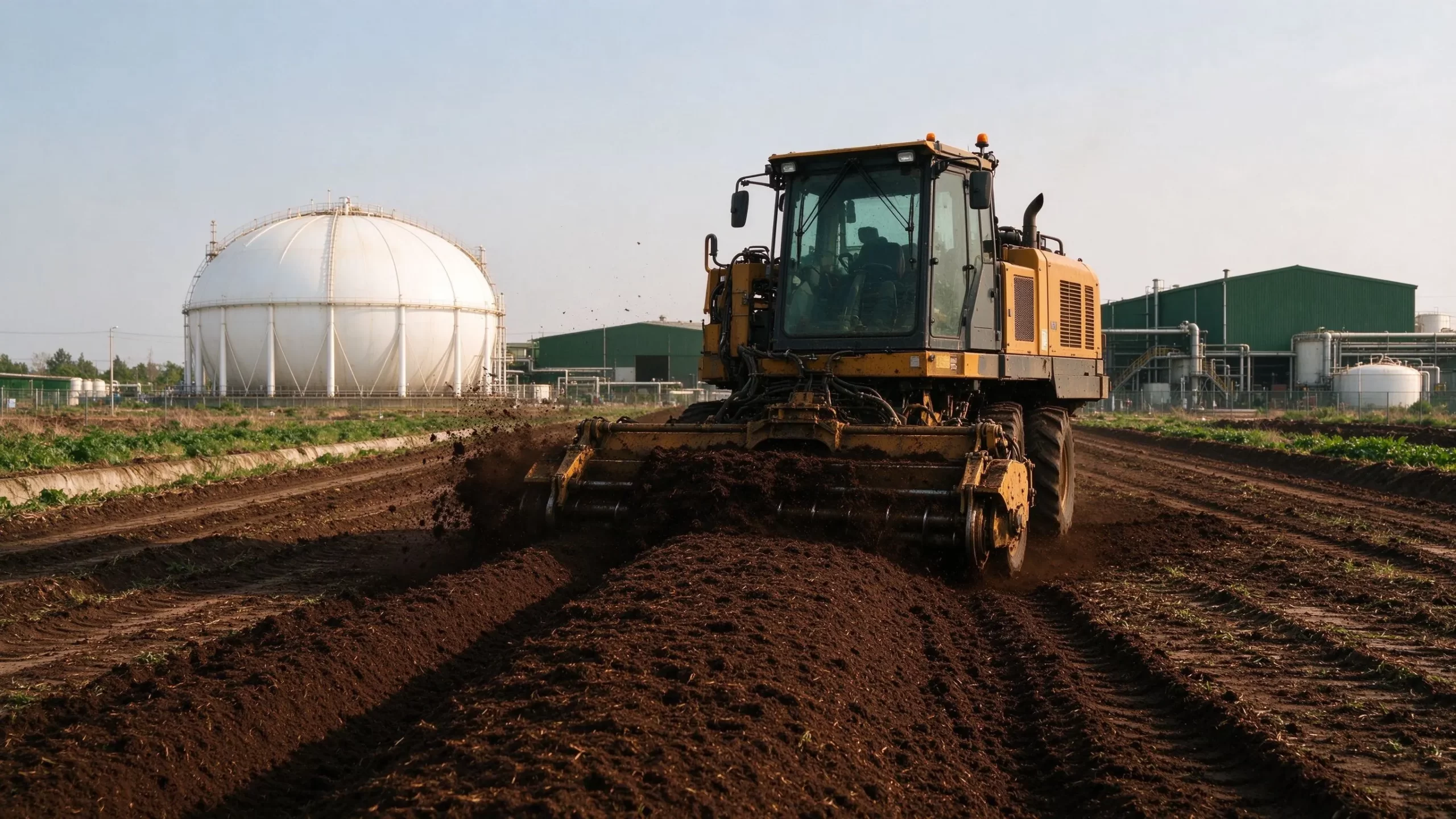
A self-propelled windrow turner aerating digestate—the low-capex, open-air option.
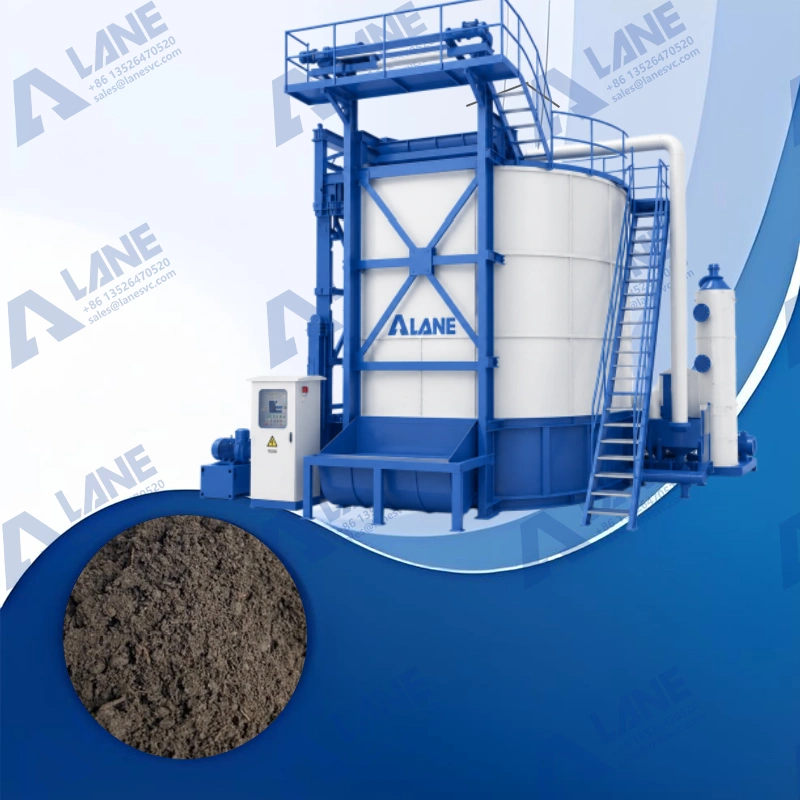
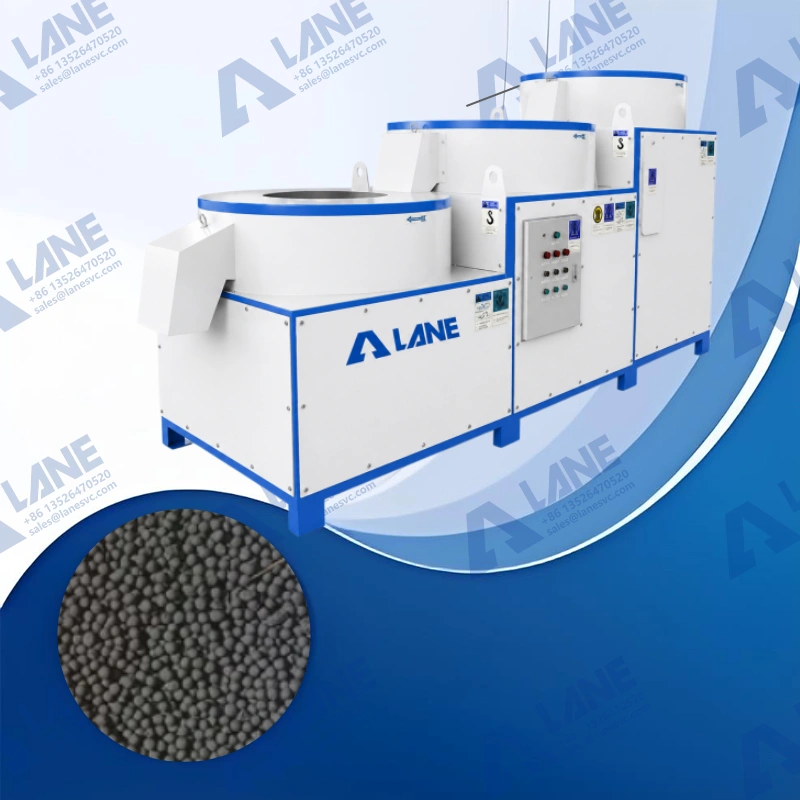
An in-vessel fermenter with forced aeration—the controlled-odor, compact option.
If odor is a permit issue (common for EU and US operations under local permitting), an in-vessel system with a biofilter is often the defensible choice; if you have land and the climate cooperates, a windrow turner cuts capital cost sharply.
Buyer warning: if a supplier can only give you a brochure and cannot provide a mass balance at your tested moisture, that is your answer—move to the next candidate.
Step 3 — Hold the Right Temperature Window
The pile must reach 55–65°C for a sustained thermophilic phase of at least 7 days to satisfy pathogen-reduction expectations, then fall below 45°C as it matures. Turn every 1–3 days in the hot phase, dropping to weekly in maturation. Monitor with a probe at 1–1.5 m depth in a windrow; in-vessel units use fixed sensors tied to the aeration blower.
Step 4 — Manage Moisture and Ammonia
Keep moisture 55–65% during active composting; below 40% the biology stalls, above 70% it goes anaerobic and smells. Because ammonium-N is high, add carbon or lime if the pile pH climbs toward 8.5–9, and consider an ammonia scrubber or biofilter where odor limits apply.
Step 5 — Maturity, Screening, and (Optionally) Granulation
Finished compost tests with a C/N around 10–12:1 and passes a germination- or Solvita-type maturity check before it is fertilizer. Screen to remove the amendment skeleton and oversized fraction, then decide: sell as screened compost or granulate into pellets for easier handling and longer shelf life. Granulation adds a dryer and a granulator but raises value per tonne and improves freight economics.
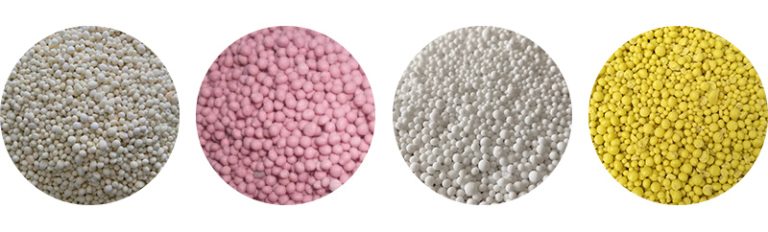
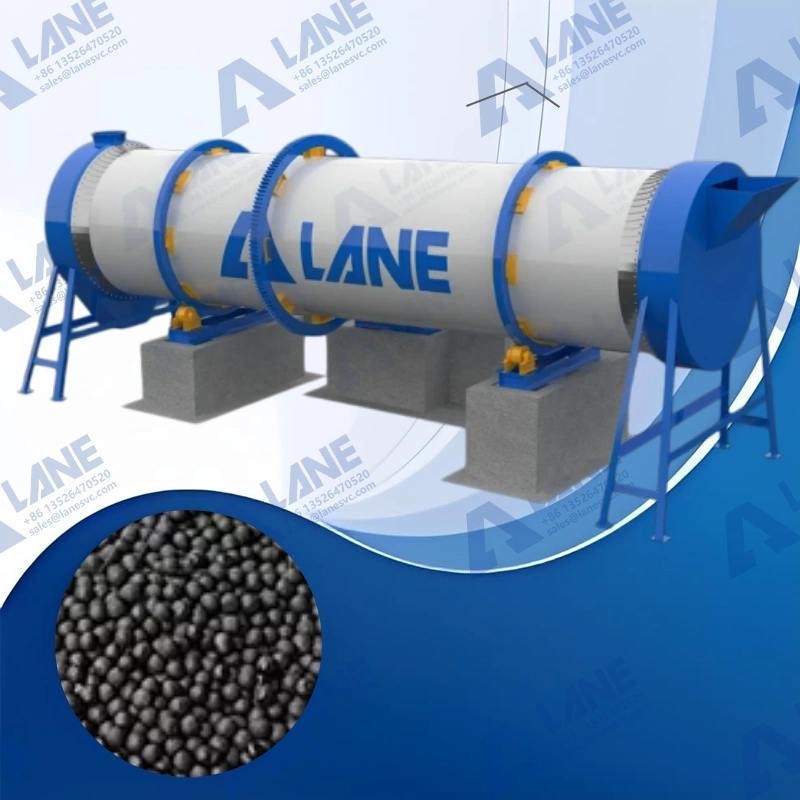
Mature digestate compost granulated into uniform organic fertilizer pellets.
Before you sign, get these written into the quote (6 acceptance questions):
The bottleneck is rarely the machine—it is the drying and handling around it. Digestate at 65% moisture is heavy and sticky; conveyors, screens, and the granulator feed all suffer if upstream moisture and C/N are wrong.
Budget for the carbon-amendment logistics and the dryer duty before you pick equipment. Underestimated cost: ongoing bulking-agent supply and hard-stand flooring with leachate collection are usually the two biggest budget overruns, yet they rarely appear in the equipment quote.
Ask the six questions above, then weigh three things:
(1) a track record on digestate specifically, not just manure lines—digestate is wetter and lower-C/N;
(2) whether the quote includes commissioning, training, and spares;
(3) total-site capability, since turnkey delivery removes most interface risk.
A supplier who can reference an installed biogas-residue line and quote a real energy figure is worth far more than a lower number on paper.
Can biogas residue be composted?
Yes—digestate composts well once you add a carbon bulking agent to raise C/N to 20–30:1. Raw digestate alone is too low in carbon and too wet to self-heat properly.
What carbon-to-nitrogen ratio do I need for biogas residue?
Start at C/N 25:1 (range 20–30:1). Raw digestate usually sits at 12–15:1, so a straw, sawdust, or wood-chip amendment is required.
How wet can digestate be for composting?
Target 55–65% at the start and through the active phase. Below 40% the process stalls; above 70% it turns anaerobic and produces odor.
What temperature must the pile reach?
Hold 55–65°C for at least 7 days during the thermophilic phase, then allow it to drop below 45°C to mature.
How long does biogas residue composting take?
Typically 4–8 weeks for active composting plus 2–4 weeks maturation, depending on C/N, moisture, and turning or aeration frequency.
What capacity can a line handle?
Windrow turners pass roughly 300–1,000 m³/day; in-vessel fermenters handle about 5–100 t/day per unit. Sizing depends on your daily digestate output and moisture.
How long is the equipment lead time and commissioning?
Standard lines typically ship in 30–60 days and commission in 2–4 weeks; turnkey projects with civil works take longer. Confirm the schedule in writing before ordering.
What does warranty, spares, and customization cover?
Typical warranty is 12 months on components; confirm spare-parts stock and voltage/customization (e.g., 380V/50Hz vs 480V/60Hz) in the quote, since these are the most common post-sale disputes.
Internal links (each anchors to the next buyer step):
Compare your equipment options on the self-propelled windrow turner
See what a complete biogas-residue line setup
Related handling practice: aerobic digestate handling in practice
Reference (authoritative):
Regulation (EU) 2019/1009, Annex II, CMC 5 — digestate component-material limits
Three things to confirm before you leave:
Use this checklist and send the six acceptance questions to your supplier for a written response, or compare against a complete line setup as a benchmark before you commit.
Contact us for a free consultation

Everything you need to know when looking at different types of organic fertilizer equipment, all in one place.
Copyright © 2026. LANE All rights reserved.
Send A Message