
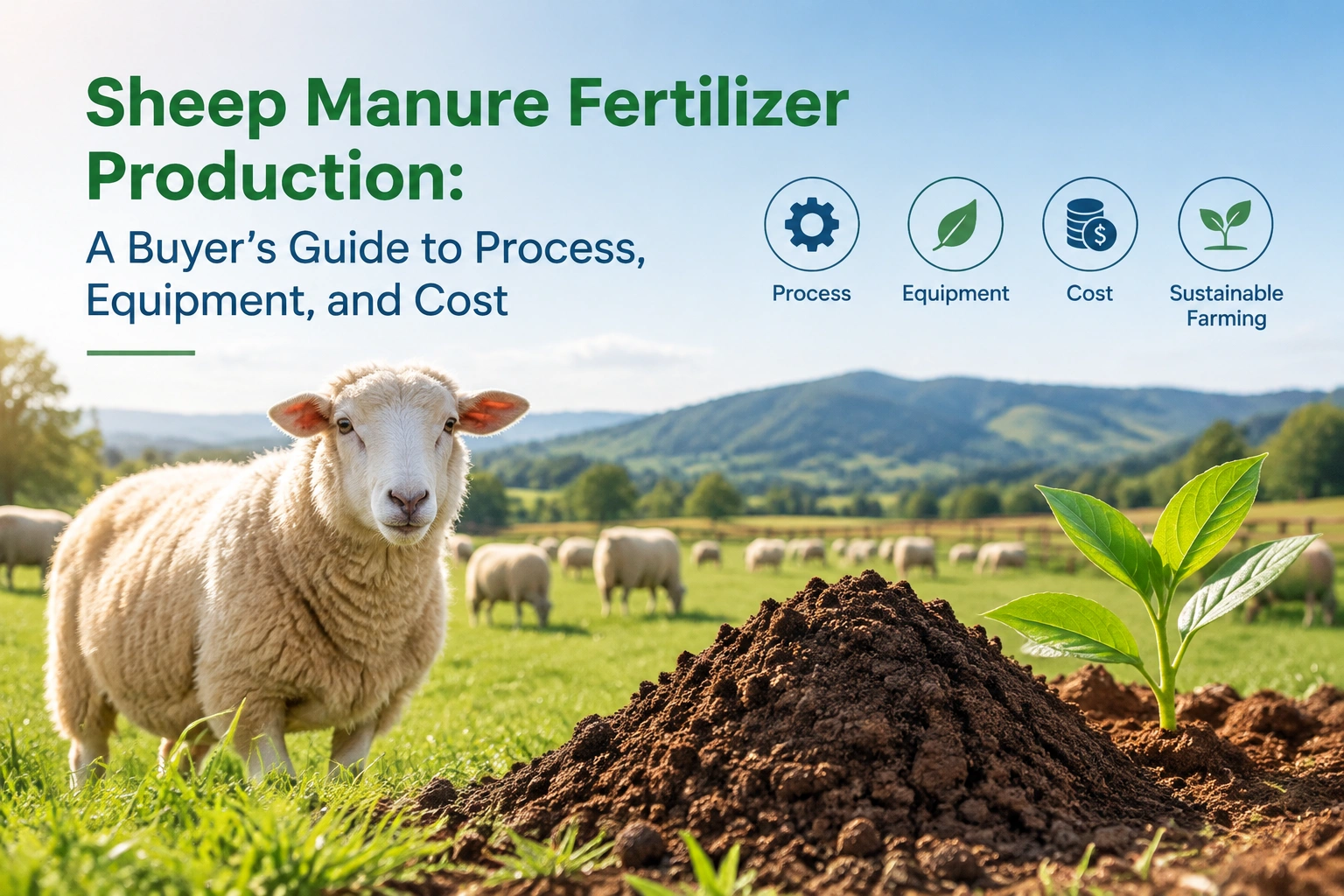
Plan a sheep manure fertilizer production line: feedstock testing, composting, granulation, equipment sizing, key cost drivers, and supplier checks.
A sheep flock produces a dry, fibrous manure that travels well and composts predictably. That is why sheep manure fertilizer production attracts investors with cheap feedstock and a nearby market for bagged organic products. The engineering question is narrower than the business case: can the manure you can secure be dried, stabilized, and granulated at a cost the market will pay?
Fresh sheep manure is not a uniform input. Material from a slatted-floor barn differs from straw-bedded manure in moisture, fiber length, ash, and nitrogen. Sand, soil, wool, and feed spillage end up in the pile.
For sheep manure fertilizer production, the first spend should be a lab analysis: moisture, organic matter, nitrogen, phosphorus, potassium, pH, conductivity, and heavy metals. Add any parameters your organic certifier requires. In the United States, the USDA National Organic Program sets rules for raw manure and compost under 7 CFR 205.203. Products sold in the EU face contaminant limits under Regulation (EU) 2019/1009.
Nutrient figures may be quoted per ton of fresh material or on a dry basis; the two cannot be compared. Moisture changes the equipment list most, because every point of water must be evaporated later.
Fresh manure releases ammonia and can heat in storage. Composting stabilizes it, cuts odor, and gives the granulator a consistent feed. The product usually goes to horticulture, vineyards, turf, landscaping, or retail garden products.
A sheep manure fertilizer production line follows the same sequence in most plants, but the equipment in each stage changes with capacity, feedstock, and product.
Receiving and blending
Manure arrives by truck or loader and goes into a receiving hopper. A weighbridge and a log of supplier, date, and moisture help you spot variation early. In the mixer, blend manure with crop residue, straw, or finished compost to adjust moisture and the carbon-to-nitrogen ratio.
Windrow composting uses a turner to aerate the pile. In-vessel systems cost more but save land and control odor. Aim for 50 to 60 percent moisture and a carbon-to-nitrogen ratio near 25:1 to 30:1. Hold the pile at 55 to 65°C (131 to 149°F) and turn it when temperature or oxygen drops. Active composting usually takes four to eight weeks, followed by curing.
If the compost is headed for certified organic production, it must meet NOP temperature and turning rules, not just look finished. The US Composting Council publishes test methods and a testing assurance program that buyers recognize.
Crushing and screening
Finished compost goes through a cage crusher or hammer mill, then a rotary screen. Oversize returns to the crusher. A consistent particle size, usually below 3 to 5 mm, helps the binder work and reduces fines.
An organic fertilizer granulator turns powder into a handleable product, but it cannot fix bad feed preparation. Disc and drum machines roll moist powder in a pan or cylinder while binder and water hold the particles together. Roller compactors press powder between rolls, and pin granulators throw fine material against a shell. Moisture, binder, and particle size decide pellet strength and recycle rate.
Granulation also solves a handling problem. Pellets flow in spreaders, produce less dust than powder, and keep nutrient distribution even in a bag.
Drying, cooling, and bagging
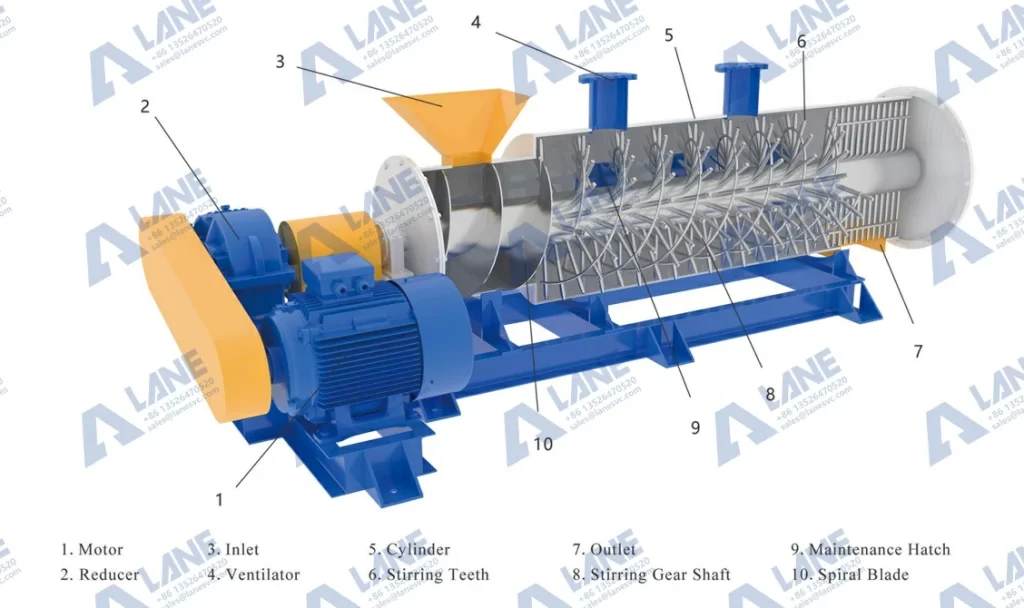
Most granulated organic fertilizer is dried to about 12 to 14 percent moisture before bagging. A rotary drum dryer is common, but inlet temperature has to be controlled because excessive heat drives off nitrogen and can damage organic matter. Cool the product before bagging so condensation does not form inside the bag. Drying is usually the largest fuel cost on an organic fertilizer production line.
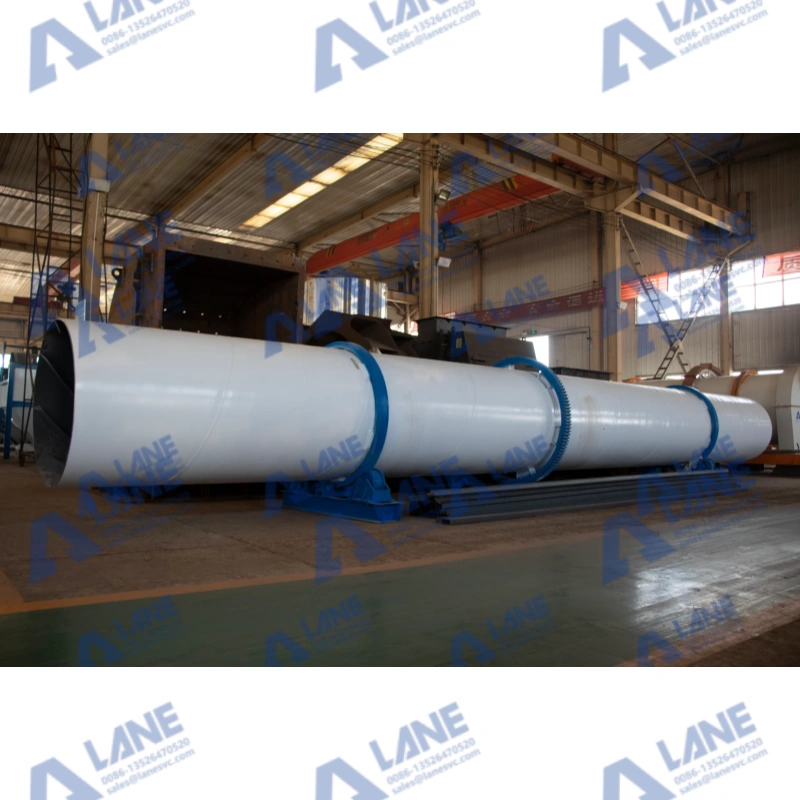
An organic fertilizer production line is more than a granulator and a dryer. Size these stages together.
| Stage | Typical Equipment | What to Specify |
|---|---|---|
| Receiving | Hopper, feeder, weighbridge | Truck size, surge capacity, moisture logging |
| Blending | Horizontal or vertical mixer | Batch size, binder addition, cycle time |
| Composting | Windrow turner or in-vessel reactor | Throughput, aeration, odor control |
| Crushing | Cage crusher or hammer mill | Feed size, target fineness, wear parts |
| Screening | Rotary or vibrating screen | Mesh size, recycle rate |
| Granulation | Disc, drum, roller, or pin granulator | Feed moisture, binder, target pellet size |
| Drying | Rotary drum dryer | Water to evaporate, fuel type, temperature control |
| Cooling and coating | Counterflow cooler, coater | Product temperature, anti-caking dose |
| Packing | Automatic packing machine | Bag size, weigh accuracy, dust control |
Every line has one bottleneck, usually the dryer. If it is rated at 2 tons per hour with 30 percent feed moisture and your compost arrives at 38 percent, the line runs below nameplate. Ask for a mass balance at your measured moisture.
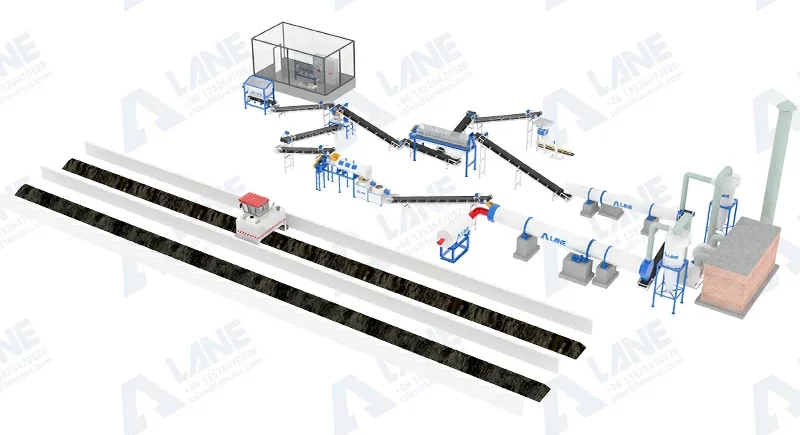
Choosing an organic fertilizer granulator comes down to feed condition and the product your buyers expect.
| Type | Feed condition | Pellet shape | Best fit | Main trade-off |
|---|---|---|---|---|
| Disc granulator | 25 to 30% moisture with binder | Round, 3 to 5 mm | Small to medium capacity, simple operation | Sensitive to feed variation |
| Rotary drum | 25 to 35% moisture, water or steam | Round, uniform | Larger capacity, steady product | Bigger footprint, more drying load |
| Double roller | Low moisture, dry-ish powder | Flattened or oval | Compact line, less drying | Roll wear, less spherical product |
| Stirring pin | Fine, uniform powder | Small spheres | Uniform granules from fine feed | Narrow moisture window |
Disc and drum routes need a dryer. Roller compaction can skip drying for some formulations but produces a flatter granule. Pin granulation requires fine, consistent feed.
Binder choice matters as much as the machine. Lignin, starch, molasses, and clay are common, but not every binder is allowed under every certification program.
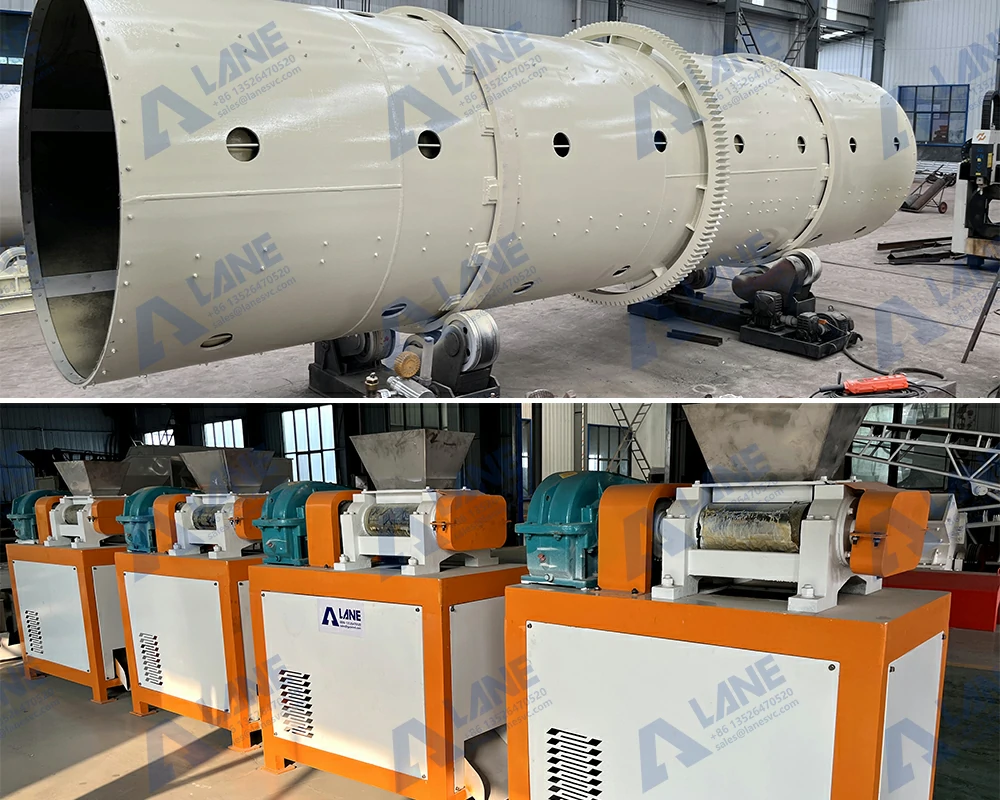
A production line quote is not a plant cost. It may stop at the battery limits, leaving civil works, electrical distribution, water, fuel storage, laboratory equipment, and permitting to someone else. Compare offers on the same scope.
For sheep manure fertilizer production projects, the largest cost variables are capacity, incoming moisture, product form, automation, and local fabrication. Drying fuel is usually the biggest operating cost because every extra point of moisture has to be evaporated. Electricity, labor, binder, maintenance, and bagging materials follow.
Compare total cost per finished ton, not price per ton of nameplate capacity. For an organic fertilizer production line, ask for utility use per ton, yield from raw manure to bagged product, spare parts pricing, and operators per shift. A cheap line that burns more fuel can cost more over five years.
Leave room for truck turning, raw material storage, finished goods, and future capacity. Composting close to neighbors invites odor complaints, so check zoning and prevailing wind before you buy land. Confirm power for the installed motor load, water for granulation and dust control, and fuel for the dryer.
Fertilizer registration and labeling rules vary by state and country. In the United States, the Association of American Plant Food Control Officials publishes model rules that most state programs follow. Check labeling rules before you print bags.
Poor granule quality usually starts with feed moisture drift, not a worn machine. Check moisture at receiving, after composting, and before granulation. Record the numbers by shift so operators see a trend instead of reacting to a bad batch.
Keep organic fertilizer granulator wear parts in stock: crusher screens and hammers, discs or rollers, dryer flights, conveyor belts, and bagging seals. Lubricate bearings on schedule and check belt alignment weekly. Machine guarding should meet OSHA 1910.212 or the local equivalent, and operators need lockout training before they clear a jam.
An organic fertilizer production line is a long-term investment. The supplier’s engineering support can matter more than the steel. Ask these questions before signing:
A supplier who answers with a catalog page instead of your sample data is telling you something. A reference visit beats a brochure case study: inspect the feed pile, watch the organic fertilizer granulator run, and ask how often the line stops. For a broader view of how an organic fertilizer production line fits together, see this guide to a turnkey fertilizer plant.
Tighter rules on manure storage and nitrogen application are pushing livestock operations to find a market for surplus manure. Retailers want consistent granule size, stable moisture, and a documented analysis. Pelletizing cuts volume and makes distant markets more economical, so many projects include drying and bagging from the start. Automation and odor control are moving into smaller plants.
How much does a sheep manure fertilizer production line cost?
The cost of an organic fertilizer production line depends on capacity, feed moisture, granulation method, fuel, automation, and scope. Ask for an itemized quote with battery limits. Drying fuel, civil works, and electrical work often sit outside equipment quotes.
How long does sheep manure take to compost?
Active composting usually takes four to eight weeks, followed by three to four weeks of curing. Climate, pile size, turning frequency, and initial moisture affect the timeline. The pile is ready when it no longer reheats after turning and smells earthy. A lab test confirms it.
Can sheep manure be granulated without drying?
Sometimes. Roller compaction can form granules from relatively dry feed, but most organic fertilizer granulator designs need a dryer to reach stable bagging moisture. Feed moisture, binder, and required pellet strength decide.
What moisture is needed for granulation?
An organic fertilizer granulator typically runs best at 25 to 35 percent moisture in disc or drum designs. Too wet and the material balls up or sticks to the equipment. Too dry and it makes dust instead of granules.
Is sheep manure better than cow manure?
Sheep manure usually has a higher nutrient concentration per ton because it contains less water and more dry matter, but bedding, feed, and storage change the numbers. Neither is automatically better. Design around a lab analysis of the manure you can supply.
How much land does the plant need?
Land depends on capacity, composting method, storage, and truck access. In-vessel composting takes less space than windrows. Leave room for raw material surges and future expansion, and check zoning first.
What is the difference between compost and fertilizer pellets?
Compost is stabilized organic matter. A pellet is a physical form that makes the product easier to handle, store, and spread. Granulation does not increase nutrient content, but it improves flow, cuts dust, and controls granule size.
Do I need a permit to sell organic fertilizer?
Most markets require product registration, labeling approval, or both, and many regulate manure storage and emissions. In the United States, state fertilizer programs set the rules. In the EU, Regulation 2019/1009 applies. Check requirements before construction.
What capacity should a new plant start with?
Size the organic fertilizer production line around the manure you can secure for at least 300 days a year, not the capacity you can finance. A line that runs below design capacity still carries the same labor and maintenance burden. Start with a realistic feedstock agreement.

Everything you need to know when looking at different types of organic fertilizer equipment, all in one place.
Copyright © 2026. LANE All rights reserved.
Send A Message