

Crawler type compost turner selection: match capacity, rotor design and windrow dimensions before requesting a quote.
A crawler type compost turner is designed for plants that process organic waste in long, open windrows and need a self-propelled machine to turn, loosen and re-form the piles. Its tracked chassis moves along the windrow without relying on a tractor or a fixed rail system, while the hydraulic turning assembly handles the material across the working width. For plant owners and procurement managers, the main question is not simply whether the machine can turn compost. It is whether its working width, turning depth, hourly volume and mobility match the site’s actual feedstock and operating schedule.
A crawler type compost turner should be selected against the windrow cross-section and daily material flow—not from a headline capacity figure alone. For a crawler type compost turner, tracked mobility is valuable only when the yard layout and pile geometry allow the machine to work without repeated repositioning. A machine that is too small creates a turning bottleneck; an oversized unit can increase capital cost and leave the rotor underloaded.
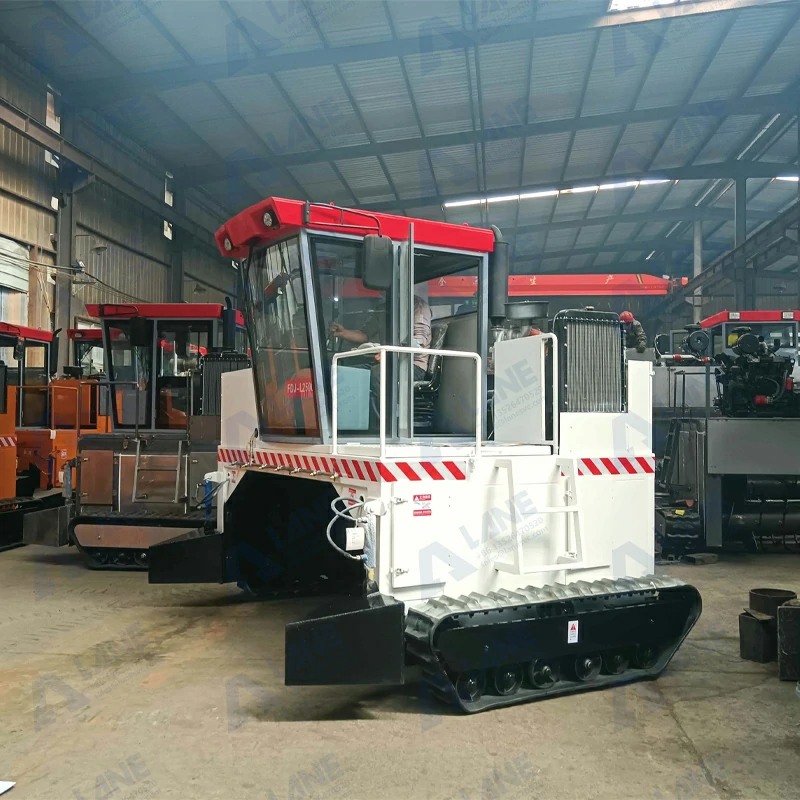
The crawler type compost turner travels along the pre-formed windrow. Its tracked travel system provides forward, reverse and steering movement. A hydraulic lifting system raises or lowers the turning drum so the operator can set the working depth for the pile.
On the LANE product page, the rotor is described as a dual-spiral arrangement: left- and right-hand spiral blades move material from the outer sections toward the center, while throwing teeth lift and discharge it behind the machine. This action turns material from different parts of the pile, breaks up compacted zones and rebuilds the windrow with a looser structure. The page also describes a hydraulic front push plate for reshaping the pile after the pass.
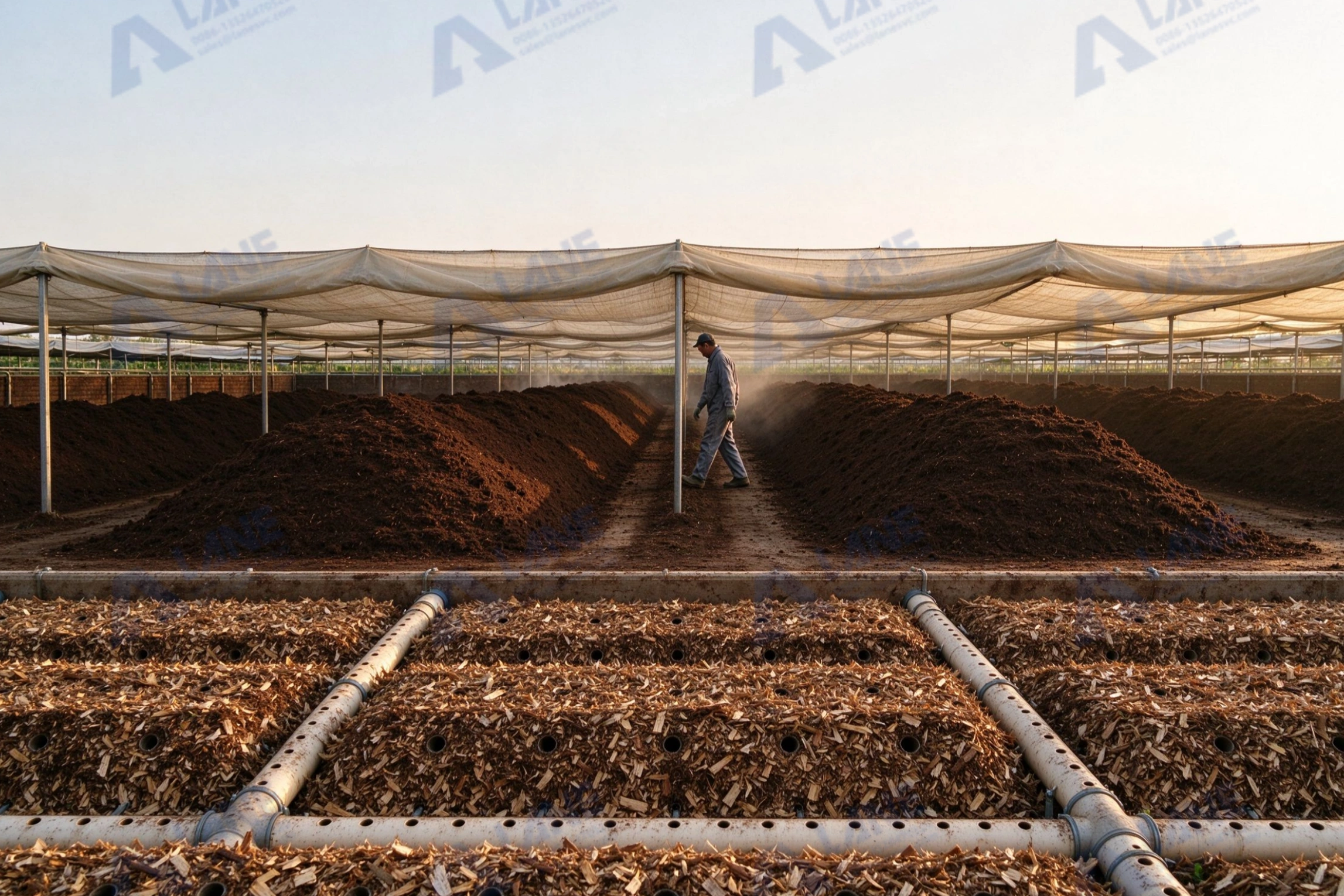
The purpose is controlled mechanical aeration, not simply moving material from one place to another. On a crawler type compost turner, rotor geometry and working depth determine how much of the pile is lifted and redistributed on each pass. Turning redistributes the outer and inner fractions, opens pore spaces and introduces air. The US EPA explains that turning is one method of supplying oxygen in windrow composting and that windrow dimensions and porosity affect air movement.
Planning a fertilizer project? Contact LANE engineering team to get a free 3D plant layout drawing, motor power calculation, and factory-direct quote within 4 hours. Request 3D Layout & Budget Estimate →
Selecting a crawler type compost turner starts with the windrow cross-section. LANE’s dedicated product page publishes three reference configurations. They are useful for initial screening, but the selected crawler type compost turner must still be checked against the actual windrow width, height, feedstock density and operating hours.
| Reference turning width | Published capacity | Buyer’s interpretation |
|---|---|---|
| 2,400 mm | 500–700 m³/h | Lower published volume range; check whether it covers the daily turning schedule |
| 2,600 mm | 1,000–1,200 m³/h | Mid-range reference; verify pile cross-section and material resistance |
| 3,000 mm | 1,300–1,800 m³/h | Higher published volume range; confirm yard width, turning lanes and machine access |
For a crawler type compost turner, the listed capacity is volumetric throughput in cubic metres per hour. It is not a guaranteed mass output in tonnes per hour. Bulk density changes significantly between loose straw, manure mixed with bedding, dewatered sludge and wet food-processing residues. Do not convert the published m³/h figures into t/h unless the supplier provides the material bulk density and the test conditions used for the rating.
The crawler type compost turner product page gives a turning-depth adjustment range of 600–1,800 mm and a diesel engine range of 75–156 hp. These are product-page reference figures, not a statement that every width uses the same engine or depth setting. Ask for a model-specific datasheet showing installed power, working width, maximum working depth, travel speed and rated throughput together.
The listed applications include livestock and poultry manure, crop residues, industrial organic by-products, municipal and food waste, and sludge or biosolids. That range does not mean every material can be fed in unchanged. Moisture, fiber length, bulk density, stickiness and foreign matter affect rotor load and the way material is thrown behind the machine.
For manure blended with straw or other bedding, check whether the incoming mixture is sufficiently blended before it reaches the windrow. Long fibers can wrap around rotating components if the feedstock is poorly prepared. For dewatered sludge or wet food waste, confirm the solids content and whether dry bulking material is needed to maintain pile porosity. Remove stones, metal and other tramp material before turning; a compost turner is not a substitute for a dedicated shredder or contaminant-removal stage.
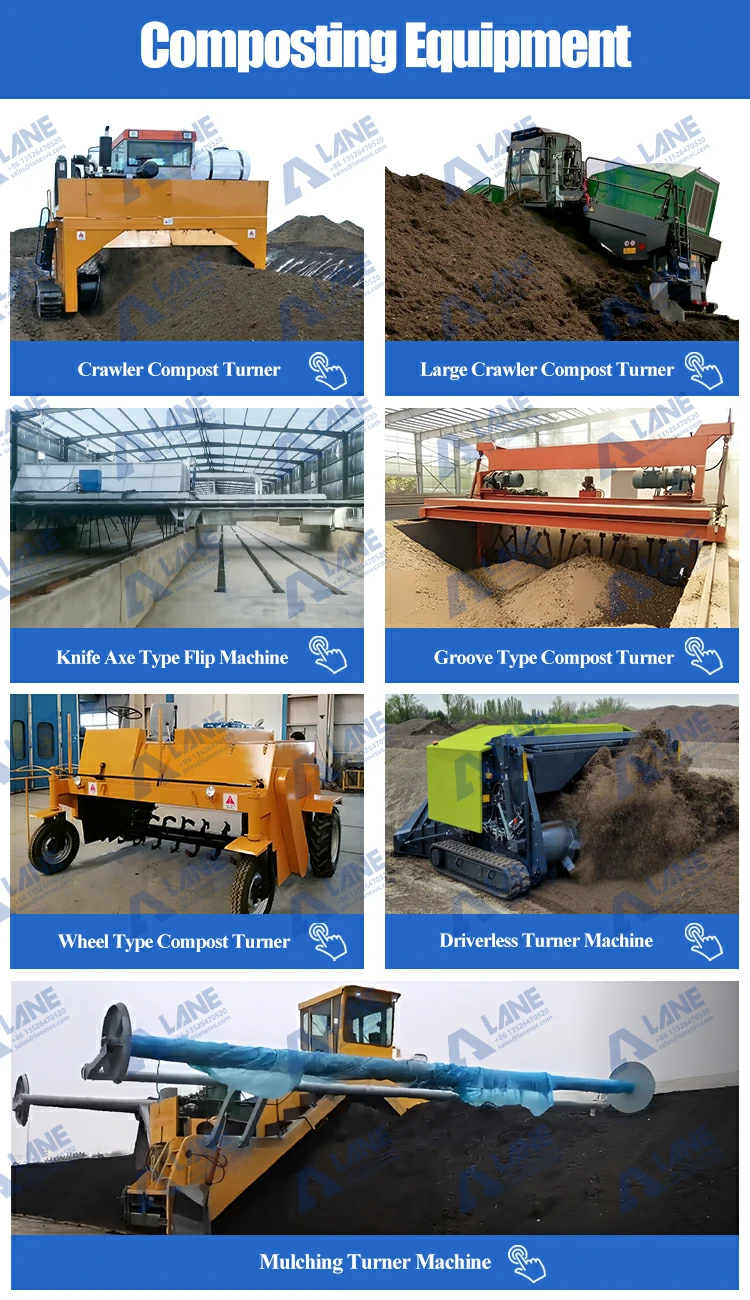
The yard is equally important. A crawler type compost turner needs a travel route that remains clear when loaders, feedstock trucks and finished-compost handling equipment are operating at the same time. A crawler chassis needs a firm, reasonably level operating surface with enough bearing capacity for the machine at working load. For a crawler type compost turner, the layout must provide turning lanes, end-of-row turning space, loader access and separation between active windrows and finished compost. If the site has a narrow fixed concrete trough, a crawler machine may not be the correct configuration; a rail-mounted trough turner is a different equipment arrangement, such as a chain plate compost turner.
A crawler type compost turner quotation should identify the exact machine configuration. Do not accept a quotation that gives only a model name and a capacity range. The proposal should identify the exact machine configuration and the conditions under which the supplier expects it to achieve the stated throughput.
| Item to confirm | Reference or required information | Why it matters |
|---|---|---|
| Turning width | LANE reference options: 2,400 / 2,600 / 3,000 mm | Must match the windrow base width and required coverage |
| Turning depth | Product-page adjustment range: 600–1,800 mm | Determines whether the rotor can work through the full pile section |
| Capacity | Model-specific m³/h with feedstock and operating conditions | Prevents comparing unlike capacity claims |
| Drive and power | Diesel engine; published range 75–156 hp | Confirm installed power for the quoted width and material |
| Rotor and wear parts | Dual-spiral rotor; blade material and replacement details | Affects mixing action, wear cost and maintenance access |
| Chassis and ground | Track type, ground pressure and required yard surface | Determines mobility and civil-work requirements |
| Controls and safety | Travel controls, drum lift, emergency stop and guarding | Affects operator control and safe maintenance |
When comparing crawler type compost turner quotations, ask the supplier to state whether the rated capacity is based on loose volume, actual windrow volume or a defined test material. Also request the guaranteed operating speed, turning frequency assumptions and the number of working hours per shift. These details are more useful than a headline figure when you calculate the number of machines required.
A crawler type compost turner handles the active windrow fermentation stage. It does not finish the fertilizer product by itself. After the material reaches the required maturity and moisture condition, it normally moves to size reduction and downstream preparation.
A typical line may follow this sequence:
Raw material receiving → Pre-mixing and moisture adjustment → Windrow formation → Crawler turning and aerobic fermentation → Crushing → Screening → Mixing → Granulation → Drying and cooling → Packaging.
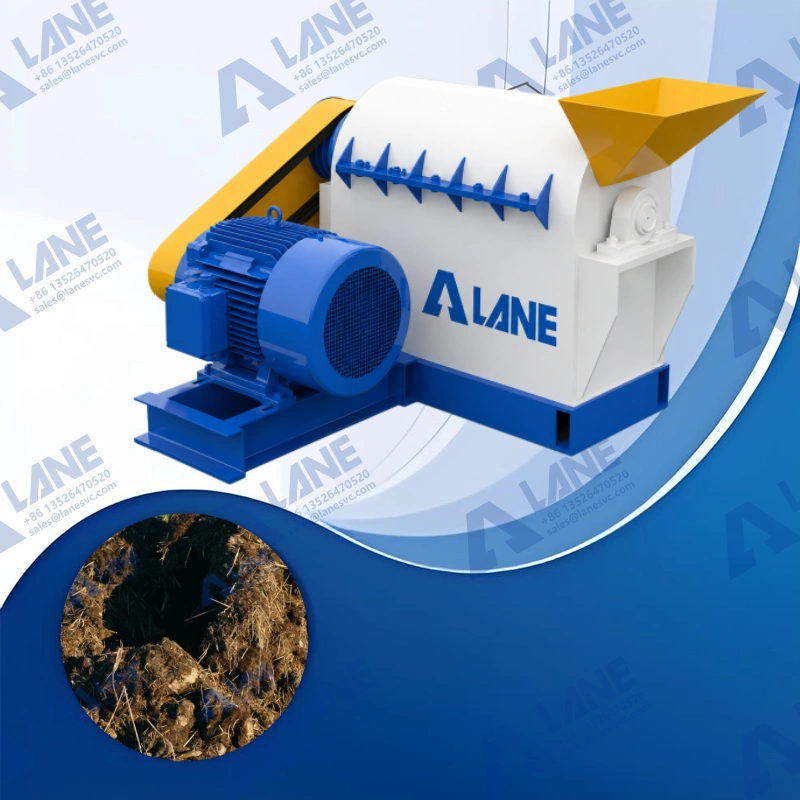
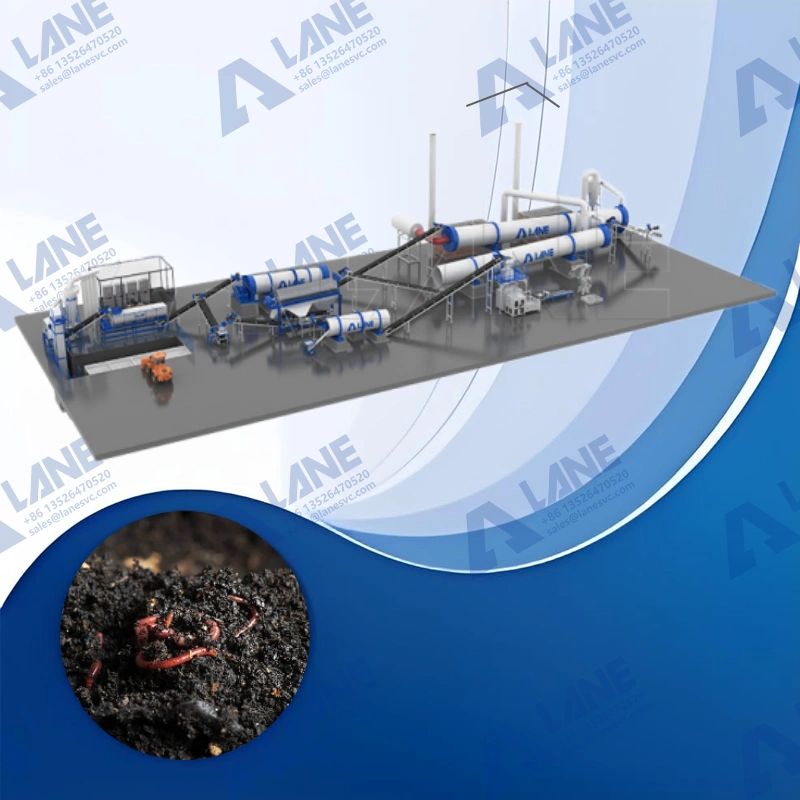
The fermented material may need a semi-wet material crusher or another suitable organic fertilizer crusher to break down lumps before screening and formulation. A suitable organic fertilizer screener then separates the material by particle size. The correct crusher depends on moisture and material behavior; do not select it only from the name of the machine.
If the plant is designed as a complete project, the turner’s capacity must be coordinated with the downstream equipment and the curing area. A fast turner does not increase finished-product output if the screening, granulation or drying section is undersized. Review the complete organic fertilizer production line layout before fixing the turner model.
Routine maintenance on a crawler type compost turner should cover the rotor, throwing teeth, blade mounts, drive components, hydraulic hoses, track assemblies and bearings. Manure, grit and fibrous residues are abrasive; wet material can also build up around the rotor and guards. The product page identifies manganese-steel blades, but it does not provide a verified blade-life figure. Do not assume a fixed service life without knowing the feedstock and working hours.
Before purchase, ask for a wear-part list with part numbers, material specifications, replacement intervals under stated operating conditions and prices for a starter spare-parts package. Confirm how the rotor is accessed for inspection, how the machine is cleaned at the end of a shift, and which lubrication points require daily or weekly attention. These details affect real operating cost more than a broad claim about low maintenance.
During acceptance of a crawler type compost turner, use the buyer’s actual or representative feedstock wherever practical. Confirm the machine travels along the planned windrow without excessive track slip, reaches the specified turning depth, produces a stable windrow profile and does not leave persistent unmixed zones. Record throughput over a defined period, but also record material type, moisture, windrow dimensions and operating speed.
For a crawler type compost turner, the contract should specify the supplied rotor width, installed engine power, hydraulic functions, control system, safety devices, included tools, spare parts, operator training and installation support. For export orders, confirm packing dimensions, shipping weight, container or break-bulk arrangement, commissioning scope and who pays for travel and local lifting equipment. Delivery time should be stated in the quotation rather than assumed from a generic product page.
Yes, provided the feedstock is prepared to suit the rotor and windrow process. LANE lists livestock and poultry manure, agricultural residues, industrial organic waste, food waste and sludge among the potential materials. Actual suitability depends on moisture, stickiness, fiber length, bulk density and contaminants. Send a representative material description or sample data before the supplier confirms the configuration.
LANE publishes reference capacities from 500 to 1,800 m³/h. The listed configurations are 2,400 mm at 500–700 m³/h, 2,600 mm at 1,000–1,200 m³/h, and 3,000 mm at 1,300–1,800 m³/h. These are volumetric figures, not tonnes per hour; obtain a model-specific rating for the actual feedstock.
No, an open-windrow crawler configuration is designed to operate on a prepared yard rather than a fixed rail-mounted trough. The yard still needs adequate bearing capacity, drainage, turning clearance and access for loaders and transport vehicles. A fixed trough process requires a different machine arrangement.
There is no reliable universal replacement interval. Wear on a crawler type compost turner depends on abrasive content, stones or metal contamination, operating hours, blade material and maintenance practice. Ask the supplier for wear-part specifications and a replacement estimate based on your feedstock and annual working hours.
The quotation should define the machine configuration, packing and shipping details, installation supervision, operator training and spare-parts supply. Confirm the production lead time, shipping method, unloading requirements and whether on-site commissioning is included or charged separately. Do not treat a general service statement as a project-specific commitment.
Before placing the order, confirm three points in writing:
A crawler type compost turner is a substantial investment in the fermentation section. For a crawler type compost turner, the final decision should be based on a matched technical proposal and a site-specific acceptance test. The right purchase is not necessarily the widest or highest-capacity model; it is the configuration that can turn the plant’s actual material consistently, fit the yard and keep pace with the downstream line. Send LANE the feedstock type, daily volume, target windrow dimensions and site layout to obtain a project-specific recommendation and quotation.
For more details, please feel free to contact us.
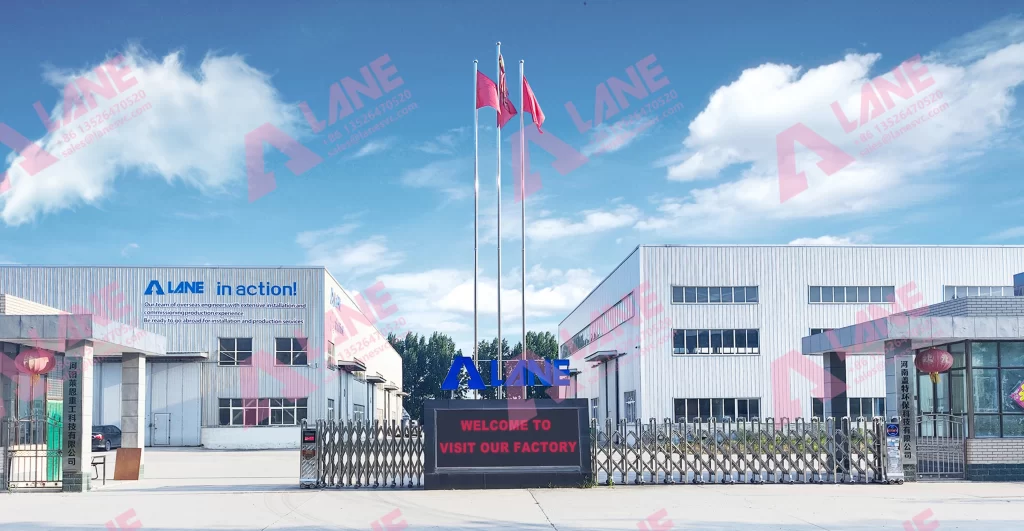
Henan Lane Heavy Industry Machinery Technology Co., Ltd.
Email: sales@lanesvc.com
Contact number: +86 13526470520
Whatsapp: +86 13526470520

Everything you need to know when looking at different types of organic fertilizer equipment, all in one place.
Copyright © 2026. LANE All rights reserved.
Send A Message