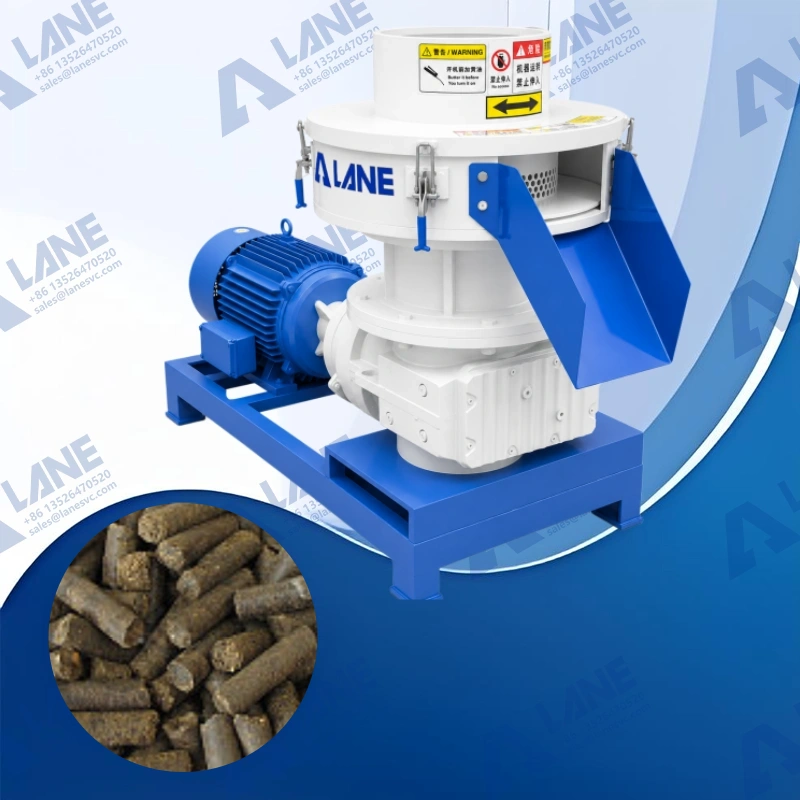
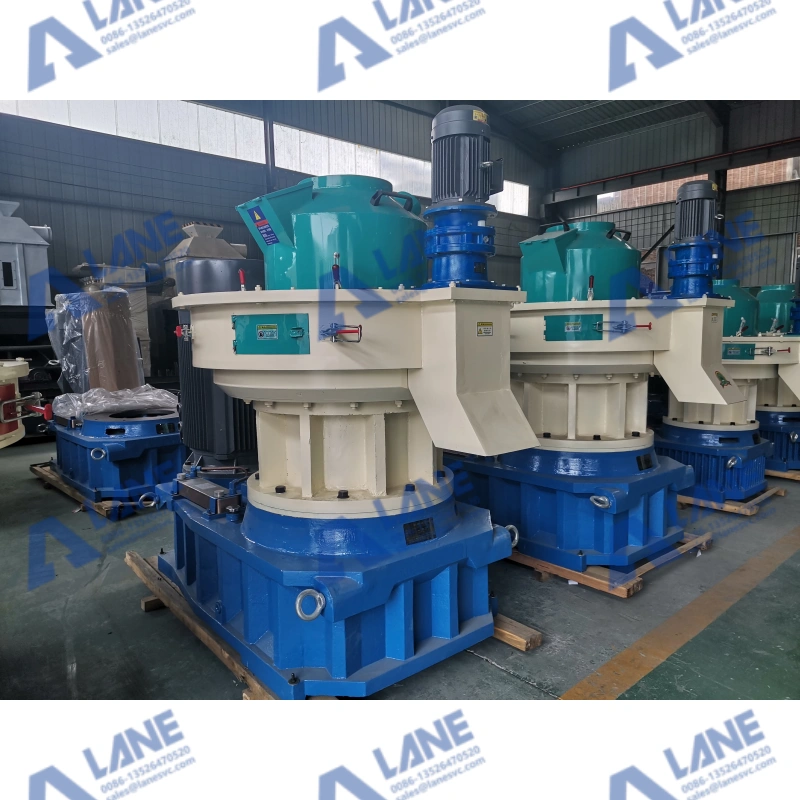
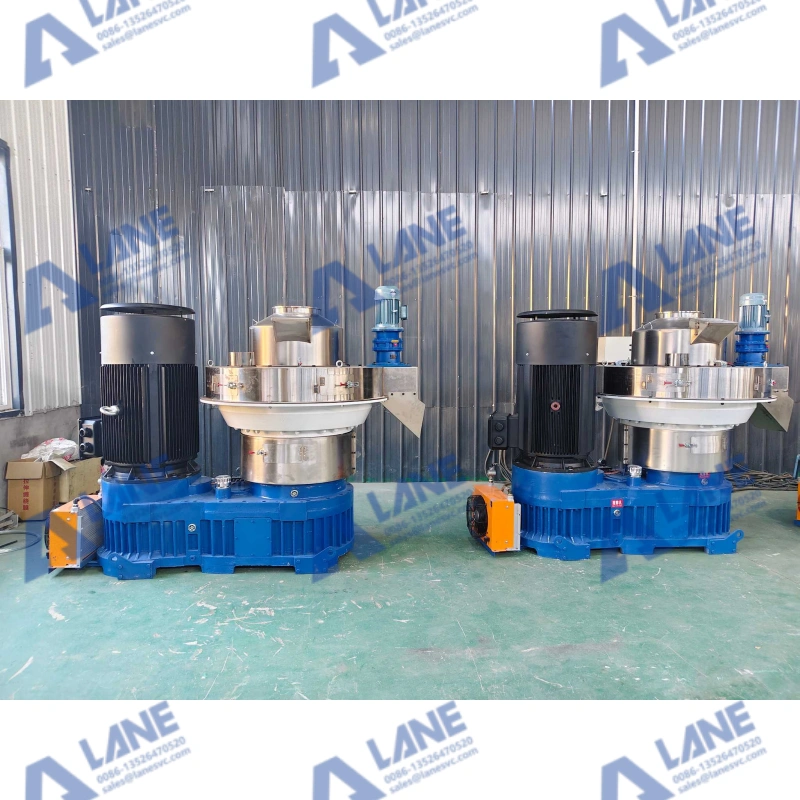
Ring die granulator (pellet mill) for organic fertilizer, compound fertilizer, and biomass fuel pellets. 0.5–8 TPH capacity. Produces hard, dense cylindrical pellets with low energy consumption. Interchangeable ring die for different pellet diameters.
The ring die granulator — also called a ring die pellet mill — is mechanically different from every other granulator on this list. Instead of tumbling powder in a drum or pan, it forces material through a perforated steel ring under high pressure. The result isn’t a sphere. It’s a dense, hard, cylindrical pellet that handles bulk transport and repeated re-bagging better than granules from any other method.
The pellet shape — consistent diameter, variable length — has a key field advantage: controlled dissolution. A 4 mm diameter, 8 mm long NPK pellet exposes less surface area per gram than a spherical granule, which means it releases nutrients more slowly in the soil. For controlled-release and slow-release fertilizer applications, that’s a product feature you can charge for, not a cosmetic difference.
This machine is the standard in the biomass pellet fuel industry (wood pellets, straw pellets). Its adaptation for fertilizer production — both organic and compound — has accelerated in the last 5 years as more manufacturers discover that pellet durability translates directly to lower return rates from distributors.
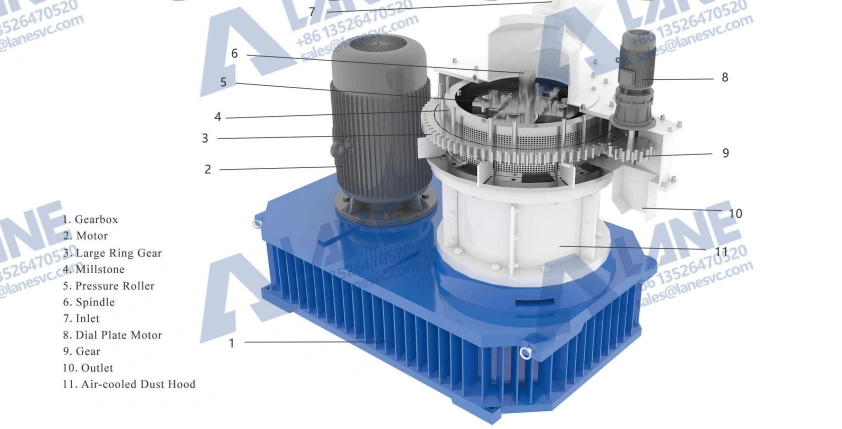
The machine’s core is a vertically mounted ring die — a thick-walled steel ring with hundreds of precision-drilled radial holes (typically 2–8 mm diameter). Inside the ring, two or three press rollers ride on an eccentric shaft assembly. The ring rotates (driven by a gearbox and motor), or in some designs the rollers rotate while the ring stays stationary.
Dry powder (≤15% moisture for organic; ≤5% for compound NPK) feeds into the ring die cavity from above. As the ring rotates, material is caught between the rotating ring’s inner surface and the press rollers. The rollers force the powder into the die holes under extreme pressure — 25–50 MPa at the roller-die contact line, an order of magnitude higher than double-roller extrusion.
The material compresses, heats up from friction (reaching 60–90°C at the die surface), and bonds through a combination of mechanical interlock, lignin plasticization (for organic materials), and partial solubilization of salt components (for NPK). The compressed material extrudes through the die holes as continuous dense strands. Stationary cutter knives mounted on the outside of the ring shear the strands into uniform-length pellets — typically 1.5–3× the hole diameter.
The entire process is continuous and dry. No steam boiler. No dryer. The friction-generated heat evaporates 2–4% of residual moisture during extrusion, so the pellets exit at 10–13% moisture — borderline-stable for short-term storage without additional drying.
Highest pellet/granule hardness of any fertilizer granulation method. Ring die pellets consistently test at 25–50 N crush strength, compared to 15–25 N for drum granules and 10–18 N for double-roller extrusion. They survive 4–6 handling cycles (factory → warehouse → distributor → retailer → farm) with negligible breakage. For export supply chains with 6–10 week transit times, that durability eliminates the “bag of dust” return problem.
Low energy consumption (30–45 kWh/ton). Energy use is comparable to or better than drum granulation, despite producing harder pellets, because there’s no dryer or steam system burning additional fuel. The friction in the die does some of the drying work.
Interchangeable ring dies for multiple pellet diameters. A single machine can produce 2 mm, 3 mm, 4 mm, 6 mm, and 8 mm pellets — just swap the ring die. Die change takes 2–3 hours with an overhead hoist. You can serve different market segments (turf fertilizer at 2 mm, field crop NPK at 4 mm, controlled-release at 6 mm) from one machine.
Dry process — compatible with heat-sensitive additives. Because the process adds no external heat beyond frictional warming (60–90°C for 2–5 seconds of die contact), biological inoculants, amino acids, and chelated micronutrients survive the granulation step with minimal degradation. Steam drum granulation kills most live microbes; ring die granulation preserves 70–90% viability depending on die temperature and residence time.
Self-cleaning die holes. The continuous extrusion action keeps the die holes clear during operation. Material that would blind a screener mesh or stick to a drum wall gets pushed through by the next rotation. This matters for slightly sticky materials — bentonite blends, molasses-bound organic feeds, humid NPK powders.
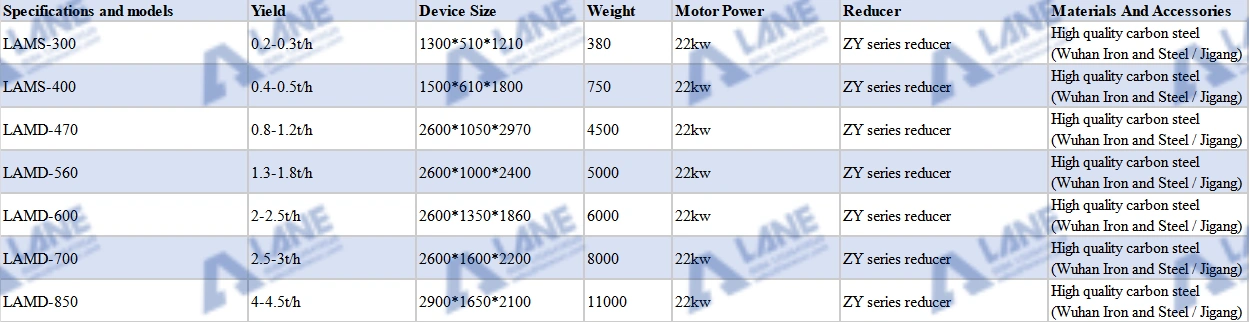
Capacity based on organic fertilizer (composted manure) at 12–15% moisture. NPK compound fertilizer throughput is 10–20% higher due to higher material density. Pellet diameter affects throughput — 6 mm pellets run at ~80% of the capacity of 4 mm pellets on the same die area.
Best performance with:
Acceptable with limitations:
Not suitable for:
The ring die is the heart of the machine and the highest-wear consumable. Key selection parameters:
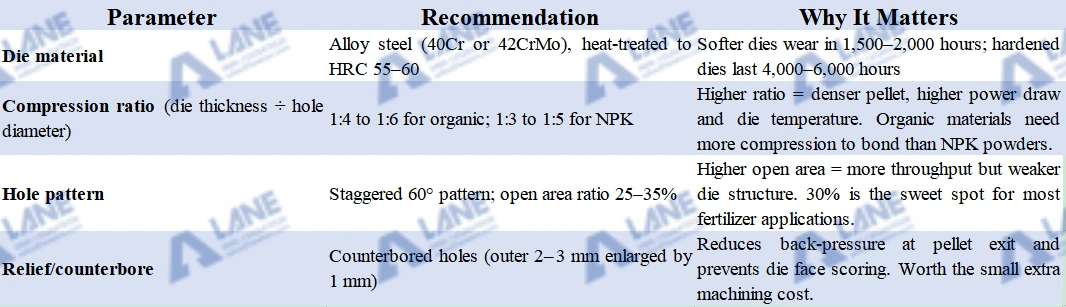
Budget a spare ring die with your machine order. Lead time for a replacement die is 4–8 weeks. If you wear out your one die mid-season, 4 weeks of downtime costs far more than the die itself.
Q: How is ring die granulation different from flat die pellet mills?
A: Both produce cylindrical pellets. Key differences: (1) Ring dies have higher throughput capacity (flat die mills top out around 1–1.5 TPH for fertilizer; ring dies go to 8+ TPH). (2) Ring dies have longer die life because the force is distributed over more holes and the die wall is thicker. (3) Ring dies cost 3–4× more than a flat die of the same capacity, so the flat die is the better entry-level choice for sub-1 TPH operations.
Q: Do ring die pellets need a coating step?
A: Optional but recommended for export and long-term storage. A thin coating of anti-caking agent (0.3–0.5% by weight) after cooling prevents moisture absorption and pellet-to-pellet sticking during transit. For domestic distribution with short supply chains (less than 4 weeks from factory to farm), uncoated pellets typically perform fine.
Producing organic or bio-organic fertilizer? Send us your material specification and target pellet size. We’ll spec the right ring die, provide throughput projections, and deliver a complete quotation.


Everything you need to know when looking at different types of organic fertilizer equipment, all in one place.
Copyright © 2026. LANE All rights reserved.