
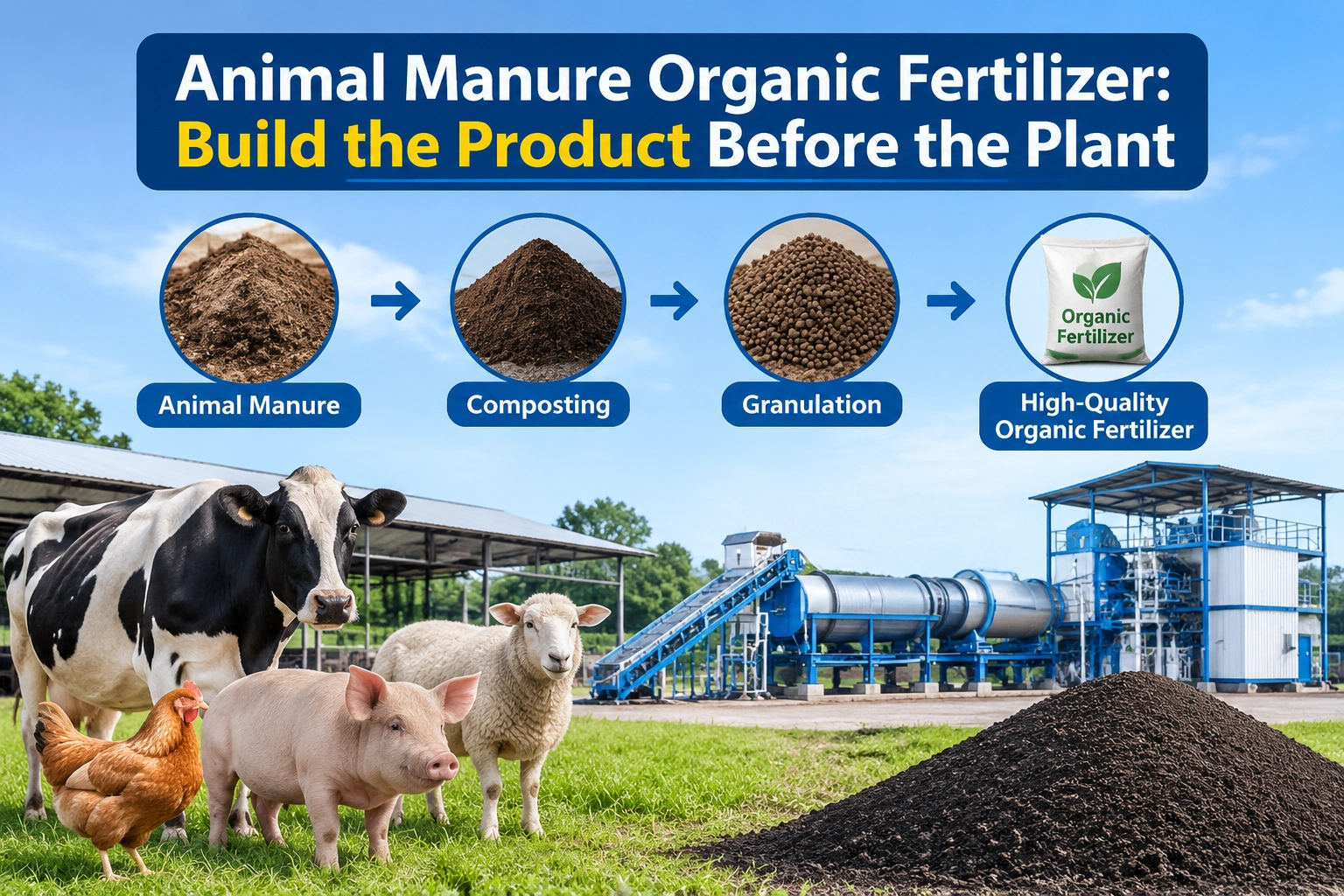
How to turn animal manure into a sellable organic fertilizer: product specs, compost rules, plant configuration, equipment selection, yield, and cost.
Most manure projects start with a pile and a price list. The ones that work start with a specification.
Animal manure organic fertilizer is a manufactured product with a declared analysis, a moisture limit, a granule size, and a contaminant profile. Until those four numbers exist, every equipment decision is a guess, and every quotation is for a different plant.
Buyers do not purchase manure. They purchase a bag with a number on it.
That number includes organic matter, nitrogen, phosphorus, potassium, moisture, and granule size. It also includes what must not be there: stones, plastic, glass, and heavy metals above the local limit.
Cow manure organic fertilizer typically tests at 1.5 to 2 percent nitrogen on a dry basis, with 35 to 50 percent organic matter. Poultry manure runs higher, closer to 3 to 5 percent nitrogen. Neither becomes a fertilizer brand until the moisture is below 14 percent for bagged product and the granule holds together in a spreader.
Write the spec before the layout. It decides whether you need a dryer, a granulator, or neither.
Manure is not one feedstock. Moisture, nitrogen, and structure change the machine list.
| Manure | Typical Moisture | Nitrogen (Dry Basis) | Structure | Best First Product |
|---|---|---|---|---|
| Cattle | 70 to 85% | 1.5 to 2% | Medium | Compost, then granules |
| Poultry | 25 to 75% | 3 to 5% | High with bedding | Granules or blend |
| Swine | Above 90% | 2 to 3% | None | Separated solids to compost |
| Sheep or goat | 60 to 75% | 1.5 to 2.5% | Medium | Compost |
Cow manure organic fertilizer is the most common starting point because the material is available in volume and the compost is forgiving. Poultry manure carries more nitrogen but loses it faster as ammonia. Swine slurry has no structure at all, so the separator comes before the turner, not after.
The same plant cannot be optimized for all four. Pick the manure you can secure for ten years, then design around it.
Animal manure organic fertilizer sits at the intersection of fertilizer law, waste law, and organic certification. Three rules matter before the first equipment order.
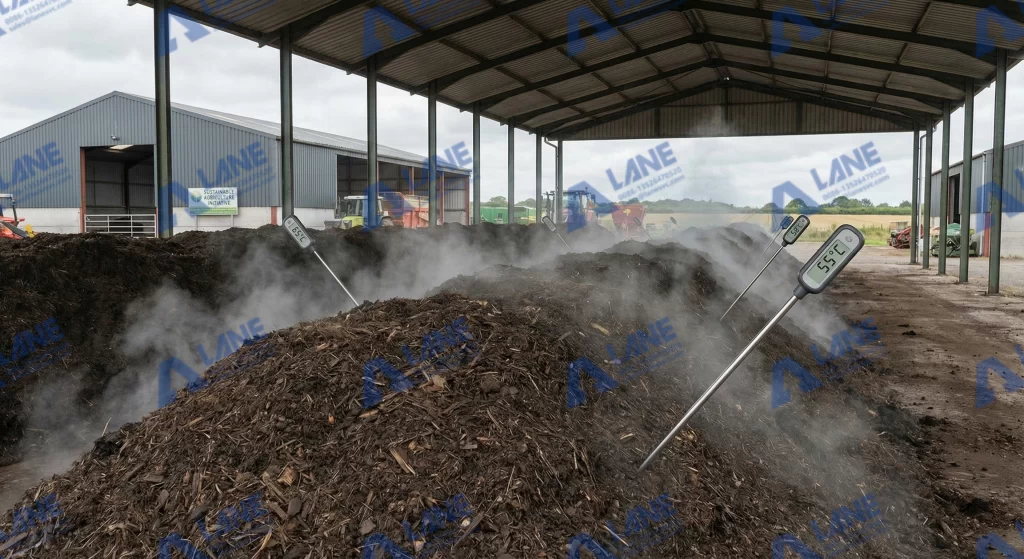
In the United States, the USDA organic rule at 7 CFR 205.203 sets the compost process for material used in organic production: an initial carbon to nitrogen ratio between 25:1 and 40:1, and a temperature of 131 to 170 degrees Fahrenheit held for three days in an in-vessel or aerated static pile, or fifteen days with at least five turns in a windrow. Raw manure has separate application intervals before harvest.
In the European Union, Regulation (EU) 2019/1009 sets the declaration and contaminant rules for a fertilizer product, including cadmium limits for phosphate materials. Manure-derived inputs also fall under the animal by-products regulation, which decides how the material can be collected, transported, and processed.
At the national level, most markets require product registration before sale. That file asks for the analysis, the process description, and the hygiene evidence. A plant designed without those documents becomes a plant that cannot legally sell.
There are two honest ways to build an animal manure organic fertilizer plant.
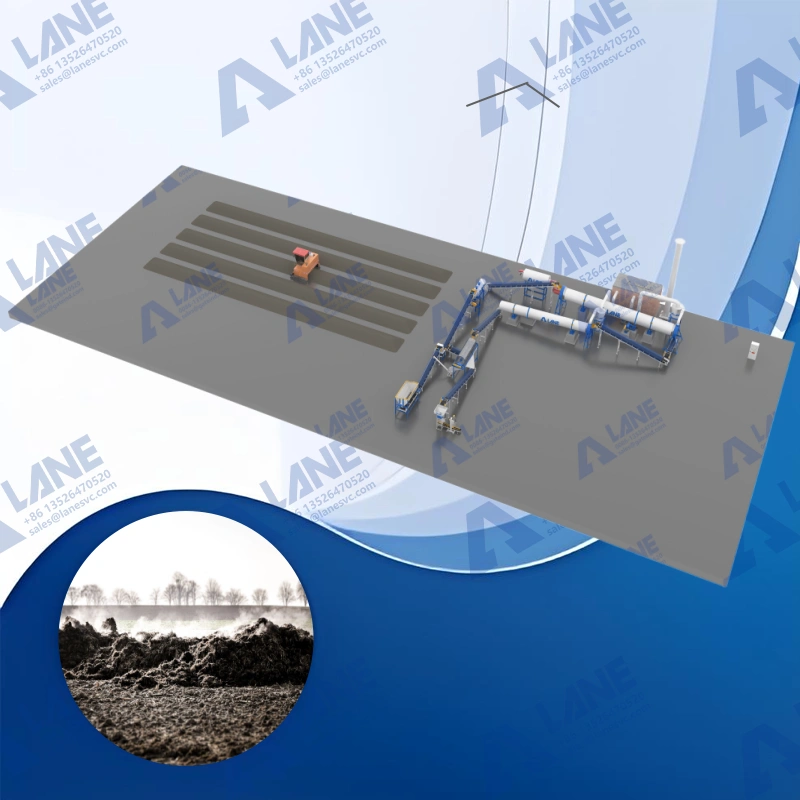
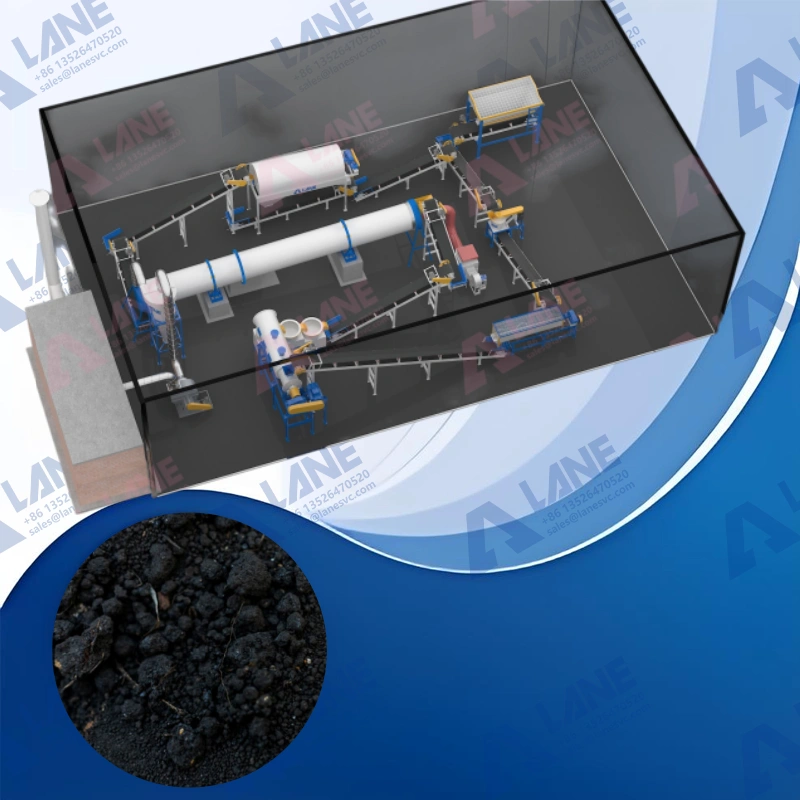
The first is compost-only: reception, separation if needed, mixing, composting, screening, and bulk loadout. A compost-only plant uses a shorter manure fertilizer machine list than a granulated one. It produces a soil amendment with a low analysis, sold by the tonne to farms, nurseries, and landscapers.
The second adds granulation: crushing, granulation, drying, cooling, secondary screening, coating, and bagging. It produces a packaged product with a declared analysis and a longer sales radius.
The difference is not cosmetic. The finishing line adds capital, energy, dust collection, and a product specification that has to be met every shift. Many projects should sell bulk compost for a year and add granulation after the channel is proven.
A manure fertilizer machine is only useful if it matches the material in front of it.
The solid-liquid separator handles swine slurry and wet dairy manure. For swine slurry, the separator is the first manure fertilizer machine that matters. A screw press is the common choice; it removes free water and leaves a stackable solid.
The compost turner aerates windrows. A pull-type turner behind a tractor is the lowest-cost option. A self-propelled turner buys independence and a wider drum. For odor-sensitive sites, an aerated static pile replaces turning with blowers, pipe, and a cover.
The grinder or hammer mill breaks clumps and shortens bedding so the mix is uniform. Long straw wraps around shafts and blinds screens.
The mixer blends manure with carbon sources and recycled fines. Horizontal shaft mixers handle high-moisture material better than vertical mixers.
The granulator forms the product. A rotary drum granulator suits larger volumes and variable moisture. A disc granulator gives tighter size control at lower tonnage. A double roller press compacts dry material and skips the dryer, but it needs a consistent fine feed.
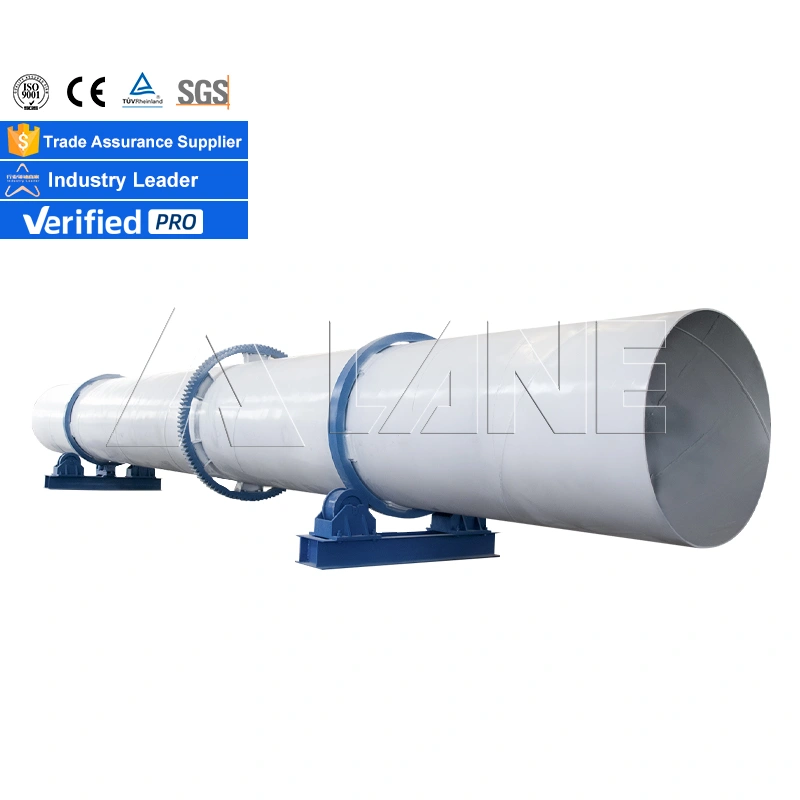
The rotary dryer and cooler set the final moisture and the bagging temperature. A dryer sized on finished product instead of total load, including recycle, will run short.
The rotary screen closes the loop. Oversize returns to the crusher, fines return to the granulator, and on-spec product goes to coating and packing.
A manure fertilizer machine bought on price alone usually becomes the bottleneck.
The automatic packing machine turns tonnes into bags. Weighing accuracy and dust control at the bagging head decide whether the product looks professional on a pallet.
Manure is bought by the tonne and sold by the tonne, but the water in between decides the yield.
For cow manure organic fertilizer, take 20 tonnes per day of raw manure at 75 percent moisture. That is 5 tonnes of dry matter. Composting typically loses 40 to 50 percent of dry matter as carbon dioxide and water vapor, leaving 2.5 to 3 tonnes. At 30 percent finished moisture, that is roughly 3.5 to 4.3 tonnes of compost per day.
If the plant granulates, expect another 5 to 10 percent loss at the screen and a recycle stream that has to be sized into the dryer.
That arithmetic explains why manure projects fail on volume promises. The equipment may be rated correctly, but the input tonnage was never converted to dry matter.
Ammonia loss is the first. It costs nitrogen, creates odor complaints, and is invisible on the production report.
Leachate is the second. A pad without slope and a sump becomes a remediation project.
Dust is the third. Grinding, drying, screening, and bagging all generate it, and bag filters at each transfer point cost less than the fines they recover.
Caking is the fourth. Cow manure organic fertilizer bagged above 14 percent moisture, or cooled insufficiently, blocks in the warehouse and comes back as a complaint.
Seasonality is the fifth. Fertilizer demand peaks before planting. A plant that cannot store finished product for eight weeks will either discount or lose the order.
Is animal manure organic fertilizer better than chemical fertilizer?
It is different, not better. Manure compost adds organic matter and improves soil structure, but its nutrient analysis is low, so application rates are high. Most systems use both.
How long does manure take to become organic fertilizer?
Composting takes 15 to 25 days of active phase, then four to eight weeks of curing. Granulation adds drying, cooling, and screening time.
Can raw manure be used as organic fertilizer?
No. Raw manure carries pathogens, weed seeds, and unstable nitrogen. Composting or digestion is what makes it safe to sell and safe to apply.
What moisture should finished organic fertilizer have?
Below 14 percent for bagged product. Above that, the product cakes in storage and loses flowability in the spreader.
Do I need a granulator?
Only if the market pays for granules. Bulk compost needs a screen and a loader, not a dryer and a bagging line.
Which manure fertilizer machine do I need first?
The separator, if the manure is slurry. Then a mixer, a turner or aeration system, a screen, and a loader. Granulation equipment comes last, and only if the market pays for it.
Is cow manure organic fertilizer good for vegetables?
Yes, if it is fully composted and applied at a rate matched to soil tests. Raw or poorly cured manure can carry pathogens and burn seedlings.
Which manure is best for organic fertilizer?
The one you can secure in volume at a stable price. Cow manure organic fertilizer is the most forgiving to compost, poultry carries the highest nitrogen, and swine needs separation first.

Everything you need to know when looking at different types of organic fertilizer equipment, all in one place.
Copyright © 2026. LANE All rights reserved.
Send A Message