
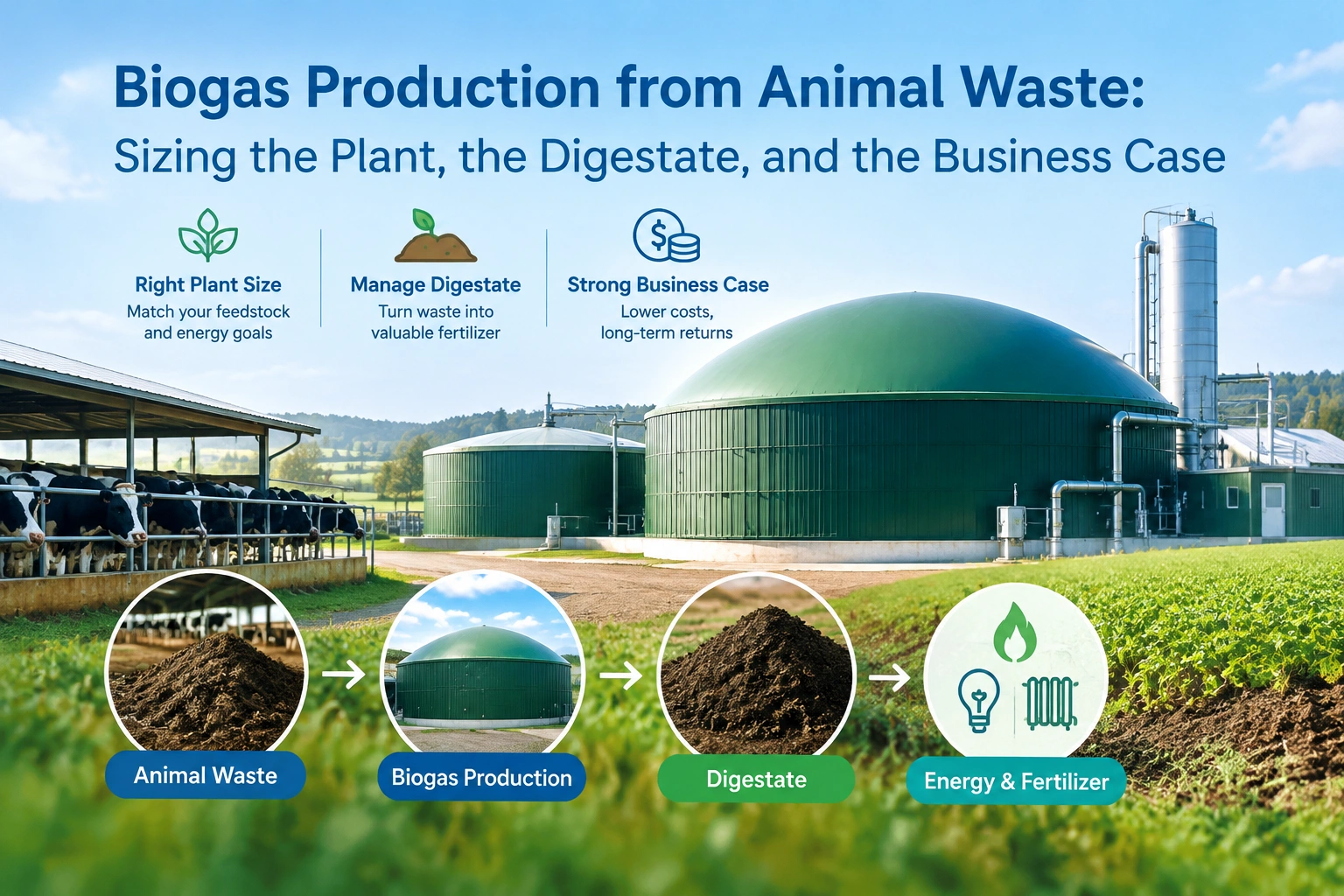
A practical guide to biogas production from animal waste: what your slurry yields, which digester fits, where the cost goes, and what to do with the digestate.
Most farm biogas projects are sold on the gas and killed by the digestate.
The gas is the easy part to model: tons in, cubic meters out, kilowatts on the meter. The digestate is the part that decides whether the project is a business or a disposal problem, and it is usually a single line in the financial model labeled “fertilizer replacement value.”
This guide covers biogas production from animal waste the way an owner has to evaluate it: what the feedstock will actually yield, which digester fits, where the money goes, what happens to the digestate, and which supplier questions expose a weak proposal.
Biogas yield depends on volatile solids, not on wet tons. Two farms with the same tonnage can differ by 40 percent because one washes more water into the slurry.
| Feedstock | Dry Matter | Typical Biogas Yield | Main Constraint |
|---|---|---|---|
| Cattle slurry | 6 to 12 percent | 15 to 25 m³ per ton | Dilute; much of the volume is water to heat |
| Pig slurry | 3 to 8 percent | 15 to 30 m³ per ton | Very dilute; ammonia rises with co-digestion |
| Chicken manure | 40 to 60 percent | 60 to 100 m³ per ton | Ammonia inhibition; needs dilution and careful loading |
| Separated solids | 20 to 30 percent | 40 to 60 m³ per ton | Fibrous; maceration and mixing load |
Those ranges are pre-feasibility numbers, not guarantees. Before anyone commits capital, run a batch fermentation test to VDI 4630 on your own material. It costs a few thousand dollars and replaces a guess that determines the size of every vessel downstream.
Two feedstock issues decide more projects in anaerobic digestion of animal waste than digester design does. Ammonia, which rises with poultry litter and with any nitrogen-rich co-substrate, inhibits the very bacteria you are feeding. And dilution, because water is free at the farm gate and expensive in the digester: every extra cubic meter of water is heated to 38 degrees and stirred for a month.
Anaerobic digestion of animal waste runs through five stages, and each one has an equipment consequence.
Reception and maceration come first. Slurry arrives with stones, sand, and long fibers that wrap around impellers. A macerator and a grit trap are cheap insurance against a pump failure in week three.
Pasteurization is required in many jurisdictions when animal by-products are involved, and it is a real cost item: a tank, a heat exchanger, and the energy to hold material at temperature for the prescribed time. Under EU animal by-product rules, that typically means 70 degrees Celsius for an hour with a defined particle size.
Digestion happens in a heated, mixed, sealed tank. Mesophilic operation at 35 to 38 degrees is the default because it is more stable and cheaper to heat. Thermophilic operation at 52 to 55 degrees kills more pathogens and digests faster, and it is less forgiving of a loading upset.
Gas treatment follows. Raw biogas carries hydrogen sulfide and water vapor, and both destroy engines. Biological or chemical desulfurization plus a chiller and condensate trap are standard; the question is whether they are sized for your sulfur load or for a generic one.
Finally the digestate is separated into a liquid fraction and a solid fraction. That step is the difference between a fertilizer product and a tanker truck schedule.
A continuously stirred tank reactor is the default for slurry-based farms. It handles variable feedstock, tolerates some grit, and is well understood by contractors. Its weakness is that it is a complete-mix vessel: fresh feed leaves with the same residence time as material that has been in for a month.
A plug-flow digester suits high-solids feedstock such as separated manure and works well in warmer climates. It needs less mixing energy and gives a more complete conversion, but it is sensitive to grit and to sand bedding.
A covered lagoon is the lowest-capital option and the least controlled. It works where land is cheap and temperatures stay high, and it fails where either assumption breaks.
In anaerobic digestion of animal waste, the digester type matters less than three design numbers: organic loading rate, hydraulic retention time, and the heat balance in January. A plant that ignores winter heat demand produces gas in July and nothing in February.
For biogas production from animal waste, complete plants are commonly quoted at USD 2,000 to 6,000 per kW of electrical capacity, and that spread is scope rather than margin. Treat any biogas plant cost figure as a screening band, never as a budget.
The biogas plant cost structure is more stable than the headline number. Digester, gas holder, and civil works take 40 to 55 percent. The CHP unit takes 15 to 20. Feedstock handling and maceration take 10 to 15. Gas treatment and desulfurization take 5 to 10. Electrical, controls, and grid connection take 10 to 15. Engineering, commissioning, and contingency absorb the rest.
Three scope items move biogas plant cost more than the digester itself. Grid connection capacity, which can require a substation upgrade the developer did not anticipate. Digestate storage, which in nitrate-vulnerable zones is sized in months, not days. And the heat recovery system, because a plant that cannot use its own waste heat is throwing away a third of its energy.
Digestate is not a waste stream to be disposed of. It is a fertilizer with a declared analysis, and the plant should be designed to sell it.
Separation produces a liquid fraction carrying most of the nitrogen and a solid fraction carrying most of the phosphorus and the fiber. The liquid goes to land application under a nutrient management plan, or to a liquid fertilizer line. The solid fraction composts, then granulates into a bagged organic product.
That is where a fertilizer equipment supplier adds value that a biogas contractor does not: composting, screening, granulation, drying, and bagging. Under Regulation (EU) 2019/1009, digestate other than fresh crop digestate is a defined component material with its own processing requirements, and the finished product must fit an organic fertilizer category. Confirm the category before the plant layout is fixed.
Projects built around biogas production from animal waste that budget for a bagging line usually find the payback in the digestate, not the kilowatt-hours.
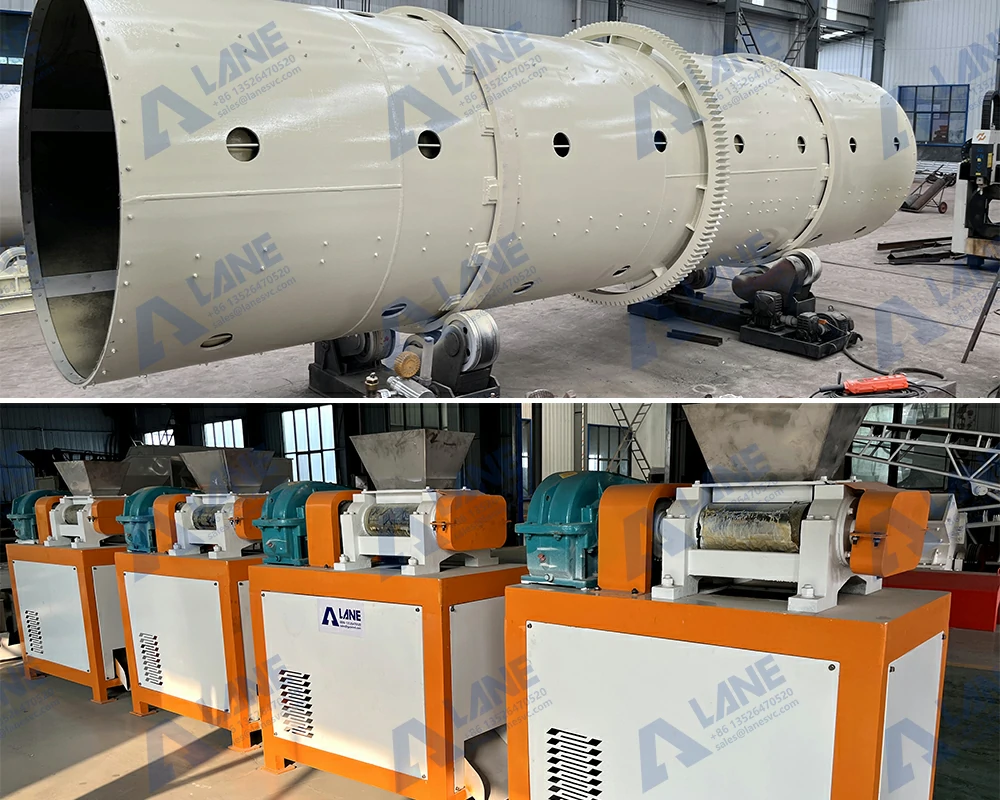
Sizing biogas production from animal waste starts with volatile solids, then the heat balance, then the digestate plan. In that order.
A practical screen: a digester receiving 20 tons per day of cattle slurry at 8 percent dry matter is handling roughly 1.6 tons of dry matter, and at 85 percent volatile solids that is about 1.36 tons of volatile solids per day. At a specific yield of 0.25 cubic meters of biogas per kilogram of volatile solids, that is about 340 cubic meters of biogas per day, or 14 cubic meters per hour.
At 60 percent methane and 38 percent electrical efficiency, that supports roughly 30 to 35 kW of continuous electrical output. That is a small plant. It is also the reality most first-time project developers discover after the sales brochure promised 250 kW.
Run the arithmetic on your own numbers before you request quotations, and ask every supplier to show the same arithmetic in their proposal.
In anaerobic digestion of animal waste, most failures start the same way: ammonia accumulation from over-feeding nitrogen-rich substrate, foaming from a feedstock change nobody recorded, hydrogen sulfide from under-sized desulfurization and a sulfur-rich diet, and a winter heat shortfall from a heat exchanger sized on summer data.
And the quiet one: an availability assumption of 8,000 hours a year on an engine that needs a major overhaul at 40,000 to 60,000 hours and a top-end rebuild well before that.
For biogas production from animal waste, ask for the mass balance and the energy balance, not the equipment list. Ask what happens at 60 percent of design loading, because that is where the plant will run in year one. Ask who owns the digestate offtake, and what the plan is if the compost does not meet the standard.
Ask for references at your feedstock, not your capacity. A supplier with twenty pig slurry plants may never have digested poultry litter.
How much biogas does a ton of cow manure produce?
Roughly 15 to 25 cubic meters per ton of cattle slurry, depending on dry matter and volatile solids. Thick slurry yields more per ton; wash water dilutes it.
How long does anaerobic digestion of animal waste take?
Twenty to forty days of hydraulic retention time for mesophilic slurry digestion, longer at lower temperature. Thermophilic operation shortens it and raises the risk of instability.
Can chicken manure go into a biogas digester?
Yes, in limited share and with dilution. In anaerobic digestion of animal waste, poultry litter is the most common source of ammonia trouble: its nitrogen releases quickly, and free ammonia inhibits the methanogens. Most plants co-digest it at 10 to 30 percent of the feed.
What happens to the digestate?
It is separated into a nitrogen-rich liquid for land application and a phosphorus-rich solid that composts and can be granulated into bagged organic fertilizer.
Do I need a CHP unit or can I upgrade the gas?
Both are viable. A CHP sells electricity and uses waste heat on site. Upgrading to biomethane needs CO2 removal, compression, and a grid or transport connection, and it usually needs a larger plant to justify.
How long does commissioning take?
Three to six months from mechanical completion to stable gas production, because the microbial population has to build. A plant that produces design gas in week two is usually over-fed and heading for a crash.
Which standards apply?
VDI 4630 for substrate testing, Regulation (EU) 2019/1009 for the fertilizer product, and EU animal by-product rules for pasteurization where applicable. Grid connection and emissions fall under local rules.

Everything you need to know when looking at different types of organic fertilizer equipment, all in one place.
Copyright © 2026. LANE All rights reserved.
Send A Message