
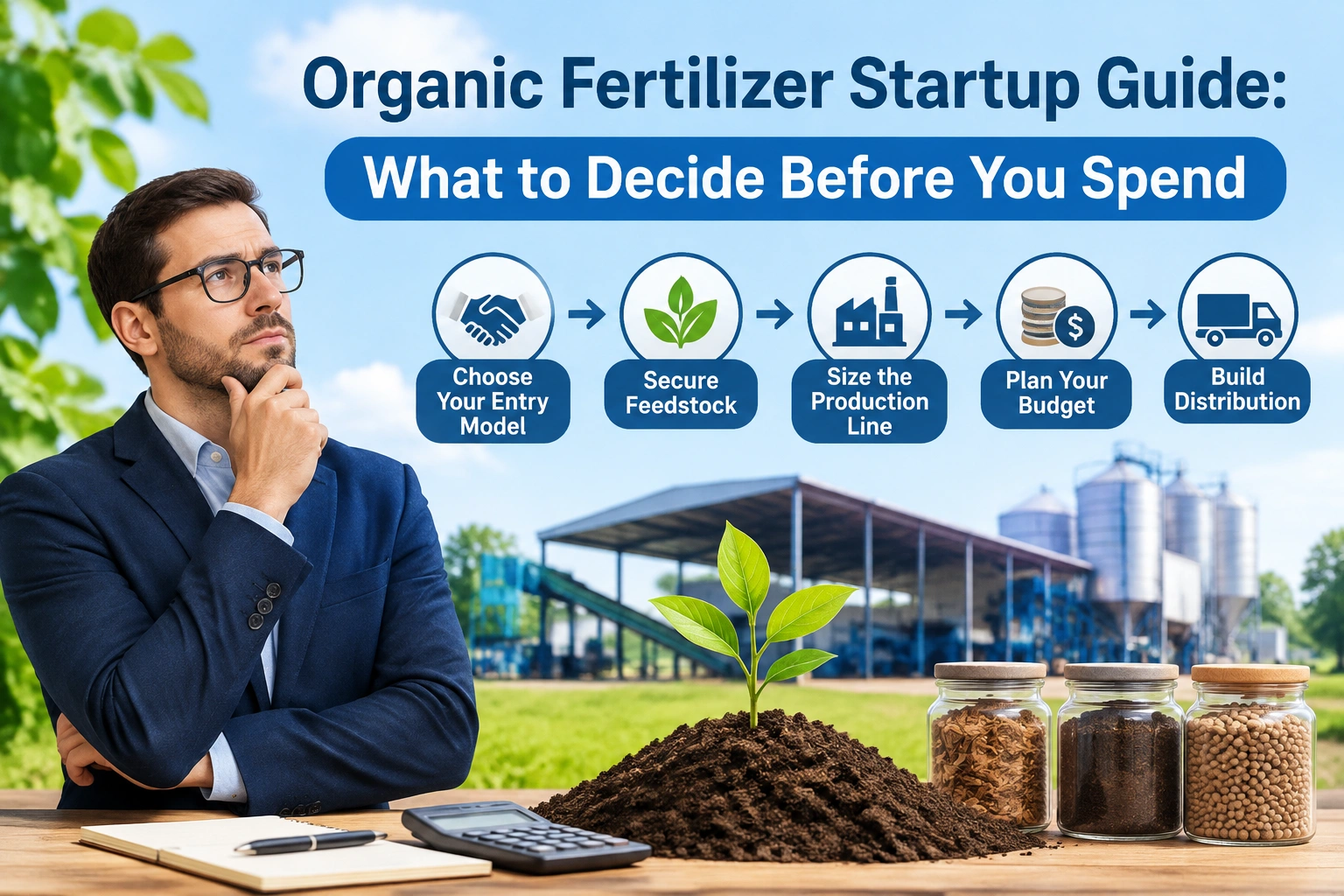
Organic fertilizer startup guide: choosing the entry model, securing feedstock, sizing the production line, budgeting, and building distribution.
Most organic fertilizer startups fail on the second sale, not the first. The first bag goes to a neighbor who wants to help. The second bag has to compete on price and consistency against a product that has been on the shelf for ten years.
A plan that begins with equipment is already behind. The plant is the part you can buy. The market, the feedstock, and the cash cycle are the parts you have to build.
This organic fertilizer startup guide sets out the sequence that keeps a first-time operator out of the expensive mistakes: product, feedstock, process, size, budget, compliance, and distribution, in that order.
Before the first quotation, decide which business you are actually in.
Reseller. You buy finished compost or granules, bag them under your brand, and sell. Capital is low, margins are thin, and you learn the market without building anything. Many successful manufacturers started here.
Blender or composter. You take raw material, compost it, screen it, and sell powder. This is the most common entry point, and the one where a modest budget buys a real plant.
Granulator. You add granulation, drying, cooling, and coating to produce a bagged, spreadable product with a longer shelf life. Capital roughly triples, and so does the addressable market.
Each step is a real business. The mistake is starting at the third one because a supplier’s brochure made it look like the only one.
Organic fertilizer sells into four channels, and they want different things.
Garden centers and retail want small bags, consistent appearance, and a brand story. Landscapers want bulk or one-ton totes and reliable delivery. Row-crop farms want price per nutrient and a spreader-friendly granule. Municipalities and landscaping contractors want documentation and a stable supplier.
Pick one primary channel, and put it in the organic fertilizer business plan before the equipment list. A product designed for all four ends up wrong for each.
Feedstock is the cost advantage and the operational risk at the same time.
Manure from a nearby dairy or poultry operation is often free or nearly free, but it arrives wet, variable, and on the farm’s schedule. Food waste brings higher nitrogen and higher contamination. Digestate from a nearby anaerobic digester is consistent and already partly stabilized.
Whatever the source, get three numbers in writing and put them in the organic fertilizer business plan: daily tonnage available, typical moisture, and who else is competing for it. A plant built on a verbal promise of free manure is a plant that runs at half capacity when the neighbor buys a digester.
Powder. Compost, screen, bag. Lowest capital, fastest to market, and the right product for bulk agricultural sales and many landscaping accounts.
Granule. Adds granulation, drying, cooling, screening, and coating. The product is uniform, spreads evenly, stores better, and earns a higher price per ton. It also adds the two hardest operating skills in the plant: moisture control at the granulator and temperature control in the dryer.
Most new operations should start with small scale organic fertilizer production, selling powder for a year, and granulate in year two. The building can be designed for the second phase from the start. Retrofitting it later costs more than building it now.
The most common sizing error is buying capacity you cannot sell.
A 5 ton per hour line running one shift, 250 days a year, produces 10,000 tons. If your realistic first-year sales are 1,500 tons, you have bought a plant that will sit idle and a depreciation line that will eat your margin.
Any organic fertilizer business plan should work backward: target annual tonnage, divided by operating days, gives daily output. Then add the mass loss from composting, typically 30 to 40 percent, to get the input tonnage you need to secure.
Small scale organic fertilizer production is a legitimate strategy, not a compromise. A one to two ton per hour line serving a 100-kilometer radius can be a better business than a ten ton per hour plant chasing distant distributors.
Equipment is the block everyone prices first and the smallest block in a well-run project. In an organic fertilizer business plan, it should not be the first block funded.
Site and civils. A composting pad that is paved, drained, and sized for the windrow layout; a covered processing area; and storage for raw material and finished goods.
Working capital. Small scale organic fertilizer production lives or dies on it: feedstock inventory, bag and pallet stock, and receivables. This is the block that kills otherwise sound projects, because it is spent before the first significant sale.
Compliance. Registration, label approval, product testing, and any environmental permit.
A useful rule for any organic fertilizer startup guide: if the equipment quote is more than 60 percent of your total available capital, you are underfunded.
Registration requirements vary by country, but the pattern is consistent: the label is a legal commitment on nutrient content, heavy metals, and pathogens.
In the European Union, Regulation (EU) 2019/1009 sets the rules for placing fertilising products on the market, including component material categories and contaminant limits. In the United States, fertilizer registration runs through state departments of agriculture under a common model framework, and organic claims fall under the National Organic Program.
Register the product, approve the label, then order the film. The sequence matters more than the timeline.
In an organic fertilizer startup guide, distribution is the step that gets the least space and decides the most. It is where most first-time operators lose the year.
Organic fertilizer is bulky, seasonal, and sold on trust. A new brand with no trial data struggles against established products, even at a lower price.
Three things shorten the ramp, and every organic fertilizer business plan should name them. Field trials with a local agronomist, documented and photographed. A distributor or cooperative partnership that puts your product beside a brand they already trust. And a consistent bag weight and granule size, because inconsistency is the fastest way to lose a repeat order.
Underfunded working capital, which shows up as an inability to buy feedstock in the season when it is cheapest.
Feedstock contamination, usually plastic in municipal or food waste streams, which ruins the product and the screen.
Moisture instability at the granulator, which turns a granulation line into a shutdown-and-clean routine.
A product with no story and no trial data, competing only on price against a commodity.
Ask for the mass balance, not the equipment list. Ask what the line does at 50 percent of design capacity, because that is year one. Ask for references at your feedstock and your scale, then call them.
And ask whether the supplier will run a granulation or composting trial on your material before the contract. A supplier who will not test your feedstock is selling a machine, not a process.
It can be, but the organic fertilizer business plan should show margin coming from distribution and product consistency rather than from the process. Bulk compost sells at commodity prices; a bagged, granulated, branded product earns more per ton and costs more to make.
No. Many successful operations run small scale organic fertilizer production for years, selling screened powder. Granulation is a second-phase investment once distribution is proven.
Four to eight months from decision to first production for a small line, including site works and commissioning. Registration can run in parallel, but it can also delay the launch if it is left to the end.
Product registration is mandatory in most markets. Organic certification, such as USDA NOP or EU organic rules, is separate and only applies if you intend to make an organic claim.
Working capital and distribution, in that order. Most failures are commercial, not technical.
Yes, and it is the lowest-risk feedstock because you control supply and quality. Just confirm the volume supports the capacity you intend to build.

Everything you need to know when looking at different types of organic fertilizer equipment, all in one place.
Copyright © 2026. LANE All rights reserved.
Send A Message