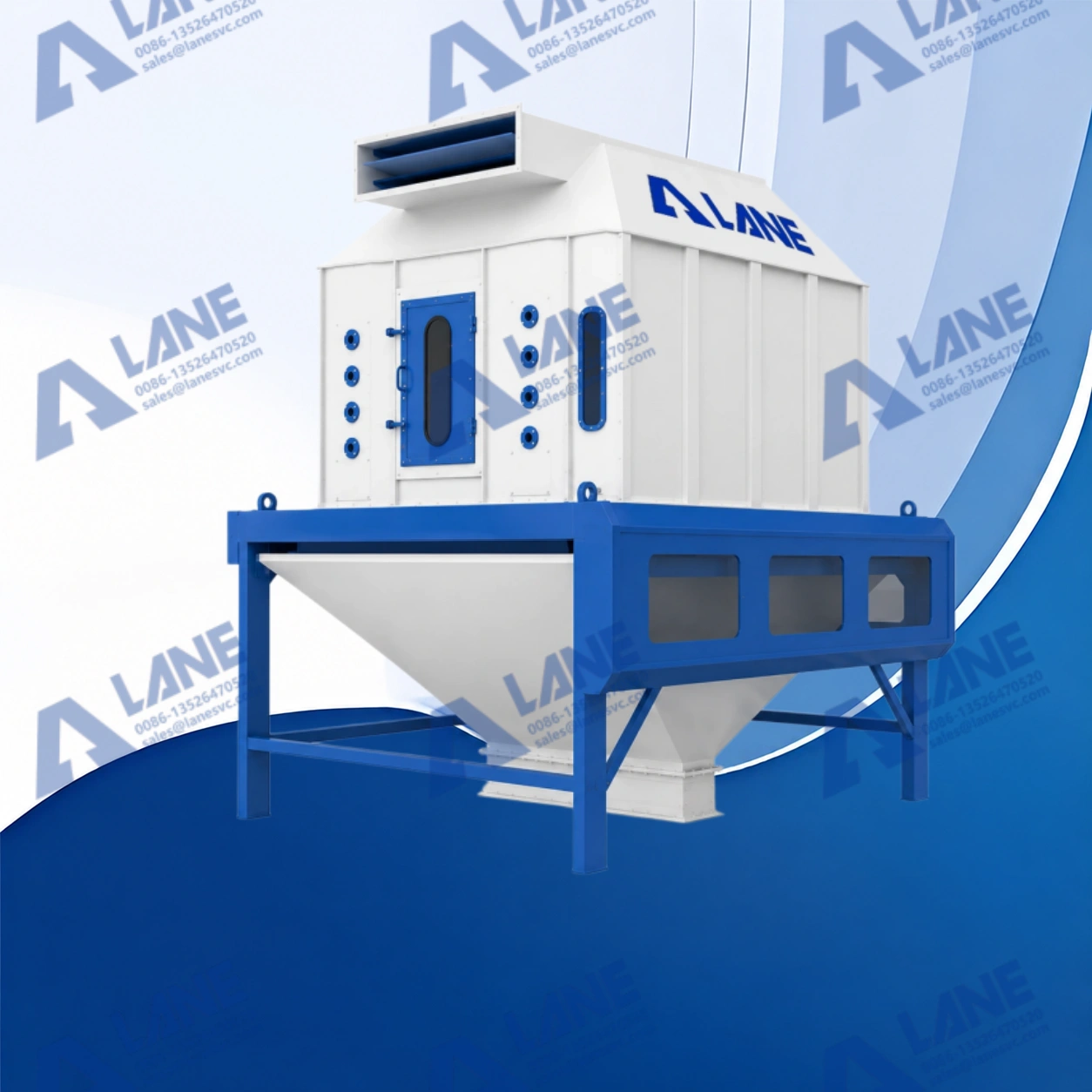
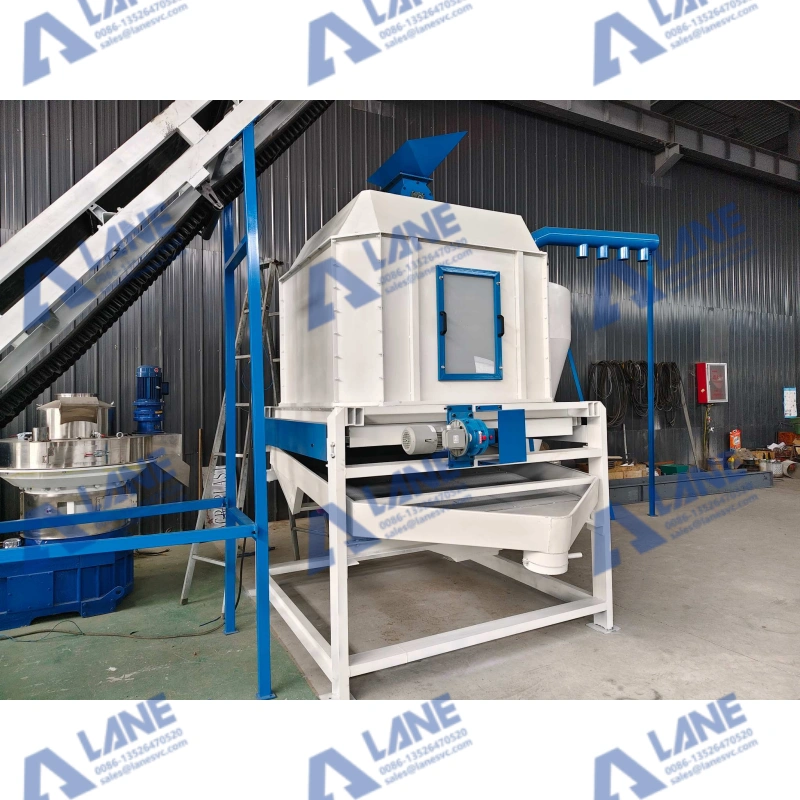
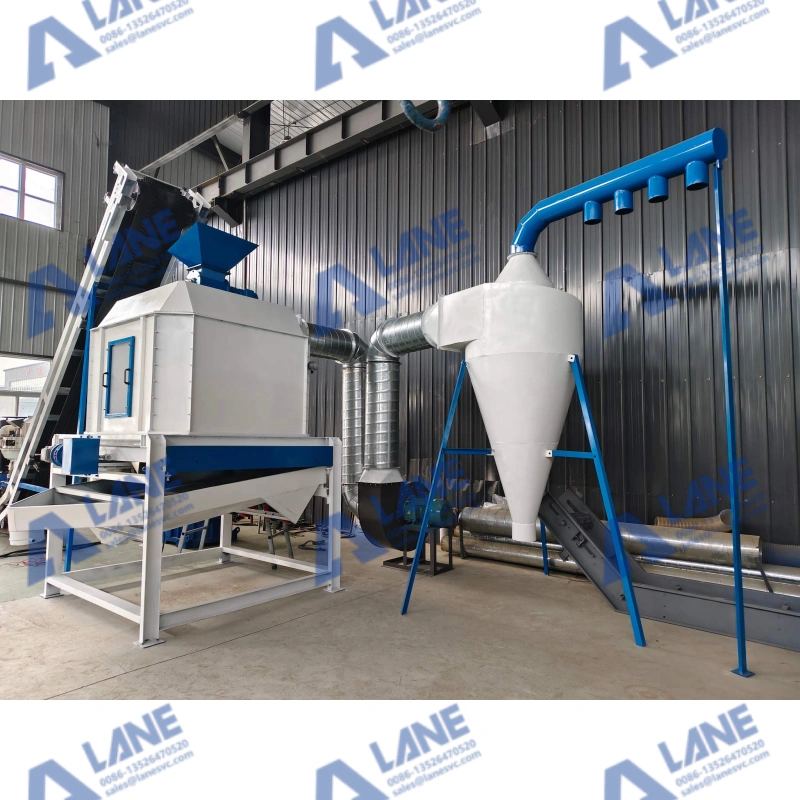
LANE Machinery’s counter-current cooler uses advanced counter-flow air cooling for fertilizer granules. Superior to conventional co-current designs for NPK, DAP, MAP, and organic fertilizer. Capacity 1–50 TPH, custom engineered.
The counter-current cooler represents the most thermally efficient configuration of rotary cooling technology for fertilizer production. While “rotary drum cooler” and “counter-current cooler” are often used interchangeably in the fertilizer industry, the counter-current designation specifically refers to the superior airflow configuration in which cooling air travels in the opposite direction to the material flow — maximizing the temperature gradient and heat transfer efficiency at every point along the drum.
LANE Machinery (Henan LANE Heavy Industry Machinery Technology Co., Ltd.) engineers its counter-current coolers with proprietary lifting flight geometries, optimized length-to-diameter ratios, and precision air handling systems to deliver granule exit temperatures consistently within 5–8°C of ambient — ensuring your fertilizer resists caking, preserves nutrients, and maintains free-flowing quality through storage, shipping, and end-use application.
Key Capability: Cools fertilizer granules from 60–120°C down to ≤40°C (or ambient +5–8°C). Counter-current design achieves 15–25% better cooling efficiency than co-current configurations of the same drum dimensions.
In a counter-current cooler, the coldest air contacts the coldest granules (at the discharge end) while warmed air contacts the hottest granules (at the inlet end). This maintains a consistent, favorable temperature gradient (ΔT) across the entire drum length — unlike co-current designs where ΔT collapses toward the discharge end. The result: 15–25% more cooling per unit of airflow compared to equivalent co-current configurations.
LANE Machinery employs a progressive flight profile along the drum:
This zoned approach optimizes cooling rate while preserving granule integrity — reducing fines generation by up to 30% compared to uniform flight designs.
The warmed exhaust air from the counter-current cooler (typically 50–70°C) contains recoverable heat. LANE Machinery offers an optional heat recovery ducting system that routes this air to:
Beyond cooling, the counter-current design provides secondary quality benefits:
For fertilizer types containing chlorides (potassium chloride, ammonium chloride) or sulfates that accelerate carbon steel corrosion at elevated temperatures:
The LANE Machinery counter-current cooler operates on opposing-flow convective heat transfer:
[Cooling Air Flow: ← ← ← ← ← ← ← ← ← ← ←] (upstream, toward hot end)
         │                                    │
[Hot Granules IN] → → → → → → → → → → → [Cooled Granules OUT]
  (Feed End, higher)         (Material Flow →)        (Discharge End, lower)

Material moves DOWNHILL by gravity + rotation.
Cooling air moves UPHILL, drawn by ID fan at feed end.
→ Maximum temperature difference maintained at every point.
Counter-Current vs. Co-Current Cooling: Performance Comparison| Parameter | Counter-Current Cooler | Co-Current Cooler |
|---|---|---|
| Temperature gradient (ΔT) along drum | Consistent; favorable ΔT at all points | High ΔT at inlet, collapsing toward outlet |
| Cooling efficiency (same drum size) | 85–95% | 70–85% |
| Air volume required | Lower (15–25% less) | Higher |
| Fan power consumption | Lower | Higher |
| Exit granule temperature | Ambient +5–8°C | Ambient +10–15°C |
| Granule breakage risk | Lower (gentle cooling) | Higher (thermal shock at inlet) |
| Complexity | Standard (widely adopted) | Simpler (shorter drum, but less efficient) |
| Best application | All fertilizer types; recommended standard | Low-budget, small-scale (<2 TPH) lines |
LANE Machinery standard: All our rotary drum coolers use counter-current airflow as the default configuration — because the superior thermal efficiency, lower operating cost, and better product quality justify the marginal increase in drum length.
| Production Line | Inlet Temp (°C) | Target Outlet Temp (°C) | Special Considerations |
|---|---|---|---|
| NPK Compound (Steam Granulation) | 70–90 | ≤40 | High throughput; consistent cooling critical for anti-caking |
| NPK Compound (Chemical Granulation) | 80–110 | ≤40 | Higher inlet temps; may need stainless steel inlet zone |
| DAP / MAP | 80–100 | ≤40 | Phosphate fertilizers; corrosion-resistant flights recommended |
| SSP / TSP | 70–90 | ≤40 | Long curing cycle upstream; cooling is final step before storage |
| Organic Fertilizer (Manure-Based) | 60–80 | ≤35 | Lower temperature targets to preserve organic matter; biomass odor management at exhaust |
| Potassium Sulfate (SOP) | 80–120 | ≤40 | Very high inlet temps possible; refractory-lined inlet section |
| Ammonium Sulfate | 60–85 | ≤35 | Highly hygroscopic — rapid, deep cooling essential |
| Ammonium Chloride | 60–90 | ≤35 | Corrosive to carbon steel; SS316L or duplex construction recommended |
LANE Machinery Counter-Current Cooler — Model Range
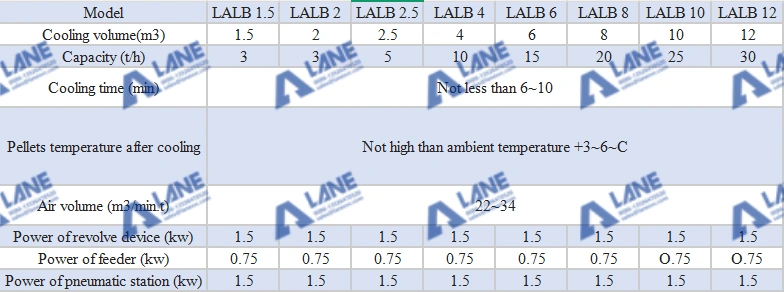
Custom sizing:Contact LANE Machinery engineering.
Factors Affecting Cooling Performance
| Factor | Impact | Optimization |
|---|---|---|
| Ambient air temperature | High ambient temps reduce cooling capacity | Consider chilled air injection for sites with summer temps >35°C |
| Granule size distribution | Wide size distribution → uneven cooling (fines cool faster, oversize slower) | Maintain consistent granulation upstream; optimize screen recycle ratio |
| Drum fill level | Overfilling reduces curtain density → poor air contact | Maintain 8–12% volumetric fill for optimal cascading |
| Air velocity | Too low → insufficient heat removal; too high → dust entrainment | Typical face velocity 1.5–3.0 m/s; adjust via VFD fan |
| Rotation speed | Too slow → poor curtain formation; too fast → granule breakage | Start at 50% of max; adjust based on outlet temp monitoring |
| Lifting flight condition | Worn flights → reduced material lift → poor curtain → reduced cooling | Inspect quarterly; replace individual worn flights as needed |
In the modern fertilizer industry, the terms are nearly synonymous — almost all rotary drum coolers use counter-current airflow because it is thermodynamically superior. The term “counter-current cooler” emphasizes this specific airflow configuration. When comparing specifications, verify the airflow direction: counter-current (air flows opposite to material) provides 15–25% higher cooling efficiency than co-current designs of the same drum size.
For hot-climate installations, LANE Machinery offers two solutions:
Our engineers will analyze your site’s peak summer temperature data and recommend the most cost-effective solution.
Yes — this is a common requirement for multi-product fertilizer plants. LANE Machinery’s counter-current coolers feature adjustable drum speed (VFD), variable air volume control, and interchangeable flight configurations. Changeover between products typically takes 2–4 hours (primarily cleaning flights of residual material).
Granule breakage during cooling has two primary causes:
Additionally, maintaining the cooler at 8–12% fill and avoiding excessive rotation speeds significantly reduces attrition.
Standard configuration includes a cyclone dust collector at the exhaust outlet, which recovers 90–95% of entrained dust for recycling back to the granulator. For applications with high dust loads or strict emission limits, a baghouse filter (99%+ collection efficiency, <20 mg/Nm³ emission) or wet scrubber (also handles odors from organic fertilizers) can be added.
| Attribute | LANE Machinery Commitment |
|---|---|
| Thermodynamic Design | Every cooler sized using computational heat and mass balance models — not rule-of-thumb |
| Matched System | Cooler paired with dryer for seamless capacity, temperature, and control integration |
| Progressive Flight Technology | Zoned lifting flight design that maximizes cooling rate while minimizing breakage |
| Material Expertise | Correct material selection for your specific fertilizer chemistry — we won’t sell you carbon steel for chloride service |
| Quality Manufacturing | ISO 9001 certified; all drums stress-relieved; complete FAT before shipment |
| Global Service | Installation supervision, commissioning, training, and lifetime technical support available worldwide |
For the fastest, most accurate proposal, please provide:
LANE Machinery — Engineered Cooling Solutions for Premium Fertilizer Quality.
Everything you need to know when looking at different types of organic fertilizer equipment, all in one place.
Copyright © 2026. LANE All rights reserved.