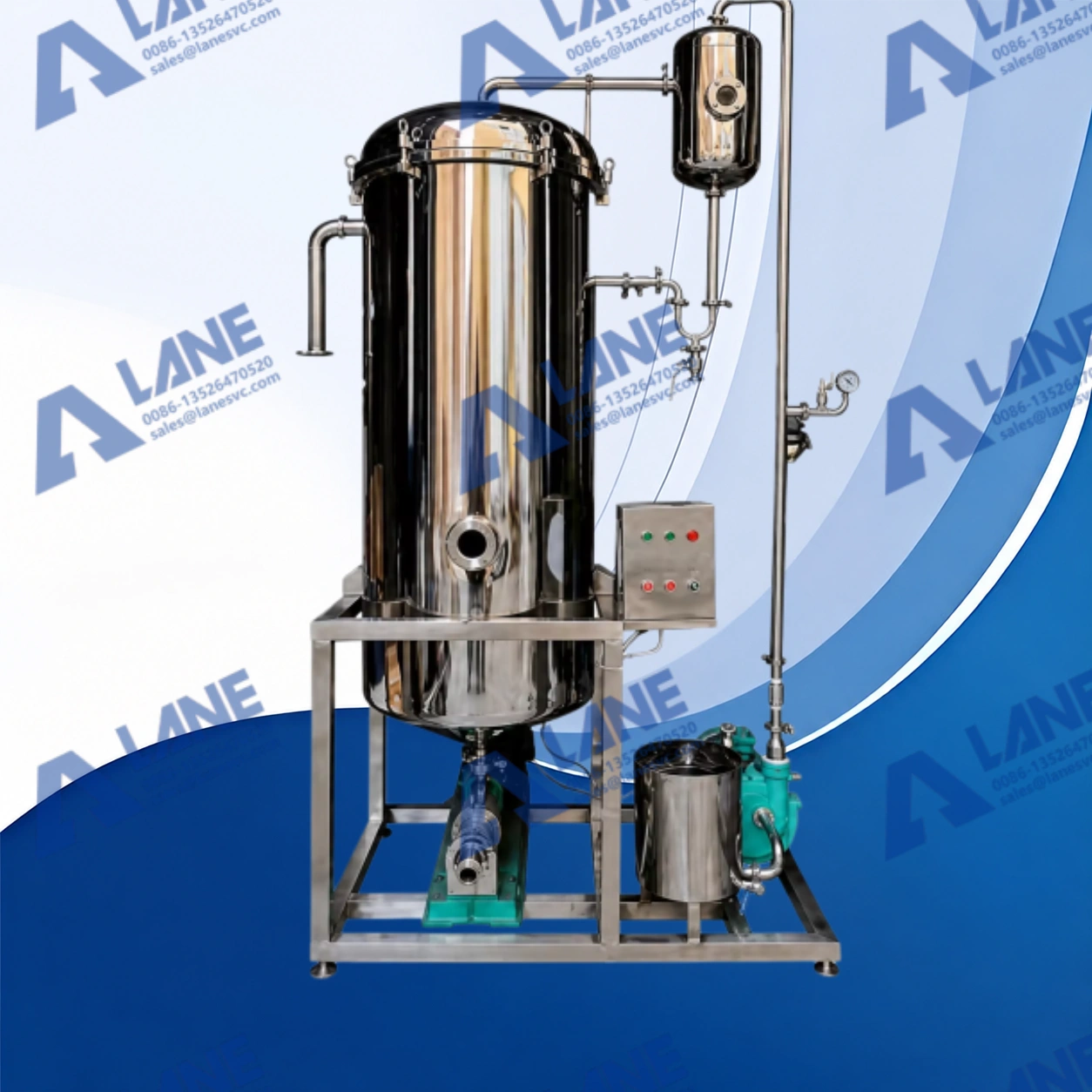
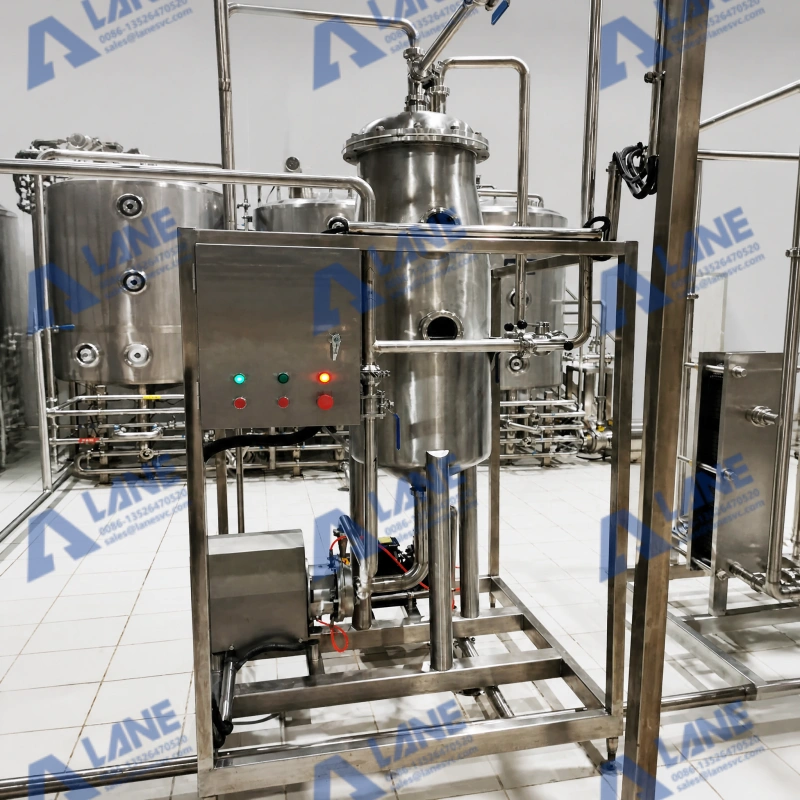
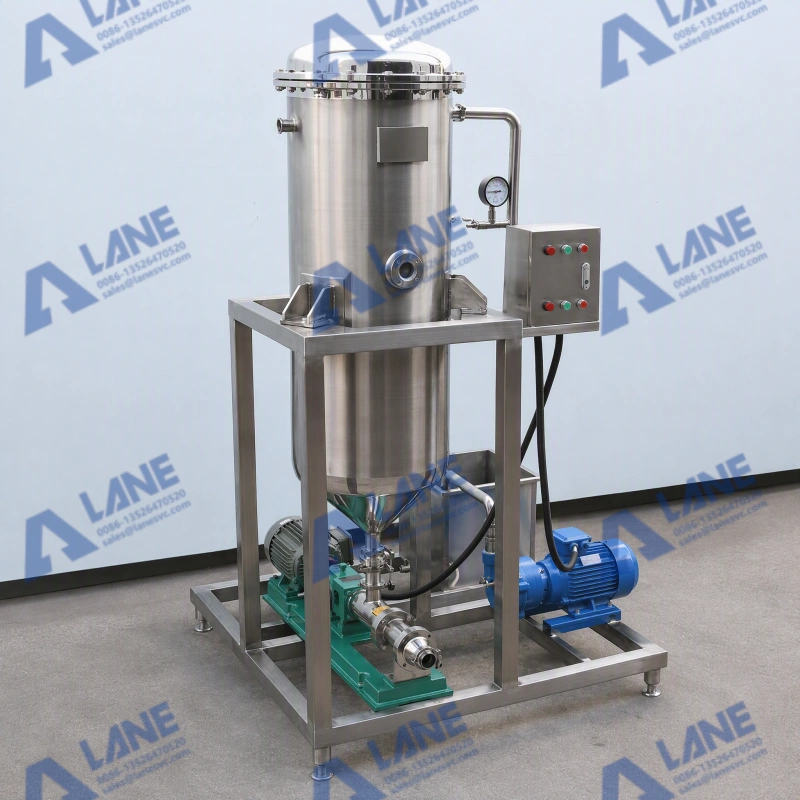
Continuous vacuum degassing machines remove dissolved and entrained gas from liquid fertilizer before filling, reducing foam, oxidation and pump problems.
A vacuum degassing machine removes dissolved and entrained gas from liquid fertilizer before the product goes to storage or filling. Air trapped in a batch can cause foam in the tank, false volume readings, oxidation of sensitive ingredients, pump cavitation, and inconsistent fill weights. Degassing before packaging gives the product a cleaner, more stable state for storage, transport, and use.
LANE Machinery supplies continuous vacuum degassing machines for liquid fertilizer production, with thin-film spreading inside a vacuum chamber, positive displacement feed, controlled discharge, PLC operation, and stainless steel construction. The machine can be integrated between homogenization and storage, or between storage and filling.
The LANE vacuum degassing machine is a continuous deaerator built for fertilizer liquids with varying viscosity, solids content, and foaming behavior. It pulls a vacuum over a thin layer of product so dissolved gases escape quickly, then transfers the degassed liquid to the next stage without exposing it to air.
The machine is supplied as a closed stainless steel system with:
The system is designed for water-soluble fertilizers, liquid NPK, organic liquid fertilizers, suspension products, and micronutrient solutions. Capacity and material selection are matched to the product and production rate.
The vacuum degassing machine operates continuously:
The thin-film step is important because gas removal depends on surface area and contact time. A thin layer lets gas escape quickly while the product remains in motion, which makes continuous degassing practical for fertilizer lines that run for hours.
The system is closed from inlet to outlet. This limits oxygen pickup during processing and keeps the degassed product from being re-aerated before filling.
The vacuum degassing machine is placed at the transition between product preparation and packaging:
Mixing tank or reactor -> Homogenizer -> Vacuum degassing machine -> Storage tank -> Filling machine -> Capping -> Labeling
In this configuration:
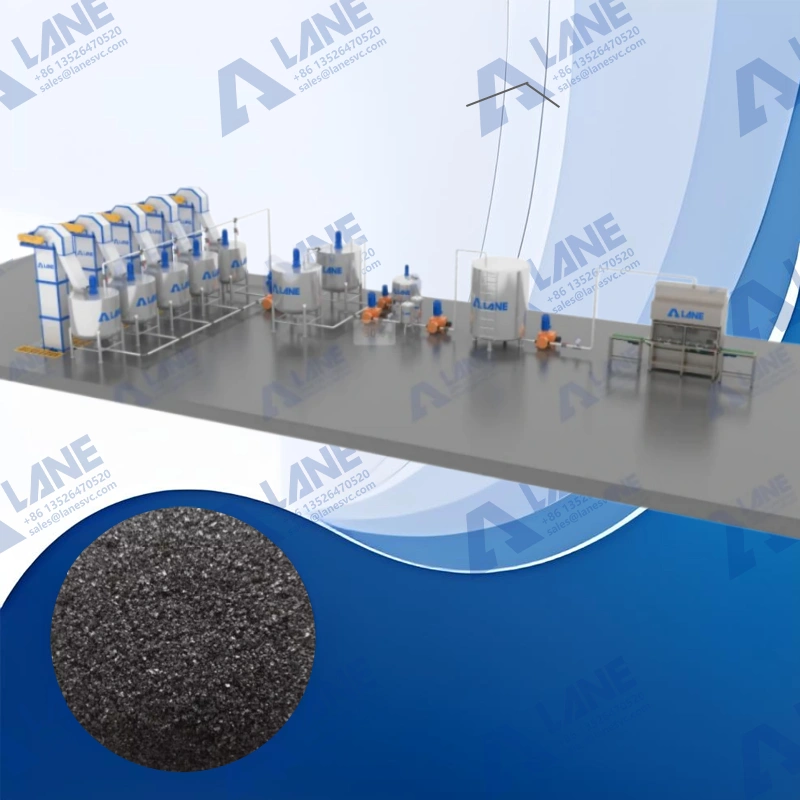
LANE supplies the degassing machine as a single unit or as part of a complete liquid fertilizer production line with mixing, reaction, fermentation, homogenization, filtration, storage, filling, and packaging systems.
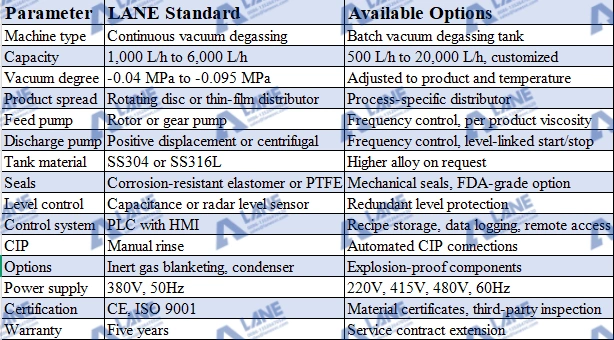
LANE manufactures vacuum degassing machines under an ISO 9001 quality management system and can supply CE-certified equipment. Pressure and vacuum components follow standard engineering practice, and materials are documented with certificates for traceability.
For liquid fertilizer products exported to the European Union, the final product must meet Regulation (EU) 2019/1009 requirements. LANE recommends independent certification of the final fertilizer product and confirms that process equipment is suitable for the intended product chemistry.
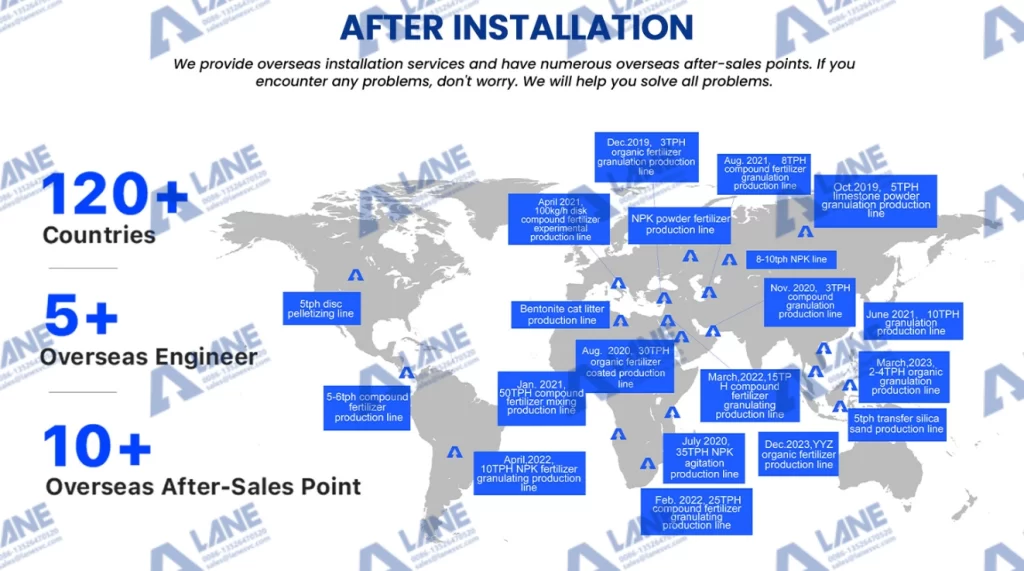
Henan Lane Heavy Industry Machinery Technology Co., Ltd. is a fertilizer equipment manufacturer with more than 20 years of engineering experience. LANE has delivered equipment and production lines to clients in more than 50 countries and supplied machines for a 100,000 tons per year national fertilizer project in Africa.
LANE provides one-stop service from process layout and machine selection to overseas installation, commissioning, operator training, remote video guidance, and after-sales support. Our engineers review your product viscosity, solids content, foaming behavior, capacity, and downstream filling equipment, then recommend the correct degassing configuration.
Why does liquid fertilizer need vacuum degassing?
Liquid fertilizer can contain dissolved and entrained air from mixing, pumping, and handling. That air causes foam, oxidation, false volume readings, pump cavitation, and unstable filling. Vacuum degassing removes the gas so the product is more stable and consistent.
What is the difference between degassing and deaeration?
The terms describe the same process. Degassing refers to removing dissolved gas, while deaeration specifically refers to removing air or oxygen. Both are performed by exposing a thin layer of product to vacuum.
Can the machine handle suspensions with solids?
Yes, within the limits of the pump and distributor design. LANE confirms the solids content, particle size, and viscosity with the customer before recommending the machine. The feed and discharge pumps are selected for the actual product.
Where should the machine be installed in the production line?
The usual position is between homogenization and storage, or between storage and filling. This removes gas after the last mixing step and before the product is measured, packaged, or held for long periods.
How much gas can be removed?
The result depends on product viscosity, temperature, vacuum level, and residence time. The system is designed for continuous removal of entrained and dissolved gas, and LANE confirms the expected degassing performance with your product sample before delivery.
Does degassing change the fertilizer formula?
No. The machine removes gas, not water or fertilizer components under normal operating conditions. Condenser and control settings are configured so moisture loss stays within your specification.
How is the machine cleaned between products?
The contact parts are accessible for manual rinsing, and CIP connections are available for automated cleaning. Quick inspection ports make it easier to verify that the chamber, disc, and pump internals are clean.
What support does LANE provide?
LANE provides a five-year warranty under the equipment contract, spare parts support, operator training, and overseas installation and commissioning services. Remote video guidance is available during commissioning and after-sales troubleshooting.
Tell LANE your product type, viscosity, solids content, capacity, and how the product is stored or filled today. Our engineering team will recommend the degassing configuration and integration plan, then provide a technical data sheet and quotation.

Everything you need to know when looking at different types of organic fertilizer equipment, all in one place.
Copyright © 2026. LANE All rights reserved.