
Compare industrial organic fertilizer plant options by capacity, process, and budget. Learn what drives cost, equipment, and supplier selection.
An industrial organic fertilizer plant is not a larger version of a farm composting operation. It is a manufacturing facility with controlled fermentation, continuous material flow, automated batching, granulation, drying, and packaging, plus the environmental systems needed to run at commercial scale. The equipment list, the site layout, and the operating budget all change when the target moves from a few tons per day to tens of tons per hour.
This guide is written for fertilizer manufacturers, plant investors, engineers, procurement managers, and project contractors. It follows the decision from market and feedstock to process, equipment, cost, execution, and supplier selection.
Organic fertilizer is no longer a small regional product. Research and Markets estimated the organic fertilizer market at about USD 11.98 billion in 2026, with a projected value of about USD 16.49 billion by 2032 and a compound annual growth rate near 8.3 percent. The same report points to organic food demand, regenerative agriculture, and certified organic acreage as the main drivers.
Industrial projects confirm the direction. Paraguay announced plans for a 260,000 tons per year industrial organic fertilizer plant focused on low-carbon nitrogen fertilizers. Den Ouden GrowSolutions broke ground on a 70,000 tons per year organic fertilizer factory in Tay Ninh, Vietnam, with a total investment reported above 827 billion VND. Hello Nature began production at a 150,000 tons per year organic fertilizer plant based on chicken manure.
For a buyer, those projects matter because they change the competitive baseline. A modern industrial organic fertilizer plant has to match the cost per ton, product consistency, and compliance level of the new generation of facilities.
An industrial organic fertilizer plant should be scoped as a system, not as a collection of machines. The main work packages are:
When the scope is vague, the industrial organic fertilizer plant becomes a list of machines. When it is written clearly, buyers can compare proposals against the same capacity and delivery basis.
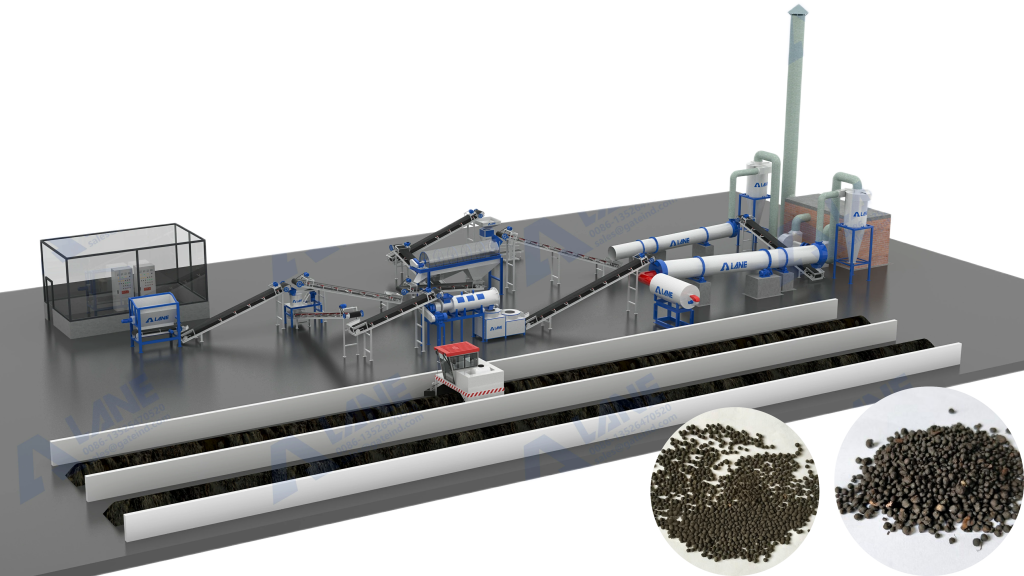
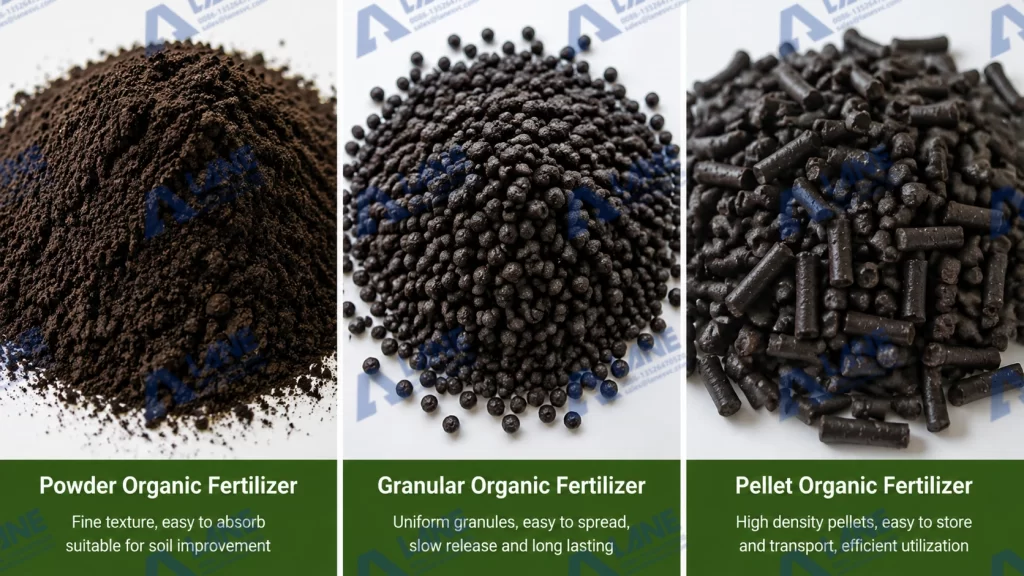
An industrial organic fertilizer production line can be configured for powder, granule, or pellet output, and the product form changes the equipment and the operating cost.
Powder line
A powder line ends after fermentation, curing, crushing, screening, and packaging. It is the lowest-cost route and suits local bulk markets, but powder is dusty, compacts in storage, and is harder to blend.
Granule line
A granule line adds granulation, drying, cooling, and final screening. Granules handle, store, blend, and spread predictably, and they open retail, bulk blending, and export markets.
Pellet line
An extrusion route compresses drier material into cylindrical pellets. It can reduce drying requirements and produce dense, uniform pellets, but the feed must be conditioned to a consistent moisture window.
The right industrial organic fertilizer production line should be selected from the sales channel, not from the machine price. A regional bulk market may accept powder. A retail, export, or organo-mineral program usually needs granules.
A large scale organic fertilizer plant depends on a different set of engineering decisions than a small line.
Feedstock supply is the first decision. At 10 tons per hour or more, the plant needs a contracted, predictable supply of manure, crop residue, food waste, or industrial organic by-products. Seasonal variation has to be absorbed by storage or by flexible formulations.
Site area is the second decision. Fermentation and curing require space that is easy to underestimate. Windrow systems need the most land, trough systems less, and in-vessel systems the least. The site also needs room for raw material storage, process buildings, product warehouse, and environmental buffers.
Utilities are the third decision. Drying consumes significant fuel and electricity, and the plant needs reliable power, water, and transport access. A large scale organic fertilizer plant that is built far from power or raw material sources will carry an operating cost disadvantage for its entire life.
The same site logic applies to odor. Industrial capacity concentrates ammonia and organic odor in one place, so biofilters, scrubbers, and buffer distance are design requirements, not optional extras.
The process in an industrial organic fertilizer plant follows a sequence of biological and mechanical stages.
Step 1: Receive, dewater, and blend the raw material
High-moisture manure or digestate should pass through a solid-liquid separator before composting. Bulking agents such as straw, rice husks, sawdust, or finished compost adjust moisture and the carbon-to-nitrogen ratio. The target before fermentation is usually 50 to 65 percent moisture.
Step 2: Ferment or compost until the material is stable
Aerobic fermentation determines whether the finished fertilizer is safe to sell. With regular turning and enough oxygen, pile temperature should stay in the 50 to 70 C range long enough to reduce pathogens and weed seeds. Most commercial systems plan for 15 to 25 days of active fermentation, followed by curing.
Step 3: Crush and screen the compost
Fermented compost comes out uneven, with clumps and oversize particles that would plug a granulator. A crusher and rotary screen create a uniform powder feed.
Step 4: Mix and formulate
After crushing, the compost is blended with water, binders, microbial inoculants, or mineral additives to reach the moisture and nutrient target for granulation. The mixer has to create a uniform feed so every granule carries the same formulation.
Rotary drum granulation handles high volume and moist feed. Disc granulation gives tighter size control at lower capacity. Extrusion compresses drier material into pellets. The choice depends on the moisture profile and the product specification.
Granules coming off a wet granulator carry roughly 20 to 30 percent moisture. A rotary drum dryer brings the product to a stable storage level, and a cooler drops the temperature before packaging.
Step 7: Screen, coat, and package
The final screen returns oversize material to the crusher and fines to the granulator. A coating machine reduces dust and improves appearance, and the automatic packaging machine records bag weight.
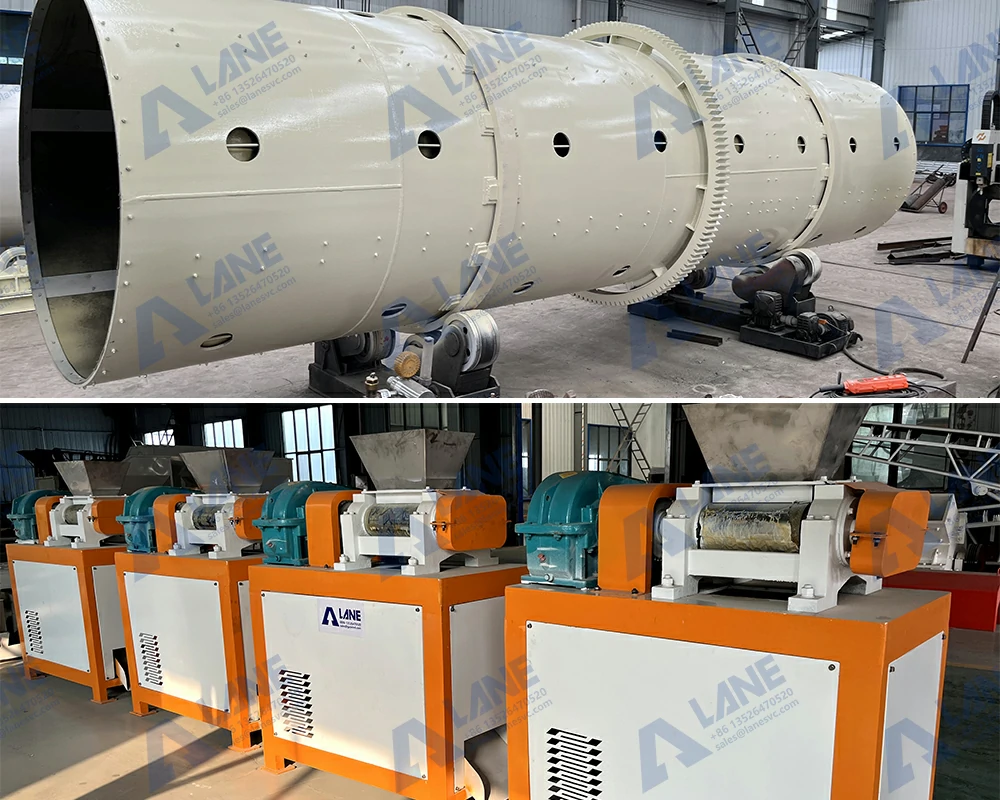
The equipment list in an industrial organic fertilizer plant is built around the process:
| Stage | Core equipment | Main job |
|---|---|---|
| Raw material | Solid-liquid separator, conveyor, shredder | Reduce moisture and remove debris |
| Fermentation | Compost turner, aeration, odor control | Stabilize the biology and reduce pathogens |
| Curing | Curing area or silo | Finish the biological process |
| Preparation | Crusher, rotary screen, mixer | Create a uniform powder feed |
| Granulation | Drum, disc, pin, or pellet machine | Shape the product |
| Drying and cooling | Rotary dryer, rotary cooler | Stabilize moisture and temperature |
| Finishing | Final screen, coater, packaging machine | Sort, condition, and package |
| Environmental | Dust collector, biofilter, leachate system | Control emissions and odor |
A complete industrial organic fertilizer production line also needs conveyors, bucket elevators, control cabinets, and instrumentation. At high capacity, the balance between the dryer, the granulator, and the screen determines whether the plant runs at rated output or spends its days chasing bottlenecks.
The easiest way to understand an industrial organic fertilizer plant is to treat it as a moisture, particle-size, and nutrient pipeline.
The front end removes water and adjusts carbon and nitrogen. The middle section stabilizes the biology and builds a uniform powder. The back end shapes, dries, and sorts the product.
Three variables control most of the operating result:
When these are designed together, the line runs predictably. When equipment is bought piece by piece, they become daily emergencies.
The technical advantages of an industrial line include:
Products from an industrial organic fertilizer plant serve several markets:
The application scope affects granule size, packaging, and certification. A plant selling into certified organic markets should confirm the requirements before finalizing the process design.
Published industry guidance indicates that a small 5,000 tons per year powder organic fertilizer line typically costs around USD 21,000 to 48,000, while granule production lines require a higher investment due to the addition of granulation, drying, cooling, and screening processes. For complete organic fertilizer plants with capacities of 1 to 5 tons per hour, equipment costs are generally estimated at USD 100,000 to 150,000, while medium and large-scale granular fertilizer production lines may range from USD 350,000 to 550,000 or higher.
The cost of an industrial organic fertilizer plant depends on capacity, process scope, automation, feedstock, and site conditions.
Published industry guidance indicates that a small 5,000 tons per year powder organic fertilizer line typically costs around USD 21,000 to 48,000, while granule production lines require a higher investment due to the addition of granulation, drying, cooling, and screening processes. For complete organic fertilizer plants with capacities of 1 to 5 tons per hour, equipment costs are generally estimated at USD 100,000 to 150,000, while medium and large-scale granular fertilizer production lines may range from USD 350,000 to 550,000 or higher.
Those numbers are planning ranges, not quotes. An industrial organic fertilizer plant at 10 tons per hour or more, with automatic batching, drying, coating, and packaging, can exceed USD 1 million before site work and working capital.
The full capital budget includes:
Equipment is often 40 to 60 percent of total project cost. Civil works, installation, and environmental controls make up the rest. A buyer who compares equipment-only prices against a competitor’s total project price is comparing different products.
Operating cost is dominated by feedstock logistics, electricity and fuel, labor, packaging, and testing. Utilization matters as much as unit cost. A plant running at 60 percent utilization will not recover capital on schedule.
Project execution is where an industrial organic fertilizer plant succeeds or fails. The schedule depends on equipment lead times, civil works, fermentation area construction, and local approvals.
The main schedule risks are:
The commissioning plan should include a raw material test, line balancing, and a trial production run. Performance tests should be written into the contract before equipment is ordered, with agreed reference conditions for feedstock moisture, ambient temperature, and product quality.
Maintenance on an industrial organic fertilizer plant is continuous rather than difficult. The highest-wear points are the screen, crusher hammers, granulator lining, dryer flights, and conveyor belts.
Keep a daily checklist for material build-up, belt tracking, bearing temperature, and screen condition. Fermentation records should include moisture, temperature, turning frequency, and odor. Batching accuracy should be checked on a schedule because a dosing error changes the final formulation.
Compliance belongs in the same routine. For EU export, the processed manure rules under Regulation (EU) 2019/1009 and Regulation (EC) No 1069/2009 define safe feedstock and processing conditions. USDA NRCS publishes composting guidance, and China’s NY/T 525-2021 defines testing and quality requirements for organic fertilizer.
Dust filters, wet scrubbers, and biofilters need a monthly inspection schedule because they lose efficiency slowly.
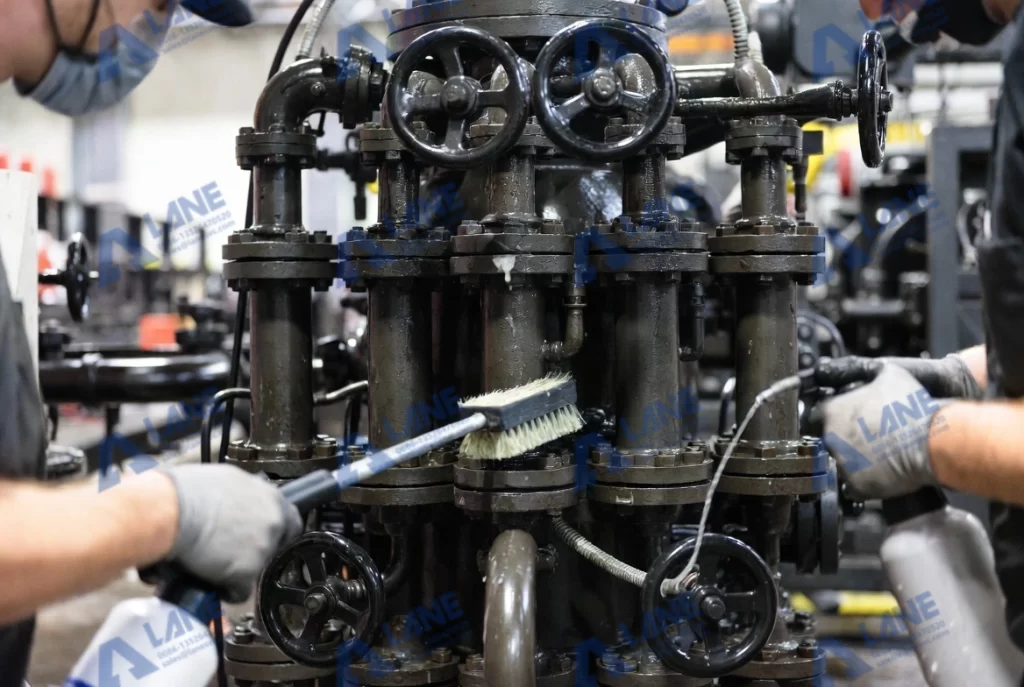
Supplier selection should start with process fit, not machine price. Ask each candidate for:
Ask whether the supplier has built an industrial organic fertilizer plant or only small farm-scale lines. The difference is not the granulator. It is the fermentation logistics, drying balance, environmental controls, and commissioning team.
A qualified supplier will ask about feedstock volume, moisture, bulking agent, climate, and odor buffer before quoting. If the supplier only asks about capacity, the project will struggle during commissioning.
The industry has enough public examples to guide a buyer.
Paraguay announced plans for a 260,000 tons per year industrial organic fertilizer plant focused on low-carbon nitrogen fertilizers. In Vietnam, a 70,000 tons per year organic fertilizer factory was launched with a reported investment above 827 billion VND. A 150,000 tons per year organic fertilizer plant based on chicken manure has also started production.
Those projects show the commercial scale now expected in the category. They also show that feedstock proximity, site area, and environmental compliance are part of the investment decision, not afterthoughts.
LANE Machinery supplies organic fertilizer production lines and has delivered equipment for a 100,000 tons per year national fertilizer project in Africa. For an industrial organic fertilizer plant, LANE can provide the dewatering, fermentation, granulation, drying, screening, and packaging scope under one process design.
What is an industrial organic fertilizer plant?
An industrial organic fertilizer plant is a large-scale manufacturing facility that processes organic raw materials into powder, granule, or pellet fertilizer through controlled fermentation, crushing, mixing, granulation, drying, cooling, screening, and packaging.
What is the difference between a small and an industrial organic fertilizer production line?
A small line is often built around a single granulator and dryer. An industrial organic fertilizer production line adds automatic batching, larger fermentation logistics, continuous drying, dust and odor control, and a commissioning team that can manage high throughput.
What raw materials can be used?
Typical feedstocks include livestock and poultry manure, crop residues, food waste, and industrial organic by-products. Bulking agents adjust moisture and the carbon-to-nitrogen ratio, and mineral additives can be blended in for organo-mineral products.
How long does it take to build a large scale organic fertilizer plant?
The schedule depends on equipment lead times, fermentation area construction, civil works, and commissioning. Small plants can be completed in weeks or a few months. Large scale organic fertilizer plant projects need more time because of site work and environmental approvals.
What equipment is needed for an industrial organic fertilizer production line?
The core set includes a solid-liquid separator, compost turner, crusher, rotary screen, mixer, granulator, dryer, cooler, final screen, coating machine, and automatic packaging system. Dust collection, biofilters, and leachate management should be in the same scope.
Can an industrial plant produce powder, granules, and pellets?
Yes, when the line is configured with the right granulation and drying options. The product form should be selected from the sales channel, because each form changes the equipment list and operating cost.

Everything you need to know when looking at different types of organic fertilizer equipment, all in one place.
Copyright © 2026. LANE All rights reserved.
Send A Message