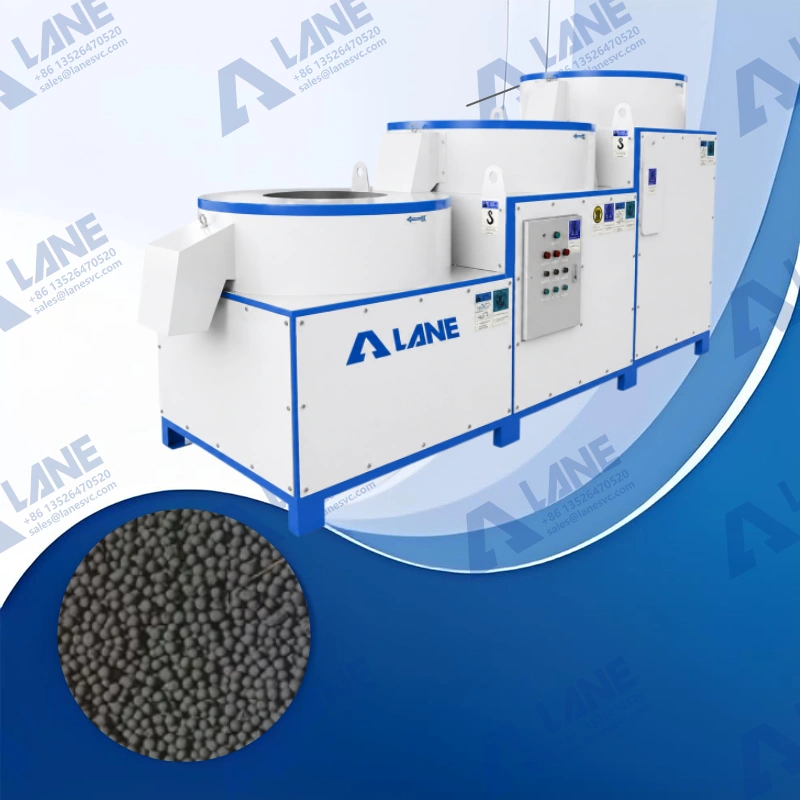
LANE Machinery rotary drum fermenter provides continuous, high-throughput aerobic composting in 5–8 days. Uniform tumbling action, low energy, excellent for industrial-scale organic fertilizer production. CE certified. Inquire now.
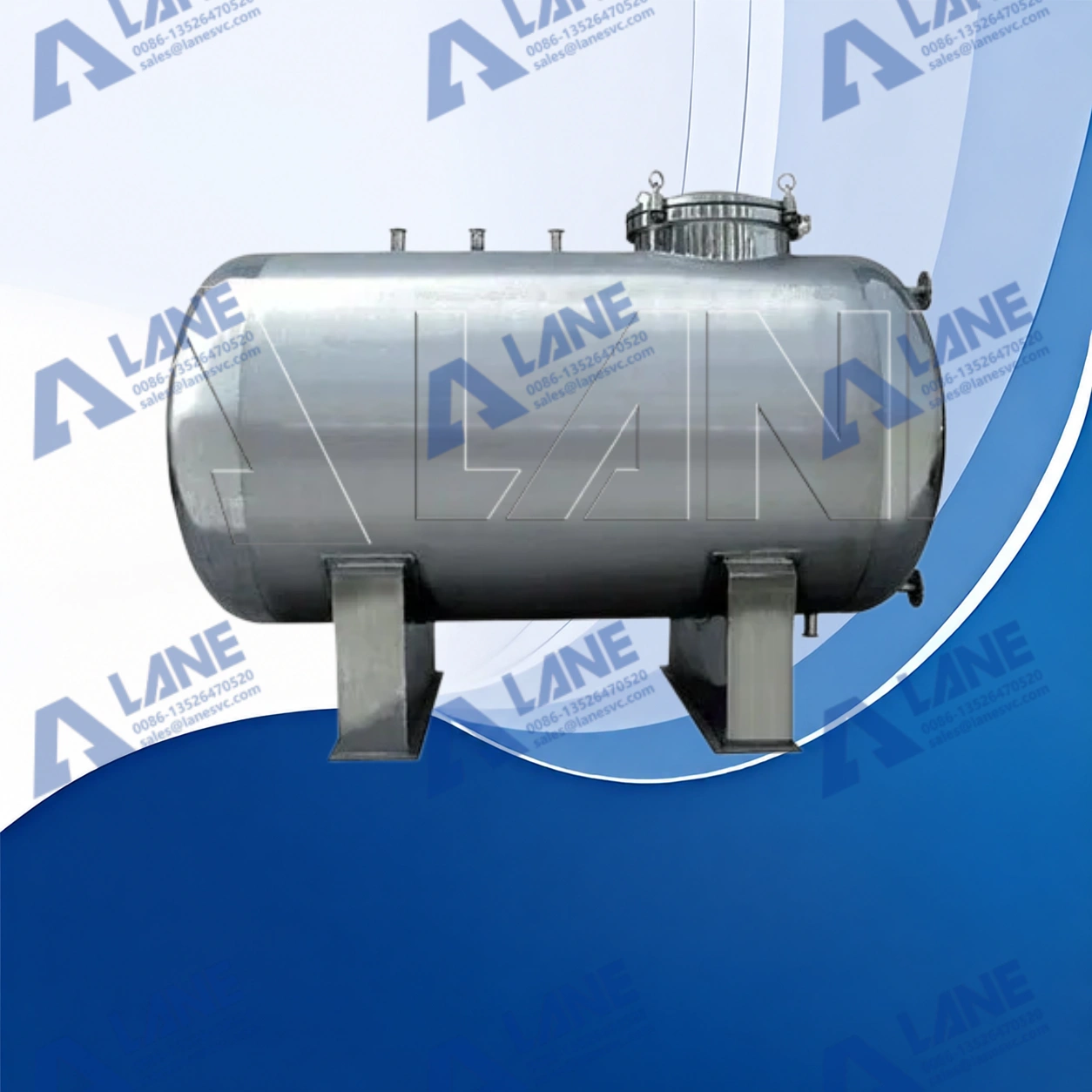
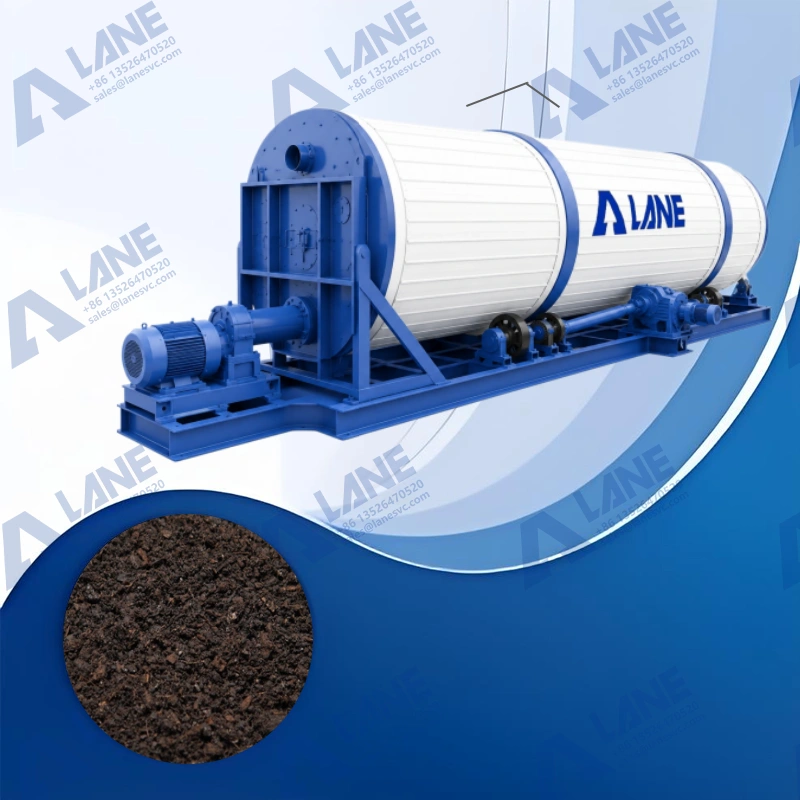
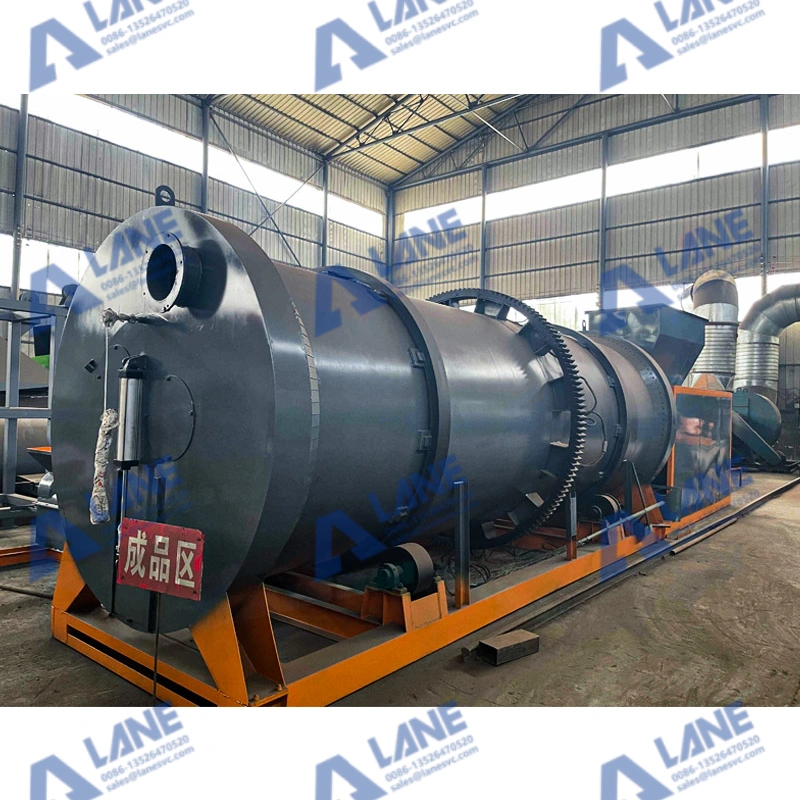
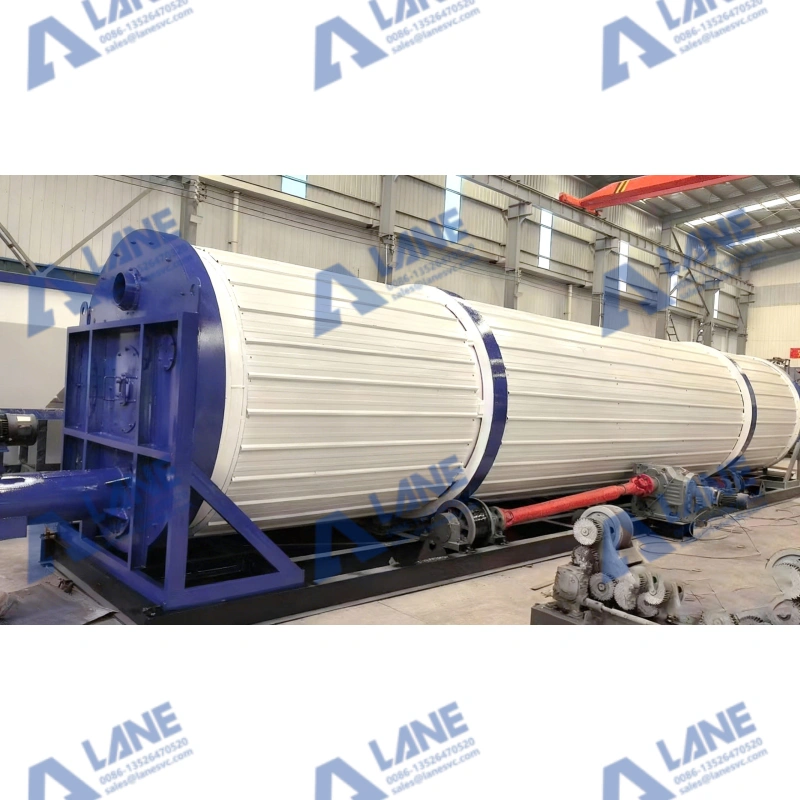
The rotary drum fermenter (also known as a rotary drum composter, rotary bioreactor, or rotary drum reactor) from LANE Machinery is a horizontal, continuously rotating cylindrical composting system designed for industrial-scale, high-throughput organic waste processing. It represents the most mechanically efficient in-vessel composting technology available — using slow, continuous drum rotation to tumble and aerate organic material, achieving rapid, uniform decomposition in 5–8 days.
Unlike stationary tank systems that rely on internal paddles or augers to move material, the rotary drum fermenter’s entire vessel rotates (typically at 1–5 RPM), causing the contents to constantly tumble and mix. This tumbling action delivers three critical advantages: superior aeration (every particle contacts oxygen regularly), unmatched mixing uniformity (no dead zones or compaction), and lower energy consumption (rotation against bearings requires less power than driving mechanical agitators through dense material).
With capacities ranging from 500 liters to 120+ m³ and throughput rates from 1.5 m³/day to 100+ tons/day, the rotary drum fermenter is the preferred front-end composting solution for large organic fertilizer plants, municipal solid waste (MSW) composting facilities, and high-volume agricultural operations.
Key Selling Points:
1. Superior Aeration Through Tumbling
The rotating drum constantly lifts and drops material via internal flights/baffles, exposing every particle to the air space inside the drum. This natural tumbling aeration is more uniform and energy-efficient than forced-air systems that can create preferential airflow channels. Research confirms rotary drum systems sustain aerobic conditions more consistently than any other enclosed composter type.
2. Fast 5–8 Day Fermentation Cycle
The combination of optimal aeration, continuous mixing, and controlled temperature achieves active thermophilic composting in 5–8 days — comparable to horizontal fermentation tanks and far faster than trough or windrow methods (40–60 days). For operations requiring maximum throughput from minimum equipment, the rotary drum delivers.
3. Unmatched Mixing Uniformity — No Dead Zones
Stationary tanks with internal agitators inevitably develop dead zones — areas where material compacts, dries out, or goes anaerobic. The rotary drum’s full-vessel rotation eliminates this problem: every particle moves with every rotation, ensuring 100% of the material mass experiences consistent conditions. The result: no “hot spots,” no “cold spots,” no quality variance.
4. Low Energy, Low Operating Cost
Drum rotation at 1–5 RPM against bearing surfaces consumes significantly less energy than driving screw conveyors or paddle agitators through dense, moist organic material. Typical power consumption for a mid-size unit (20 T/day) is 8–15 kW — 30–50% less than equivalent-capacity horizontal or vertical stationary tank systems.
5. Continuous-Flow Processing
Many rotary drum fermenter configurations support continuous operation: raw material enters one end, and finished compost exits the other — without stopping the drum. This enables true 24/7 production scheduling, eliminating the downtime between batches that batch-mode tanks require.
6. Robust, Low-Maintenance Mechanics
The rotary drum fermenter has fewer moving parts in contact with corrosive material than any stationary tank system. There are no internal paddle shafts, auger bearings, or agitator seals exposed to the composting environment. The drum itself rotates on external trunnion wheels or support rollers — easily accessible for lubrication and replacement. This design simplicity translates to lower maintenance costs and longer service life.
7. Multi-Chamber Configurations Available
Advanced models feature two- or three-chamber drums with progressively sized internal ports. Material moves from Chamber 1 (initial mixing, 1–2 days retention) → Chamber 2 (primary thermophilic composting, 3–5 days) → Chamber 3 (maturation and cooling, 1–2 days). Each chamber maintains independent conditions for optimal phase-specific microbial activity.
8. Corrosion-Resistant Options
Standard construction uses carbon steel with anti-corrosion coating. Optional upgrades include 304 or 316L stainless steel for highly acidic or chloride-rich feedstocks, and concrete-lined interiors for extreme-duty applications. All external surfaces receive industrial-grade protective coating.
The rotary drum fermenter operates on the continuous tumbling aerobic composting principle:
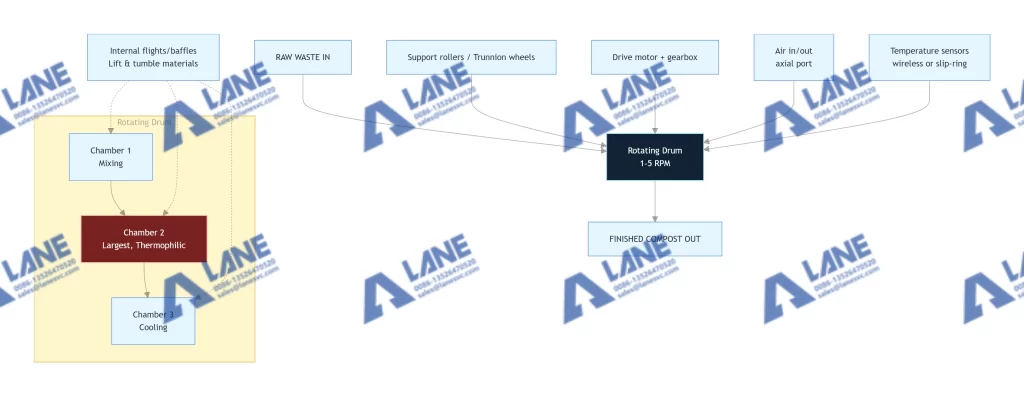
1. Feeding Pre-shredded organic waste (moisture-adjusted to 50–65%, C:N ratio ~25–30:1) is loaded into the drum’s inlet end via conveyor or loader. A microbial inoculant is added to accelerate decomposition.
2. Tumbling & Aeration As the drum rotates slowly (typically 1–5 RPM, with 3.5 RPM being a research-validated optimum), internal flights or baffles attached to the drum wall lift material and allow it to cascade back down through the air space. This continuous lifting-and-falling action:
3. Thermophilic Fermentation Microbial activity generates heat, raising the core material temperature to 55–70°C within 24–48 hours. This thermophilic phase is sustained for 3–5 days, during which:
4. Temperature Monitoring & Control Temperature sensors (contact or wireless) monitor material temperature at multiple points along the drum. If temperatures exceed the set threshold (typically 65–70°C — above which beneficial microbes begin dying), the control system triggers increased ventilation or a brief acceleration in rotation speed to dissipate excess heat.
5. Multi-Chamber Progression (Advanced Models) In multi-chamber drums, material advances through progressively sized axial ports between chambers as the drum rotates. Each 1/3 turn of the drum (or timed interval) allows a portion of material to move forward, ensuring each “plug” of material spends the correct residence time in each chamber.
6. Discharge Finished compost exits through the discharge port at the drum’s outlet end. In continuous-flow systems, the discharge rate is matched to the input rate. The compost typically requires an additional 2–4 weeks of curing in a static pile for complete stabilization before use as fertilizer.
Total drum residence time: 5–8 days. Total time to fully mature, plant-ready compost (including post-drum curing): 3–5 weeks.
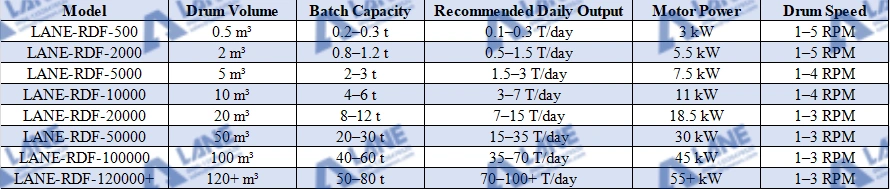
Custom engineering available. Drum diameter, length, chamber configuration, materials of construction, and drive systems can all be customized to meet specific throughput, feedstock, and site requirements.
| Sector | Typical Application | Scale |
|---|---|---|
| Large Organic Fertilizer Plants | Primary composting stage for 5–100 TPH production lines | Industrial |
| Municipal Solid Waste (MSW) Composting | Organic fraction treatment for city-scale composting | Municipal |
| Industrial Agriculture | Manure management for 10,000+ head cattle feedlots, large piggeries, mega-poultry operations | Agricultural |
| Sugar & Ethanol Industry | Press mud / filter cake composting | Industrial |
| Palm Oil Industry | Empty fruit bunch (EFB) and palm oil mill effluent (POME) composting | Industrial |
| Coir & Coconut Processing | Coir pith composting and valorization | Industrial |
| Biogas Plant Digestate | Large-volume post-digestion solids stabilization | Industrial |
| Compost Export Operations | High-volume, consistent-quality compost for international shipping | Commercial |
Integration advantages:
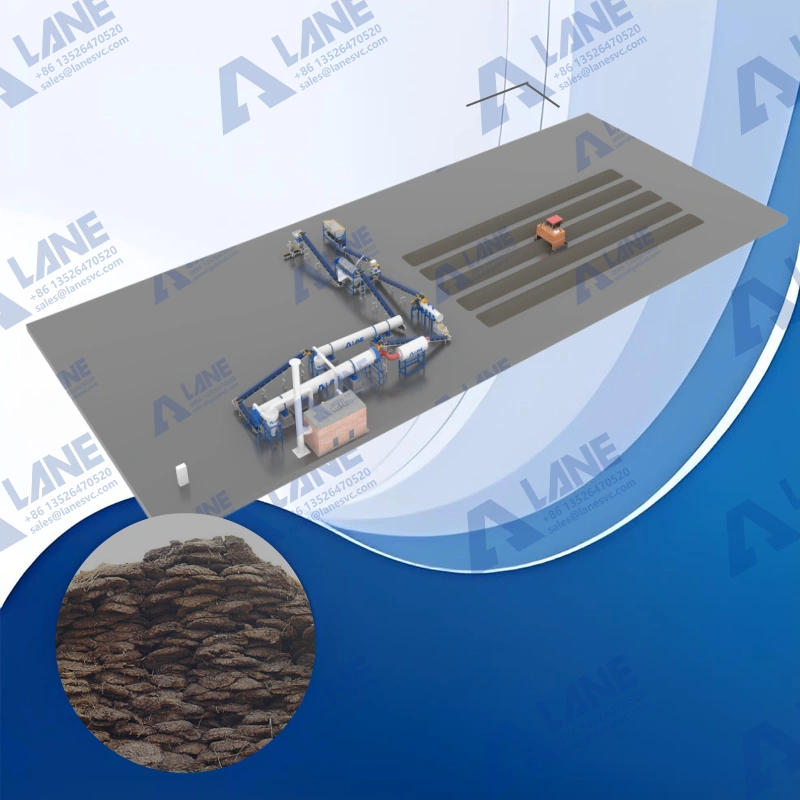
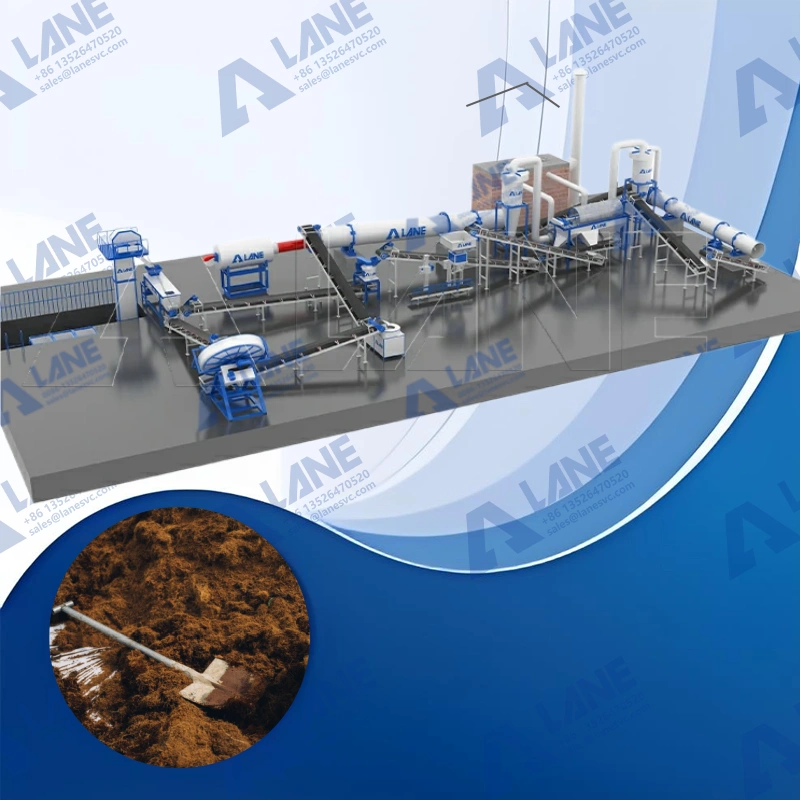
LANE Machinery provides the rotary drum fermenter as a standalone unit or as the centerpiece of a complete turnkey organic fertilizer production line, including:
Q1: How does the rotary drum fermenter differ from a horizontal fermentation tank?
Both are horizontal, enclosed composting systems, but the key difference is how material moves and mixes:
Choose rotary drum when: throughput volume is high (30+ T/day), energy efficiency is a priority, and a 5–8 day cycle time is acceptable. Choose horizontal tank when: the fastest possible cycle time is needed and higher energy consumption is acceptable.
Q2: What raw materials can the rotary drum fermenter process?
Virtually all organic waste types: animal manure (all livestock types), crop residues and straw, food waste, municipal green waste, sewage sludge (dewatered), press mud (sugar industry), empty fruit bunches (palm oil), coir pith, biogas digestate, and mixed organic fractions of MSW. Materials should be pre-shredded to <5 cm and moisture-adjusted to 50–65%.
Q3: Does the rotary drum produce finished, plant-ready compost?
The drum produces stabilized, pathogen-free compost in 5–8 days, but it is recommended to cure the material for an additional 2–4 weeks in a static pile for full maturation. Freshly discharged drum compost is biologically active; curing allows final decomposition of resistant compounds and ensures it won’t “rob” nitrogen from soil when applied. For industrial fertilizer granulation, drum compost can proceed directly to downstream processing (drying, crushing, granulating) without extended curing.
Q4: What maintenance does a rotary drum fermenter require?
Compared to stationary tank systems, maintenance is significantly simpler:
The absence of internal shaft bearings, seals, and agitators exposed to the composting environment dramatically reduces wear-part count and maintenance frequency.
Q5: Can the drum operate continuously, 24/7?
Yes. Many configurations support continuous operation — raw material enters at the inlet end, and finished compost discharges at the outlet end without stopping rotation. The drum’s slight inclination (1–5°) and internal flight design provide the material conveying action. Continuous operation maximizes throughput and eliminates batch-changeover downtime.
Q6: How is temperature controlled in a rotating drum?
Temperature is monitored via wireless sensors embedded in the material flow or slip-ring-connected thermocouples mounted through the drum wall. If temperature exceeds the set point (typically 65–70°C), the control system can:
Q7: What about odor control?
The drum is fully enclosed during operation. An exhaust collection hood at the discharge end captures air and gases, which pass through a biofilter or chemical scrubber before atmospheric release. The aerobic conditions maintained by continuous tumbling minimize odor generation at the source — anaerobic odors (H₂S, ammonia) simply don’t develop when oxygen is consistently present.
Q8: Is the equipment suitable for outdoor installation?
Yes. The drum and drive system are designed for outdoor installation with appropriate weather protection. Key considerations:
Q9: Can the drum be customized for specific feedstocks?
Yes. LANE Machinery customizes:
Q10: Is there a minimum order quantity or can I start with one unit?
Single-unit orders are welcome. Many clients start with one rotary drum fermenter and add additional units as their operations expand. LANE Machinery also offers smaller pilot-scale drums (0.5–2 m³) for process validation before committing to full-scale equipment.
HENAN LANE HEAVY INDUSTRY MACHINERY TECHNOLOGY CO., LTD. is your partner for industrial-scale composting solutions:
Large-scale composting requires careful engineering. Let LANE Machinery’s technical team design the right solution for your operation.
LANE Machinery — Engineered for Scale. Built for Reliability.


Everything you need to know when looking at different types of organic fertilizer equipment, all in one place.
Copyright © 2026. LANE All rights reserved.