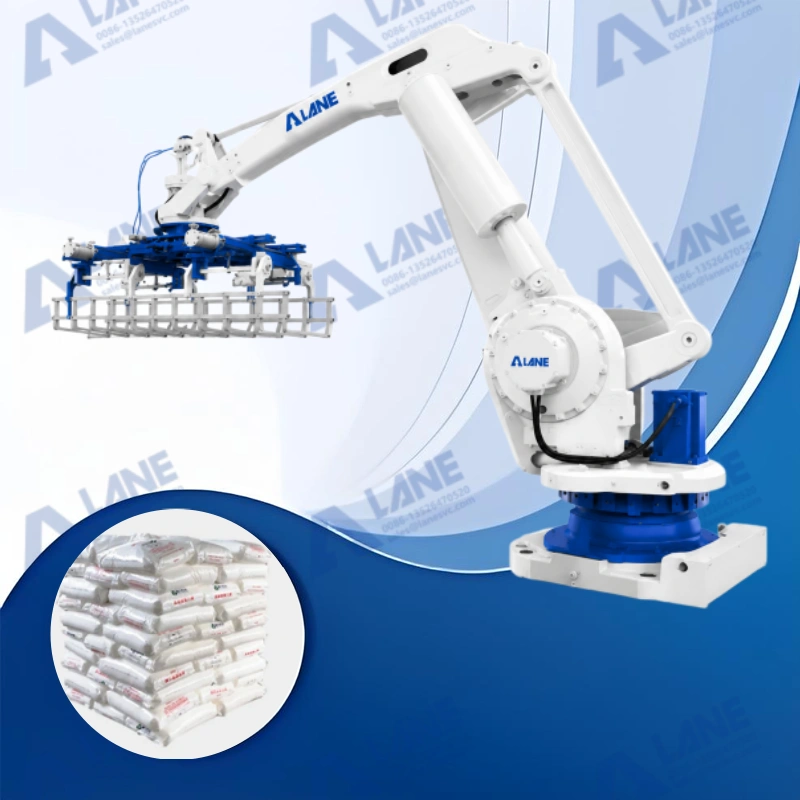
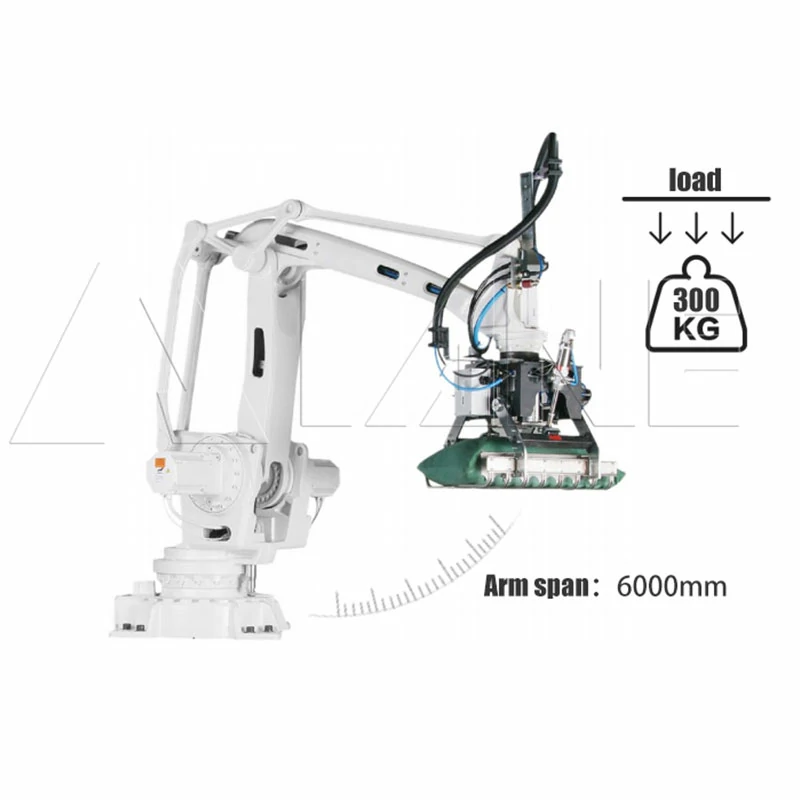
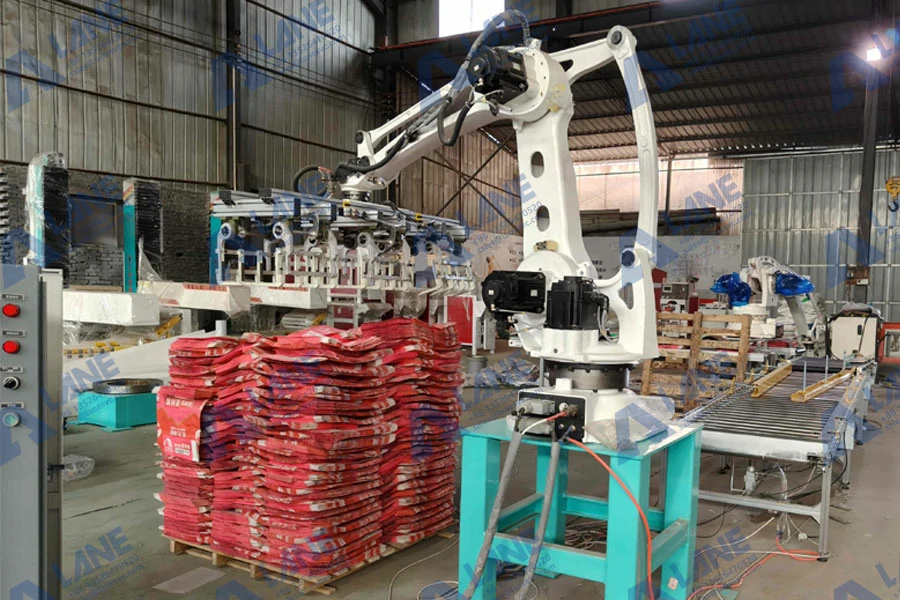
Automated robotic palletizer for 25-50kg fertilizer bags. High-speed stacking up to 1,200 bags/hour with flexible pattern programming. CE certified, factory direct pricing.
Stack up to 1,200 fertilizer bags per hour with ±1 mm positioning accuracy. LANE Machinery’s robotic palletizer replaces 3–6 manual workers per shift, delivering consistent, stable pallet loads for NPK, urea, organic, and compound fertilizer bags — 24/7, shift after shift.
Request a Quote · Download Brochure
A robotic palletizer for fertilizer is an automated end-of-line system that uses an industrial robot arm to pick, orient, and stack filled fertilizer bags onto pallets in pre-programmed patterns. It sits downstream of your bagging machine and upstream of your stretch wrapper — the critical bridge between packaging and warehousing.
In a typical fertilizer production line, filled and sealed bags (25–50 kg, woven PP, PE, or paper) arrive by conveyor. The robot’s vision system or photoelectric sensors detect each bag’s position. A customized gripper — mechanical claw, vacuum suction, or combination — picks the bag and places it precisely onto the pallet. The PLC controller manages stacking pattern, layer count, and bag orientation, all adjustable from the touchscreen HMI in seconds.
Unlike conventional mechanical palletizers that require fixed bag dimensions and lengthy changeovers, a robotic system handles multiple SKUs, bag sizes, and stacking patterns on the same line. For fertilizer plants producing NPK 15-15-15 one shift and organic 5-5-5 the next, that flexibility translates directly to production uptime.
1. High Flexibility for Multi-Product Fertilizer Lines
Change stacking patterns in under 30 seconds via the touchscreen — no mechanical adjustments, no tools, no downtime. Store unlimited palletizing recipes for different NPK grades, organic blends, bag sizes (25 kg, 40 kg, 50 kg), and pallet dimensions (1,200 × 1,000 mm, 1,200 × 800 mm). The system can even build mixed or “rainbow” pallets when needed.
2. Precision Stacking (±1 mm Repeatability)
Industrial robot arms (FANUC, ABB, KUKA, or Yaskawa — integrated per your specification) deliver positioning repeatability within ±1 mm. Vision-guided systems compensate for bag irregularities common with granular fertilizer — a bag that settled slightly off-square on the conveyor still gets placed perfectly. The result: uniform, stable pallet loads that survive long-distance truck and sea freight without collapsing.
3. Labor Cost Reduction — Replace 3–6 Workers Per Shift
One robotic palletizer handles the work of 3 to 6 manual stackers per shift. In a 3-shift operation, that’s 9–18 positions reduced to 1 supervising operator. Fertilizer plants worldwide document payback periods under 12 months from labor savings alone. You convert a variable, seasonally constrained labor expense into a predictable fixed cost — and eliminate workplace lifting injuries at the same time.
4. Intelligent PLC Control & Remote Monitoring
Centralized PLC control (Siemens, Allen-Bradley, or Mitsubishi) with touchscreen HMI provides:
5. Comprehensive Safety System
Safety is engineered in, not added on:
6. Compact Footprint — 20–30% Less Floor Space
Robotic palletizers occupy significantly less floor area than conventional high-level or low-level palletizers. The compact cell design fits into existing fertilizer plants without major structural modifications. Some configurations serve two production lines simultaneously from a single robot position, further improving space utilization and ROI.
7. Heavy-Duty, Corrosion-Resistant Construction
Fertilizer is corrosive. LANE Machinery’s robotic palletizer systems are built to withstand it:
8. Gentle Bag Handling — Reduced Product Damage
The robot’s controlled motion profile and customized gripper design handle bags gently. Unlike mechanical systems that compress layers under significant force, the robotic approach reduces torn bags, product spillage, and packaging waste. For premium fertilizer brands, this means fewer customer rejections and lower hidden costs.
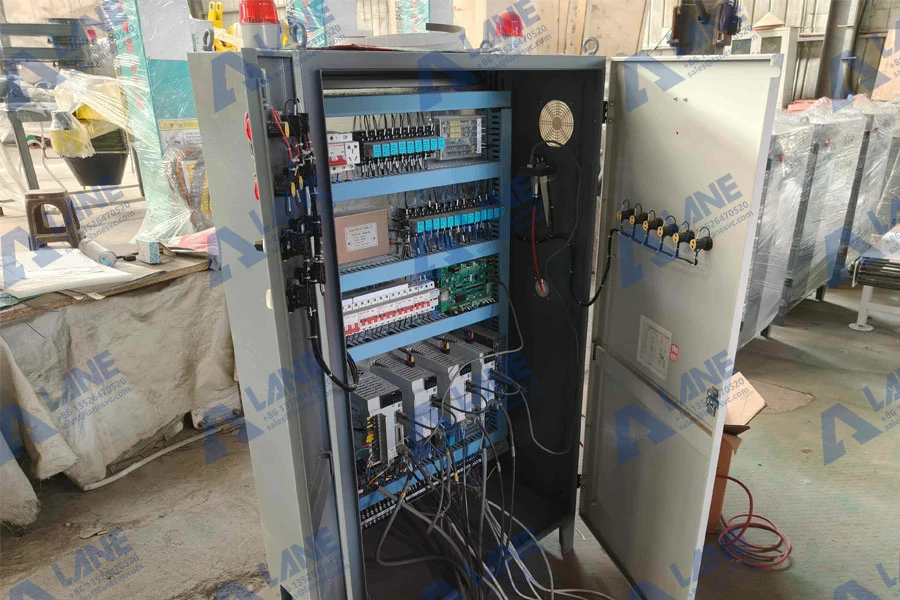
Bag Arrival & Conditioning — Filled and sealed bags (25–50 kg) exit the bagging machine. A bag flattener or vibrating leveler settles the fertilizer evenly inside, creating a uniform profile for stable stacking.
Bag Orientation — A servo-controlled turning device rotates bags by 90°, 180°, or 270° as required by the stacking pattern. Seams face inward; bags are correctly aligned for the programmed layer layout.
Position Detection — Photoelectric sensors or 3D vision systems detect each bag’s exact position on the infeed conveyor. Vision systems compensate for deviations up to ±5 mm, accommodating natural bag shape variation.
Robot Pick & Place — The robot arm positions its customized end-of-arm tool (EOAT) and grips the bag. Mechanical claw grippers with anti-slip coatings are standard for fertilizer; vacuum or combined clamp-and-suction options are available for smoother bag surfaces.
Pallet Stacking — The robot places each bag according to the programmed pattern (interleaved, columnar, pinwheel, or custom). The PLC tracks layer count and orientation. When a layer is complete, an optional automatic slip sheet inserter places a separator sheet before the next layer begins.
Full Pallet Discharge — Once the programmed number of layers is reached, the completed pallet is conveyed out to the stretch wrapper or stretch hooder. An empty pallet is automatically dispensed from the pallet magazine (10–15 pallet capacity), and the cycle repeats — zero downtime between pallets.
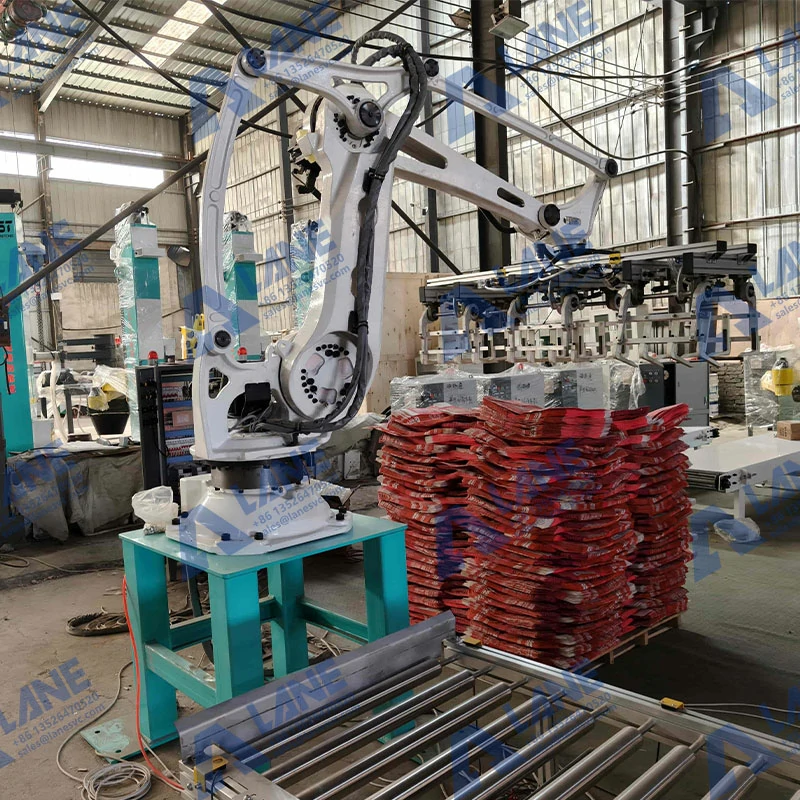
| Fertilizer Type | Examples | Palletizing Considerations |
|---|---|---|
| NPK Compound Fertilizer | 15-15-15, 17-17-17, various grades | Most common application; multi-grade production needs fast recipe changeover |
| Nitrogen Fertilizers | Urea (46-0-0), ammonium sulfate, CAN | Hygroscopic (CRH ~45–50%); needs well-sealed bags and weather-protected finished pallets |
| Phosphate Fertilizers | DAP (18-46-0), TSP, SSP | Granular, moderately dusty; stainless steel components recommended |
| Potash Fertilizers | MOP (0-0-60), SOP (0-0-50) | Abrasive but less corrosive; standard material handling |
| Organic Fertilizers | Compost, manure-based, bio-organic | Variable density and flow; may be dusty or fibrous; flexible gripper design needed |
| Bulk Blended (BB) Fertilizer | Custom NPK blends | Small batches, high SKU variety; rapid changeover essential — ideal for robotic flexibility |
| Water-Soluble Fertilizers | MAP, MKP, potassium nitrate | Fine powder; dust-tight sealing required |
| Ammonium Nitrate-Based | CAN, AN | Regulated hazardous material; anti-static and explosion-proof options available |
| Factor | Robotic Palletizer | High-Level Palletizer |
|---|---|---|
| Max Throughput (bags/hr) | 800–1,600 | 800–2,400 |
| Multi-SKU Flexibility | ★★★★★ Excellent | ★★☆☆☆ Limited |
| Changeover Time | ~30 seconds (software) | 15–60 minutes (mechanical) |
| Footprint | Compact (20–30% less space) | Larger (elevated structure) |
| Bag Types Supported | All — woven PP, PE, paper, FFS, irregular | Best for uniform bags with consistent dimensions |
| Mixed / Rainbow Pallets | Fully supported | Not supported |
| Multi-Line Feeding | Can serve 2+ lines from one robot | Typically dedicated to 1 line |
| Maintenance Complexity | Low — fewer mechanical parts; MTBF 80,000 hours | Moderate — more wear parts at height |
| Upfront Cost | Moderate | Higher (more civil/structural work) |
| Service Life | 10–15 years | 15–20+ years |
| Best For | Multi-grade plants, frequent product changes, limited floor space | High-volume single-SKU lines, continuous 24/7 identical product |
Not sure which fits your operation? Read our detailed comparison guide → or contact our engineers for a free consultation based on your production requirements.
LANE Machinery supplies both types. We recommend based on your specific throughput, product variety, and plant layout — not on which machine we happen to sell.
What is a robotic palletizer for fertilizer bags?
A robotic palletizer for fertilizer bags is an automated stacking system that uses an industrial robot arm with a customized gripper to pick filled fertilizer bags (25–50 kg) from a conveyor and arrange them onto pallets in precise, programmable patterns. It automates the end-of-line palletizing process, replacing manual labor.
How many bags per hour can a fertilizer robotic palletizer stack?
Standard systems handle 800–1,200 bags per hour with a single gripper. High-speed configurations with dual-pick end-of-arm tooling can reach up to 1,600 bags per hour. For reference, one manual worker typically stacks 100–150 bags per hour.
What types of fertilizer bags can a robotic palletizer handle?
Woven polypropylene (PP) bags, PE plastic bags, kraft paper bags, and FFS (Form-Fill-Seal) tubular film bags — from 10 kg retail packs to 50 kg industrial bags. The gripper is customized to your specific bag type and weight range.
What is the ROI / payback period?
Most fertilizer plants achieve payback in 8–18 months. A single robotic palletizer replaces 3–6 workers per shift. At $5,000–$8,000 annual labor cost per worker (varies by region), labor savings alone recover the investment quickly. Additional savings come from reduced product damage, fewer workplace injuries, and increased throughput during peak seasons.
How many workers does a robotic palletizer replace?
One robotic palletizer typically replaces 3–6 manual workers per shift. In a 3-shift operation, this means 9–18 positions reduced to 1 supervising operator. Labor cost reductions of 60–80% are routinely documented.
Can the palletizer handle different stacking patterns?
Yes. Stacking patterns are programmed through palletizing software with an intuitive wizard interface — no coding required. Common fertilizer patterns include five-flower (3+2 interleaved), six-flower (3+3), eight-flower (4+3), and custom configurations. Patterns are switched in seconds via the HMI touchscreen.
Is a robotic palletizer suitable for corrosive fertilizer environments?
Absolutely. LANE Machinery builds fertilizer-specific robotic palletizers with AISI 304 or 316L stainless steel product-contact surfaces, anti-corrosion structural coatings, IP65+ sealed electrical enclosures, and Teflon-coated gripper surfaces. These measures ensure reliable operation in the aggressive chemical environments common in fertilizer plants.
What maintenance does a robotic palletizer require?
Routine maintenance is minimal — primarily periodic lubrication of robot joint drives (per manufacturer schedule), gripper inspection, and sensor cleaning. The industrial robot arm itself is rated for 80,000+ hours MTBF (Mean Time Between Failures). LANE Machinery provides a recommended maintenance schedule, spare parts list, and remote diagnostic support.
Can one robot serve two bagging lines?
Yes — depending on throughput requirements. A centrally positioned robot can reach two infeed conveyors from adjacent bagging lines, palletizing both streams simultaneously. This is a common configuration that improves space utilization and ROI by 50–100%.
What power and utilities are required?
Standard requirements: 380–480 VAC / 3-phase / 50–60 Hz power supply (8–15 kW), clean dry compressed air at 0.5–0.8 MPa (5–7 bar), and a level concrete floor capable of supporting the palletizer and pallet loads. LANE Machinery provides detailed site preparation drawings before shipment.
| Trust Signal | What It Means for You |
|---|---|
| Fertilizer Equipment Specialist | LANE Machinery focuses exclusively on fertilizer production equipment. Your palletizer is built by engineers who understand NPK granulation, urea hygroscopicity, and organic fertilizer handling — not by a general-purpose automation integrator. |
| Factory-Direct Pricing | You buy directly from our manufacturing base in Henan, China. No distributor margins, no agent commissions. Competitive pricing with full factory warranty and support. |
| CE & ISO 9001 Certified | Our equipment meets international safety and quality standards. Documentation packages support import clearance in your country. |
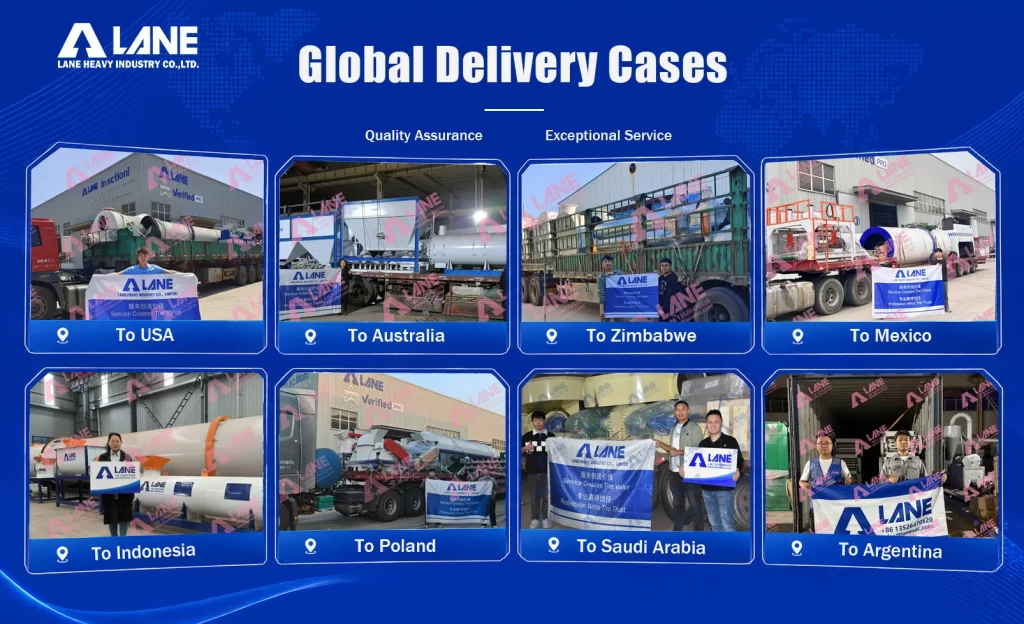
| Global Export Experience | We have supplied fertilizer production lines to customers across Asia, Africa, the Middle East, South America, and Eastern Europe. We understand international logistics, documentation, and after-sales support across time zones. |
| Turnkey Project Capability | Need more than a palletizer? LANE Machinery delivers complete fertilizer production lines — from raw material handling through granulation, drying, cooling, coating, bagging, palletizing, and wrapping. One supplier, one point of accountability. |
| Remote Diagnostics & Support | Our PLC-based control systems support remote VPN access for troubleshooting and optimization. Most issues are resolved without waiting for an engineer to travel. |
| Spare Parts Availability | We maintain a comprehensive spare parts inventory and ship globally. Critical wear components are stocked for immediate dispatch. |
Tell us about your production line, and we’ll recommend the right palletizer configuration — robot brand, gripper type, throughput, and integration scope — with a detailed quotation.
What we need to know:
Typical response time: within 24 hours (business days).


Everything you need to know when looking at different types of organic fertilizer equipment, all in one place.
Copyright © 2026. LANE All rights reserved.