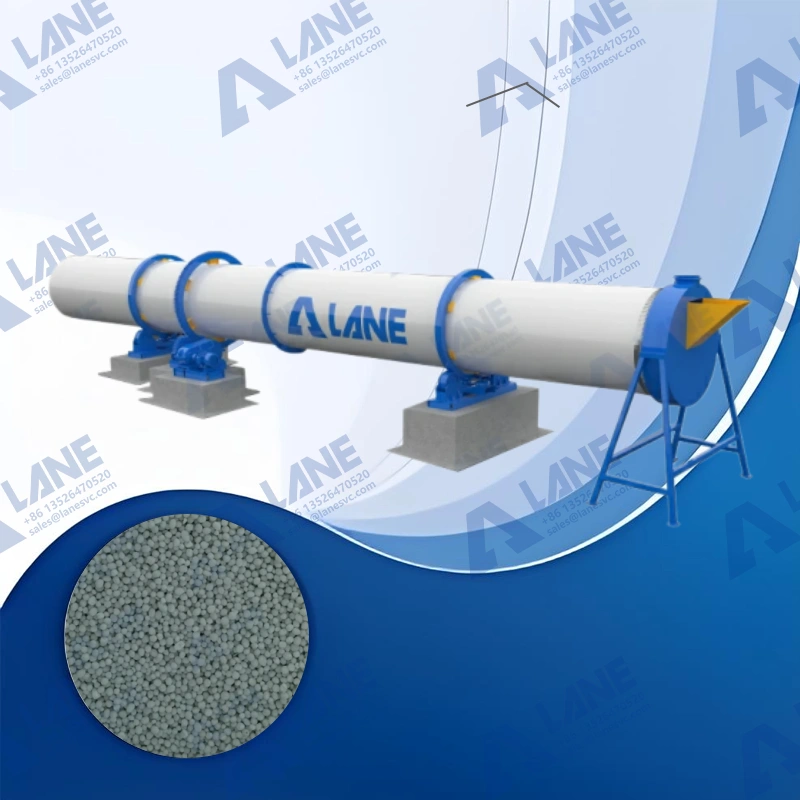
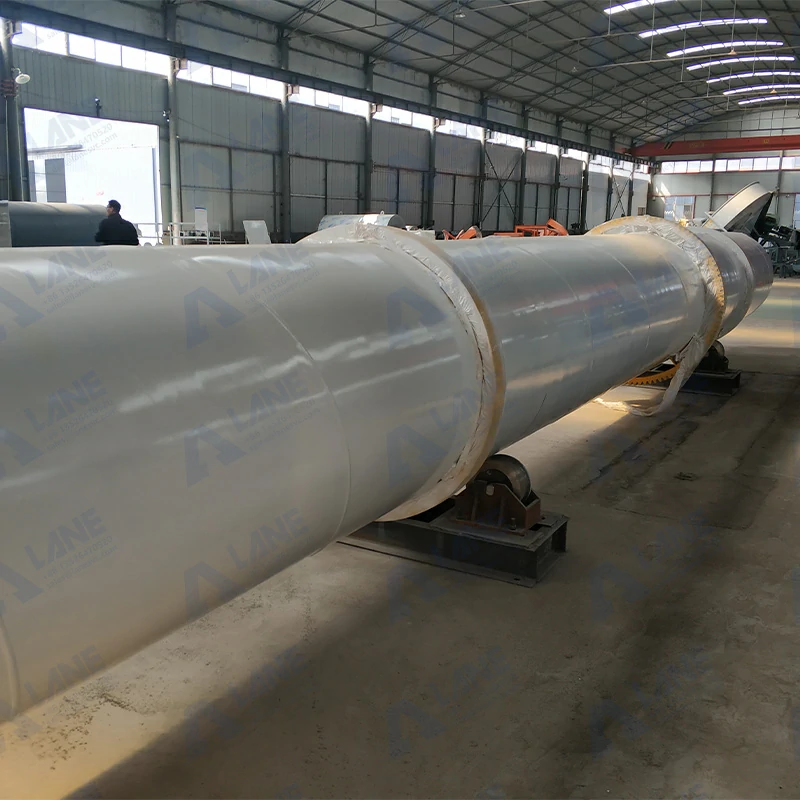
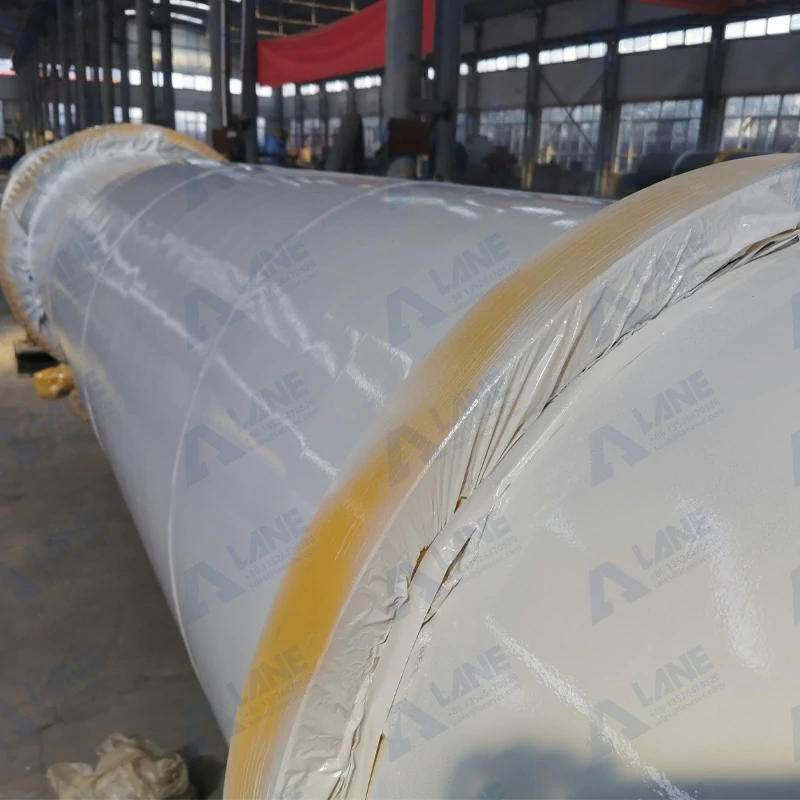
LANE Machinery’s rotary drum cooler rapidly reduces granule temperature post-drying to prevent caking, preserve nutrients, and ensure storage stability. Capacity 1–50 TPH, counter-current design, ISO certified.
The rotary drum cooler is the critical downstream partner to the rotary drum dryer in every modern fertilizer production line. After drying, fertilizer granules emerge hot (typically 60–90°C) and require rapid, controlled cooling to prevent caking, nutrient degradation, and moisture reabsorption during storage and transport. LANE Machinery’s rotary drum cooler uses a counter-current air-cooling principle to bring granule temperature down to within 5–8°C of ambient air temperature — ensuring your fertilizer remains free-flowing, stable, and market-ready.
Designed and manufactured by LANE Machinery (Henan LANE Heavy Industry Machinery Technology Co., Ltd.), our rotary drum coolers are capacity-matched with our dryers for seamless integration in organic, NPK compound, SSP/TSP, MAP/DAP, and other fertilizer production lines ranging from 1 to 50+ TPH.
Key Outcome: Cooled granules at ≤40°C exit temperature; prevents caking; preserves NPK nutrient content; extends shelf life.
Ambient or forced cooling air enters at the discharge end and flows opposite to material movement. This counter-current arrangement maintains a consistent temperature gradient along the full drum length, maximizing heat transfer efficiency — typically achieving 85–95% cooling efficiency with minimal energy input.
Hot fertilizer granules stored without proper cooling release residual heat and moisture, causing particles to fuse together (caking) and nutrients to degrade. Our rotary drum cooler eliminates this risk, ensuring your product arrives at the customer’s farm in the same condition it left your factory.
LANE Machinery’s proprietary lifting plate geometry — developed through years of field data — creates an even, dense material curtain for maximum air-to-particle contact. Flights are arranged in a progressive pattern: aggressive scooping at the inlet (hot end), transitioning to gentler cascading at the outlet (cool end) to minimize granule breakage.
The cooler primarily uses ambient air drawn by an induced draft fan — no heating fuel required. For large-capacity lines, the warmed exhaust air (containing recovered heat from the granules) can be ducted back to the rotary dryer or hot air furnace as preheated combustion air, reducing overall plant fuel consumption by up to 8–12%.
Standard configuration includes a cyclone dust collector at the exhaust outlet. Optional upgrades: baghouse filter (for fine dust) or wet scrubber (for hygroscopic dust). This ensures compliance with workplace and environmental air quality standards.
The LANE Machinery rotary drum cooler operates on a counter-current convective cooling principle:
[Hot Granules from Dryer] → [Rotating Inclined Drum] → [Counter-flow Cooling Air] → [Cooled Granules Discharge]

                                                                        ↑

Ambient Air IntakeStep 1 — Feeding: Hot fertilizer granules (60–90°C) discharge directly from the rotary drum dryer and enter the cooler’s inlet chute at the elevated end. The transfer is continuous and sealed to minimize heat loss.
Step 2 — Drum Rotation & Material Advancement: The cylindrical drum is inclined at 2–5° and rotates at a controlled speed (3–6 r/min). Material gradually moves from the inlet (higher) end toward the discharge (lower) end.
Step 3 — Counter-Current Air Flow: An induced draft fan at the inlet end pulls ambient air through the drum. The air enters at the discharge end — where the granules are coolest — and flows upstream toward the inlet end — where the granules are hottest. This counter-current design means the coldest air always contacts the coldest granules and the warmest air contacts the hottest granules, maximizing the temperature differential for efficient heat exchange at every point along the drum.
Step 4 — Material Cascading: Internal lifting plates pick up material as the drum rotates and shower it through the cooling air stream. This creates a uniform material curtain that dramatically increases the surface area for convective heat transfer.
Step 5 — Heat Dissipation & Exhaust: Heat transfers from the hot granules to the cooling air. The now-warmed exhaust air passes through a cyclone dust collector (and optional secondary filter/scrubber) before being released to atmosphere or recirculated for heat recovery.
Step 6 — Cooled Product Discharge: Granules now cooled to ≤40°C (or within 5–8°C of ambient) exit at the lower end and proceed via belt conveyor to the screening stage.
The rotary drum cooler is essential in every complete fertilizer production line:
| Production Line | Inlet Temp | Target Outlet Temp | Benefit |
|---|---|---|---|
| NPK Compound Fertilizer | 70–90°C | ≤40°C | Prevents caking; preserves granule hardness; protects N-P-K nutrient ratios |
| Organic Fertilizer | 60–80°C | ≤40°C | Maintains organic matter integrity; prevents microbial kill from residual heat |
| SSP / TSP / MAP / DAP | 70–100°C | ≤40°C | Critical for phosphate fertilizer; prevents acid reversion and caking |
| Potassium Sulfate (SOP) | 80–110°C | ≤40°C | Handles high-temp mineral granules; corrosion-resistant construction recommended |
| Ammonium Sulfate | 60–90°C | ≤35°C | Hygroscopic material — rapid cooling essential to prevent moisture absorption |
| Bio-organic Fertilizer | 50–70°C | ≤35°C | Low-temperature cooling protects beneficial microorganisms |
LANE Machinery Rotary Drum Cooler — Model Range
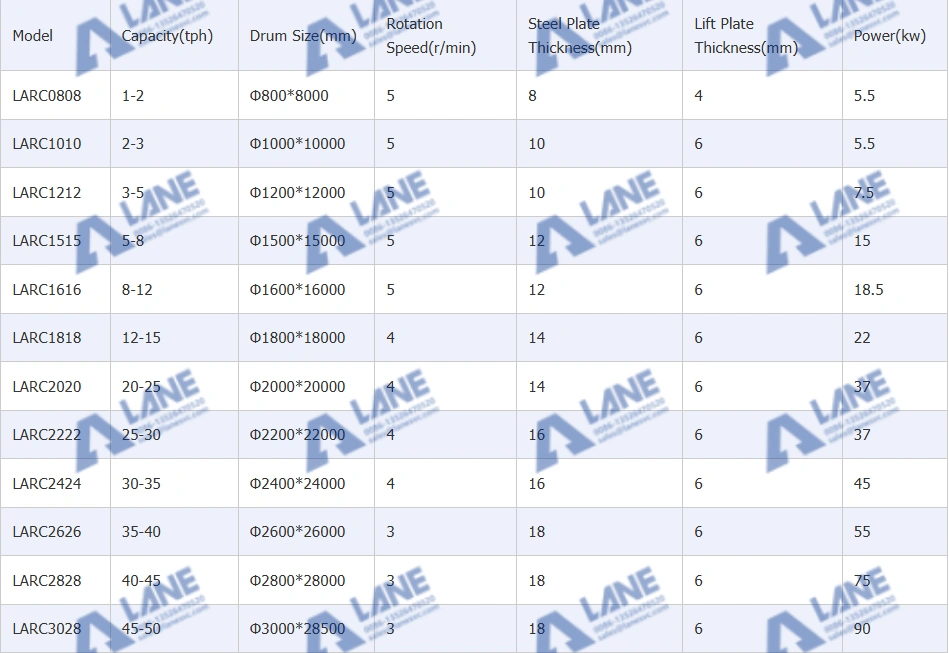
Custom sizing available. Contact LANE Machinery to match cooler specifications to your exact dryer output and production line capacity.
| Parameter | Specification |
|---|---|
| Material of Construction (Drum) | Q235B / Q345B carbon steel (SS304/316L optional) |
| Lifting Plate Material | Wear-resistant alloy steel / SS304 (corrosion-resistant option) |
| Supporting Roller Material | ZG45 / ZG55 cast steel |
| Reducer | ZQ / ZSY series hard-tooth surface gear reducer |
| Motor | Siemens / ABB / domestic brand per customer specification |
| Sealing | Multi-layer labyrinth seal at both ends |
| Dust Collection | Cyclone separator (standard); baghouse filter or wet scrubber (optional) |
| Exhaust Fan | Centrifugal induced draft fan, sized to drum volume |
| Optional Upgrades | VFD speed control, PLC automation with temperature monitoring, stainless steel construction, heat recovery ducting |
The LANE Machinery rotary drum cooler is designed as the direct downstream partner to our rotary drum dryer:
Rotary Drum Dryer → (Hot granules, 60–90°C) → Rotary Drum Cooler → (Cooled granules, ≤40°C) → Screening → Coating → Packaging
Why this matters:
Without cooling, hot fertilizer granules (60–90°C post-drying) continue to release residual heat and moisture inside storage bags. This causes caking (particles fuse into hard lumps), nutrient degradation (especially nitrogen loss from continued ammonia volatilization), and moisture reabsorption (hygroscopic materials pull humidity from air). Proper cooling eliminates all three problems.
Industry best practice is to cool granules to within 5–8°C above ambient air temperature, typically ≤40°C. For highly hygroscopic materials like ammonium nitrate or urea-based NPK, target ≤35°C.
In practice, most modern rotary drum coolers are counter-current coolers — meaning the cooling air flows opposite to material direction. The term “counter-current cooler” is sometimes used interchangeably with rotary drum cooler in the fertilizer industry. Both achieve the same purpose. (See our separate [Counter-current Cooler page] for additional configurations.)
Yes. LANE Machinery rotary drum coolers are engineered for non-stop industrial operation with oversized bearings, heavy-duty gear reducers, and robust drum construction designed for multi-year continuous service with routine maintenance only.
Routine maintenance includes: weekly lubrication of support roller and trunnion bearings; monthly inspection of lifting plate wear; quarterly check of sealing ring condition; annual reducer oil change. Critical wear parts (lifting flights, seals) are designed for field replacement in 4–6 hours.
Yes. LANE Machinery can supply a standalone rotary drum cooler sized to match an existing dryer (any brand). Provide your current dryer’s model, capacity, and outlet temperature, and our engineers will recommend the appropriate cooler and connection design.
| Attribute | LANE Machinery Commitment |
|---|---|
| Matched System Design | Dryer + Cooler engineered as one system, not two separate purchases |
| Verified Performance | 500+ fertilizer plants globally rely on LANE Machinery cooling equipment |
| Quality Manufacturing | ISO 9001 certified; all drums stress-relieved after welding; full FAT before shipment |
| Corrosion Expertise | Material recommendations based on your specific fertilizer chemistry |
| Lifetime Support | Spare parts supply, remote troubleshooting, and on-site service globally available |
Information to include in your inquiry:
LANE Machinery — Complete Cooling Solutions for World-Class Fertilizer Production.


Everything you need to know when looking at different types of organic fertilizer equipment, all in one place.
Copyright © 2026. LANE All rights reserved.