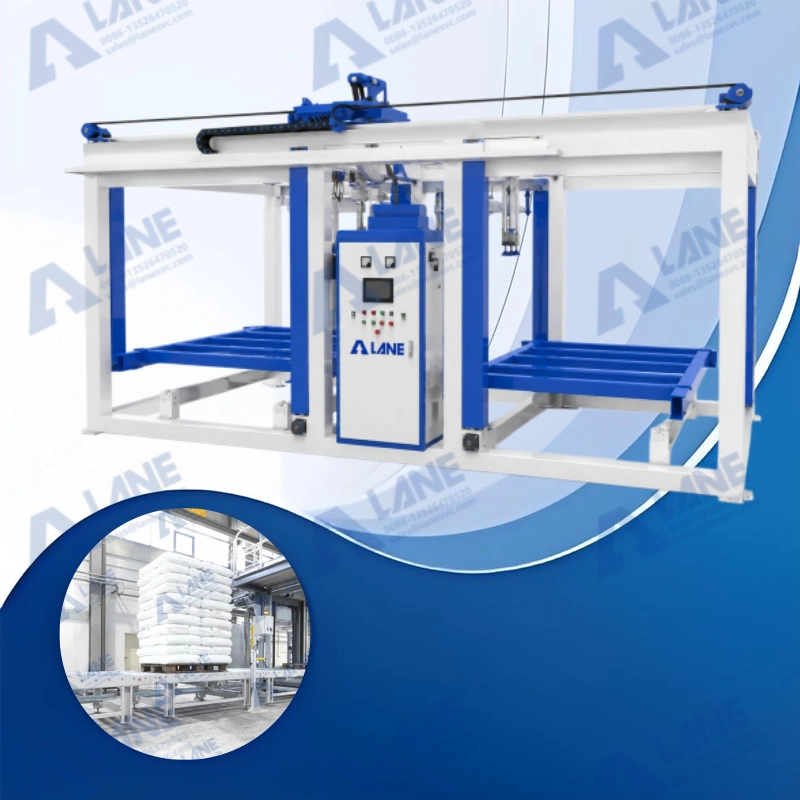
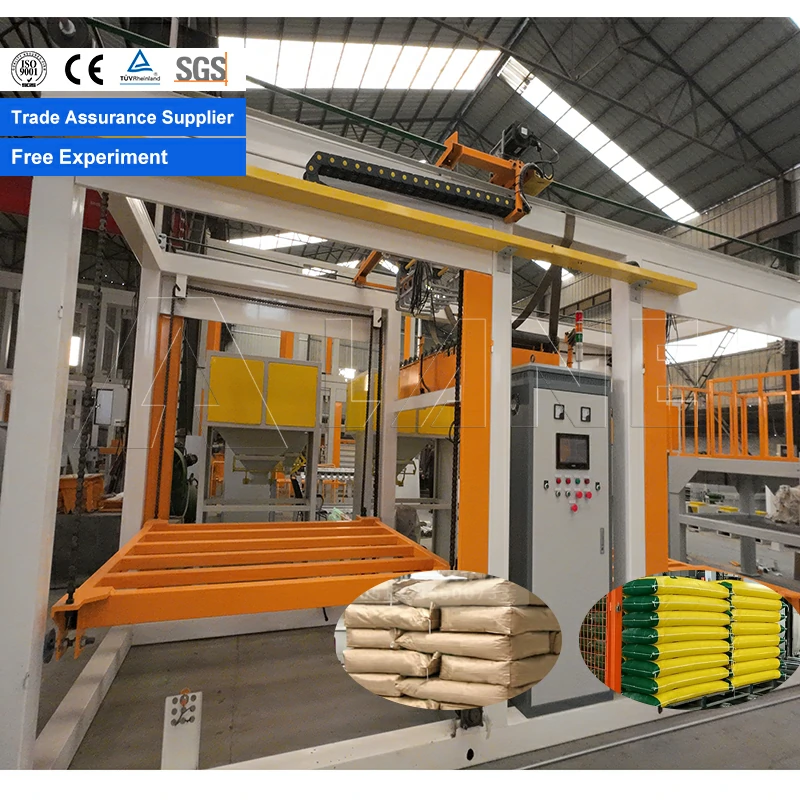
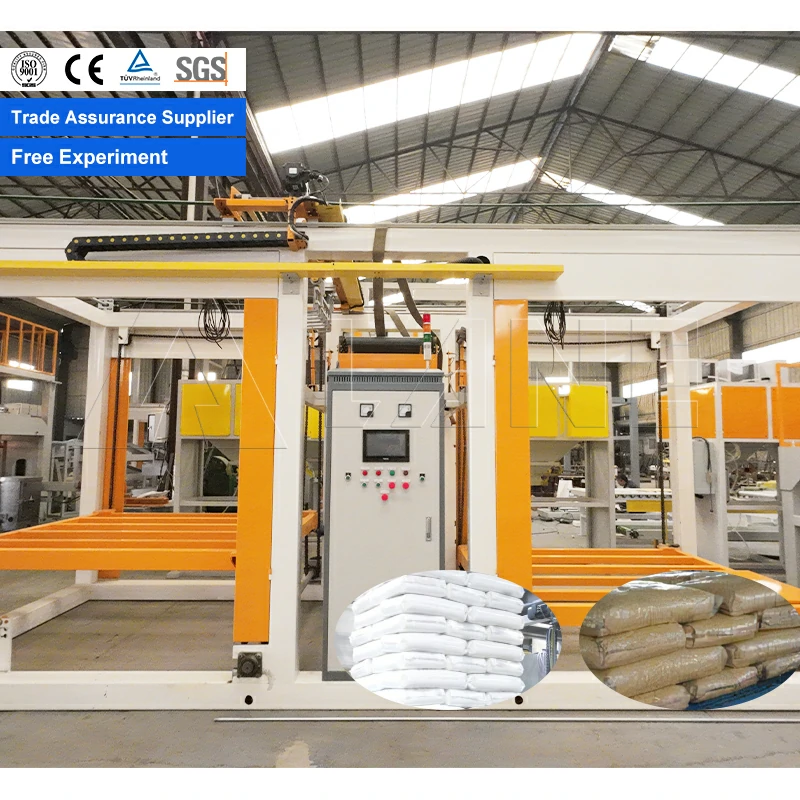
High-level automatic palletizer for 25-50kg fertilizer bags. Capacity 800-1,500 bags/hr. Stable mechanical stacking for heavy bags with layer compression. 15+ year lifespan. CE certified, factory direct pricing.
Stack 800–1,500 fertilizer bags per hour with proven mechanical reliability. LANE Machinery’s high-level palletizer delivers continuous, high-throughput layer stacking for 25–50 kg NPK, urea, and compound fertilizer bags. Designed for 15+ years of service life in demanding fertilizer plant environments — with layer compression technology that produces the most stable pallet loads in the industry.
A high-level palletizer (also called a high-position or elevated palletizer) is a fully automated stacking machine that receives filled fertilizer bags via an elevated conveyor, arranges them into complete layers on a forming table, then deposits each completed layer onto a pallet — layer by layer — until the programmed stack height is reached.
The term “high-level” refers to the elevated infeed: bags are lifted by a climbing conveyor to a height of 3–4.5 meters, where layer formation and deposition occur. After each layer is placed, the pallet elevator descends by exactly one layer height, ensuring the next layer is deposited at the same precise position. This top-down architecture is what enables the high-level palletizer’s exceptional throughput and mechanical consistency.
In a fertilizer production line, the high-level palletizer typically sits between the bagging machine and the stretch wrapper:
Bagging → Bag Closing → Flattener → Climbing Conveyor → HIGH-LEVEL PALLETIZER → Stretch Wrapper → Warehouse
It is the proven workhorse of high-volume fertilizer bag stacking — particularly well-suited to plants that produce consistent, single-specification products at high throughput around the clock.
1. Industry-Leading Throughput — 800–1,500 Bags Per Hour
High-level palletizers are purpose-built for speed. While a manual worker stacks 100–150 bags per hour, a LANE Machinery high-level system consistently delivers 800–1,500 bags per hour — enough to match even the fastest FFS (Form-Fill-Seal) bagging lines producing up to 2,000 bags per hour. For large-scale NPK, urea, and compound fertilizer plants, this throughput ensures the palletizer never becomes the bottleneck.
2. Superior Pallet Stability Through Layer Compression
After each layer is deposited, the elevator raises the entire stack upward, compressing the top layer against the underside of the stripper plates. Compression force is precisely controlled by monitoring elevator motor current — when the preset threshold is reached, the motor reverses, and the next layer cycle begins. This ensures identical layer compaction from the first layer to the last, regardless of how many layers are stacked.
The result: pallets that survive long-distance truck transport, container shipping, and outdoor storage without bags shifting or stacks collapsing. For fertilizer exporters shipping product across continents, this stability translates directly to fewer cargo claims and customer rejections.
3. Proven Mechanical Reliability — 15+ Year Service Life
High-level palletizers are mechanically mature technology with decades of field history in the fertilizer, cement, and chemical industries. With proper preventive maintenance, these machines routinely operate for 15–20+ years. The robust mechanical design — chain-driven push rods, screw or hydraulic elevators, hardened stripper plates — tolerates the dust, vibration, and 24/7 duty cycles of fertilizer production better than many newer automation technologies.
4. Cost-Effective for High-Volume Single-SKU Operations
For fertilizer plants producing large volumes of a consistent product — for instance, NPK 15-15-15 in 50 kg woven PP bags, day in and day out — the high-level palletizer offers the best throughput-to-cost ratio of any palletizing technology. The initial investment is competitive, and the long service life with low per-bag operating cost delivers exceptional lifetime ROI.
5. Consistent, Repeatable Stacking — Shift After Shift
Unlike manual palletizing, where stacking quality varies by worker, shift, and fatigue level, the high-level palletizer produces identical pallets every time. The servo-controlled layer forming table and mechanical push rod ensure every bag is positioned exactly where it belongs. Bag seams are systematically turned inward for a clean, professional appearance that reflects well on your brand.
6. Dual-Station A/B Design — Zero Downtime Between Pallets
LANE Machinery’s high-level palletizer can be configured with dual pallet stations (A/B design). While stacking continues on Station A, a completed pallet on Station B is discharged to the stretch wrapper and a new empty pallet is dispensed. The transition is seamless — zero production downtime between pallet changeovers. For 24/7 fertilizer operations, this feature alone can add hours of productive time per week.
7. Fertilizer-Ready Heavy-Duty Construction
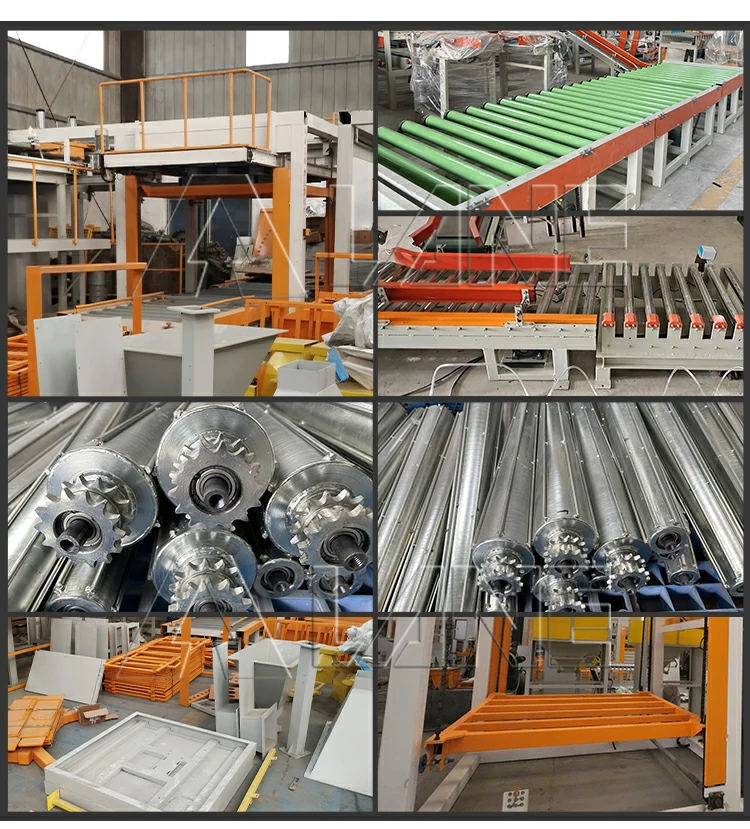
1. Bag Elevation (Climbing Conveyor)
Filled, sealed bags exit the bagging station at floor level. A cleated climbing conveyor lifts them to the palletizer infeed height — typically 3–4.5 meters above floor level. The incline angle and cleat design are configured for your specific bag type to prevent slippage or rollback.
2. Bag Flattening & Shaping
Bags pass through a flattener/leveler — two inclined conveyor belts (one fixed, one floating on a parallelogram linkage) that compress each bag, evenly distributing the granular fertilizer inside and squeezing out entrapped air. This creates the uniform, flat bag profile essential for stable interleaved stacking.
3. Bag Turning & Orientation
A servo-controlled bag turner selectively rotates individual bags by 90°, 180°, or 270° as required by the stacking pattern. Photoelectric sensors count bags as they arrive; the PLC determines whether a given bag in the sequence needs turning to achieve the programmed layer layout — for example, positioning three bags lengthwise and two crosswise per layer, with seams facing inward.
4. Row Marshalling & Layer Formation
An indexing conveyor spaces bags at controlled intervals. The marshalling section groups individual bags into complete rows (e.g., 5 bags per row). These rows then accumulate on the layer forming table, where a complete layer pattern — all bags for one pallet tier — is assembled. A layer squarer compacts the formed layer on all four sides to ensure uniform dimensions before transfer.
5. Layer Transfer (Push Rod → Stripper Plates)
A chain-driven or servo-driven push rod (rake assembly) sweeps the completed layer forward from the forming table onto the stripper plates — a set of separable metal plates positioned directly above the pallet. Some systems incorporate air-assist: perforated plates with upward airflow that creates an air cushion, reducing friction as the layer slides into position.
6. Stripper Plate Deposition
The stripper plates sit together as a solid surface supporting the layer. To deposit, the plates separate laterally (bi-parting) or slide out from under the bags. The bags drop gently — only the plate thickness, roughly 25–50 mm — onto the pallet or previously stacked layer below. The short drop distance minimizes bag impact and product disturbance.
7. Pallet Elevator — Layer-by-Layer Descent
A motor-driven screw or hydraulic elevator positioned directly beneath the stripper plates performs a precise dance:
8. Full Pallet Discharge & Auto Restart
When the pallet is complete:
| Fertilizer Type | Why High-Level Palletizer Fits |
|---|---|
| NPK Compound Fertilizer (15-15-15, 17-17-17, etc.) | High-volume continuous production; consistent bag dimensions enable maximum throughput. The most common application for high-level palletizers in the fertilizer industry. |
| Urea (46-0-0) | Large-scale urea plants produce enormous volumes of uniform 50 kg bags. High-level palletizer throughput matches urea plant output rates without creating a bottleneck. |
| DAP / TSP / SSP (Phosphate fertilizers) | Granular, free-flowing products that stack well. Anti-corrosion construction (stainless steel contact parts) protects against the moderately corrosive phosphate chemistry. |
| MOP / SOP (Potash fertilizers) | Abrasive but chemically less aggressive. Standard heavy-duty construction handles the density and weight of potash bags. |
| Bulk Blended (BB) Fertilizer | High-level palletizers are best for dedicated BB lines running consistent blend specifications. For plants that switch blends frequently, a robotic palletizer may offer more flexibility. |
| Organic & Organo-Mineral Fertilizers | For high-volume organic fertilizer plants with standardized packaging, the high-level palletizer’s mechanical reliability handles variable-density organic materials. Dust extraction integration is recommended. |
| Ammonium Sulfate / CAN | Corrosion-resistant construction and dust-proof sealing protect the machine in these chemically active environments. |
| Factor | High-Level Palletizer | Robotic Palletizer |
|---|---|---|
| Max Throughput (bags/hr) | 800–2,400 | 800–1,600 |
| Best for Product Variety | Single SKU, high volume ★★☆☆☆ | Multi-SKU, frequent changes ★★★★★ |
| Changeover Time | Seconds (recipe-based, same bag size) | ~30 seconds (software) |
| Service Life | 15–20+ years | 10–15 years |
| Floor Space | Larger footprint + vertical structure | Compact (20–30% less space) |
| Multi-Line Capability | Dedicated to 1 line (optimal) | Can serve 2+ lines |
| Mixed / Rainbow Pallets | Not supported | Fully supported |
| Maintenance | Moderate — more mechanical wear parts | Low — fewer moving parts |
| Upfront Investment | Moderate to High | Moderate |
| Layer Compression | Built-in (core mechanism) | Optional |
| Best Decision Driver | Maximum throughput + long life + consistent product | Flexibility + compact footprint + product variety |
LANE Machinery supplies both technologies. Our engineers assess your throughput requirements, product variety, plant layout, and growth plans to recommend the right solution — without bias toward either technology. Contact us for a free consultation →
For a deeper comparison, read our guide: Robotic vs. High-Level Palletizer for Fertilizer: Which Is Right for Your Plant?
What is a high-level palletizer for fertilizer?
A high-level palletizer is an automated bag stacking machine that receives filled fertilizer bags via an elevated conveyor (3–4.5 m height), assembles them into complete layers on a forming table, and deposits each layer onto a pallet through a set of stripper plates — layer by layer — until the full pallet is complete. It is the highest-throughput mechanical palletizing technology available for uniform fertilizer bags.
How many bags per hour can a high-level palletizer stack?
LANE Machinery’s high-level palletizers deliver 800–1,500 bags per hour as standard, with throughput depending on bag dimensions, weight, and stacking pattern. This is significantly faster than manual stacking (~100–150 bags/hour per worker) and competitive with robotic systems.
What is the difference between a high-level and a low-level palletizer?
In a high-level palletizer, bag infeed and layer formation happen at an elevated height (~3–4.5 m), and the pallet descends incrementally as each layer is added. In a low-level palletizer, layer formation occurs at floor level, and the formed layer is pushed onto a stationary pallet. High-level systems are faster and more compact in floor area but require more height; low-level systems are simpler but slower, making them uncommon in high-capacity fertilizer lines.
What is the difference between a high-level palletizer and a robotic palletizer?
High-level palletizers form complete layers mechanically and deposit them in a single motion — optimized for speed and consistent products. Robotic palletizers use a robot arm to pick and place individual bags — optimized for flexibility and mixed products. High-level systems are best for high-volume single-SKU fertilizer operations; robotic systems excel with product variety, frequent changeovers, and limited floor space.
How long does a high-level palletizer last?
With proper preventive maintenance, a high-level palletizer typically operates for 15–20+ years. These are mechanically mature, proven machines with decades of field history in fertilizer, cement, and chemical industries. LANE Machinery provides maintenance schedules, spare parts lists, and remote diagnostic support to maximize your equipment’s service life.
Can a high-level palletizer handle different bag sizes?
High-level palletizers are optimized for consistent bag dimensions. While the stacking pattern can be changed via HMI recipe selection, significant bag size changes (e.g., switching from 50 kg to 25 kg format) typically require mechanical adjustments to the layer forming table and guide rails. For operations with frequent bag size changes, a robotic palletizer is recommended.
How does layer compression improve pallet stability?
After each layer is deposited, the elevator lifts the entire stack upward and presses the top layer against the closed stripper plates with controlled force. This compresses each layer identically — removing trapped air and settling bags firmly into place. The result is a dense, stable pallet that withstands truck vibration, container shipping, and outdoor storage without bags shifting or toppling.
What kind of maintenance does a high-level palletizer require?
Routine maintenance includes: periodic lubrication of drive chains, elevator screw/hydraulic system checks, stripper plate alignment verification, conveyor belt tensioning, and sensor cleaning. A central automatic lubrication system is available on higher-end configurations to reduce manual maintenance time. LANE Machinery provides a detailed maintenance manual with every installation.
What does a complete high-level palletizer system include?
A complete LANE Machinery high-level palletizer system includes: climbing conveyor, bag flattener, bag turning device, indexing and marshalling conveyors, layer forming table, push rod assembly, stripper plates, pallet elevator/hoist, automatic pallet dispenser, full pallet discharge conveyor, PLC control system with HMI touchscreen, safety fencing with interlocks and light curtains, and emergency stop circuits. Optional: dual A/B pallet station, slip sheet inserter, central lubrication system, dust extraction, and remote monitoring module.
How does the palletizer integrate with my existing bagging machine?
The high-level palletizer PLC is electrically interlocked with your upstream bagging machine. If the bagging machine stops, the palletizer stops automatically to prevent bag pile-ups — and vice versa. LANE Machinery provides integration engineering as part of every installation, including conveyor interfaces, control signal mapping, and height matching to your existing bagger discharge elevation.
| Trust Signal | What It Means for You |
|---|---|
| Fertilizer Equipment Specialist | Unlike general packaging machinery suppliers, LANE Machinery focuses exclusively on fertilizer production. Your high-level palletizer is engineered by teams who understand NPK granulation, urea hygroscopicity, and the rigorous demands of fertilizer plant environments. |
| Factory-Direct Manufacturing | You buy directly from our manufacturing facility in Henan Province, China. No distributor margins. Full factory warranty, directly supported by our engineering team — not a third-party agent. |
| CE & ISO 9001 Certified | International safety and quality certifications. Full documentation packages support import clearance and local regulatory compliance in your country. |
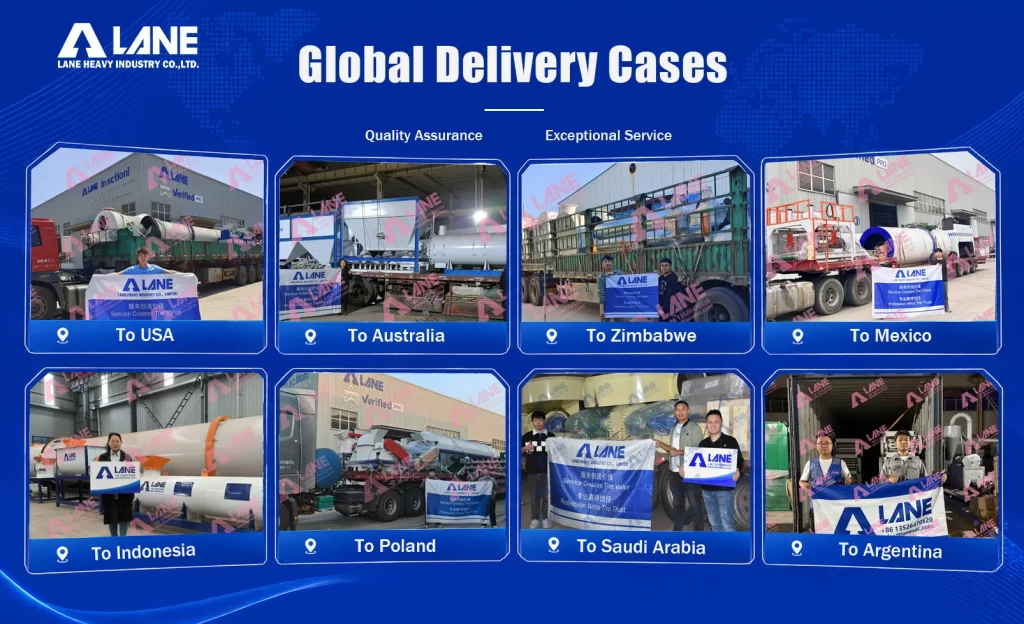
| Global Project Experience | We have delivered fertilizer production lines — including high-level palletizers — to customers across Asia, Africa, the Middle East, South America, and Eastern Europe. We manage international logistics, customs documentation, and multi-time-zone after-sales support. |
| Complete Line Capability | Need more than a palletizer? LANE Machinery supplies turnkey fertilizer production lines: granulation, drying, cooling, screening, coating, bagging, palletizing, and wrapping. One supplier = one point of accountability. |
| Remote Support | PLC-based control systems with optional VPN remote access. Our engineers diagnose and resolve most issues remotely, minimizing downtime without waiting for an on-site visit. |
| Spare Parts Program | Comprehensive spare parts inventory with global express shipping. Critical wear components — drive chains, stripper plate liners, conveyor belts, bearings — are stocked for immediate dispatch. |
 Ready to Automate Your Fertilizer Bag Stacking?
Whether you are building a new fertilizer plant or upgrading an existing line, LANE Machinery’s high-level palletizer delivers the throughput, reliability, and pallet quality your operation demands.
To prepare your quotation, we’ll need to know:
We respond to all quotation requests within 24 hours (business days).

Everything you need to know when looking at different types of organic fertilizer equipment, all in one place.
Copyright © 2026. LANE All rights reserved.